
A bearing starts announcing its own failure at a specific frequency months before it ever sounds or feels wrong, and AI is now what listens to that announcement across an entire plant at once.
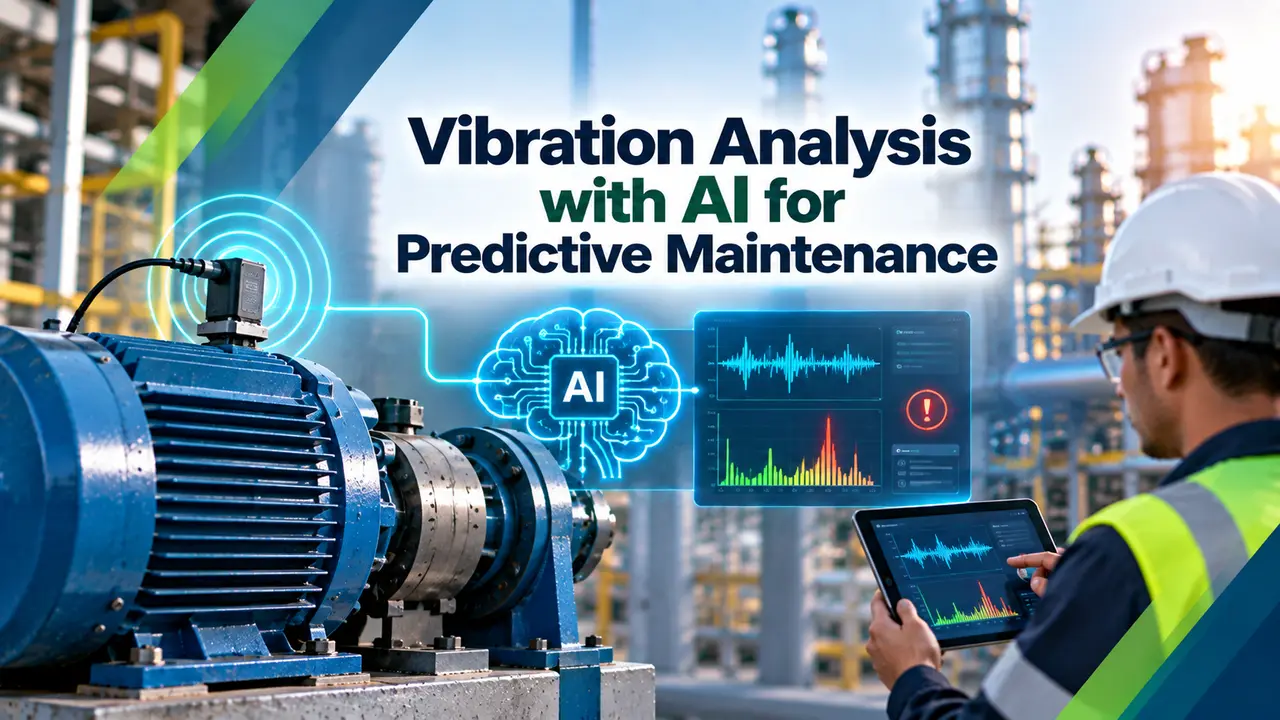
Vibration analysis with AI applies trained models to raw vibration signals, automatically classifying bearing, gear, and unbalance faults across many machines at once instead of relying on a limited pool of human analysts.
Why Vibration Reveals a Fault So Early
Every rotating machine, a motor, pump, fan, compressor, or gearbox, produces a vibration pattern governed by its geometry and running speed, and a developing fault introduces its own distinct forcing frequency into that pattern.
A spalled bearing race, a cracked gear tooth, or a shaft going out of alignment all show up as vibration at a mathematically predictable frequency long before the fault produces detectable heat, noise, or a measurable performance loss.
Reading a Spectrum the Traditional Way
A Fast Fourier Transform converts the raw time domain waveform into a frequency spectrum, and a trained analyst then checks specific bands, one times running speed for unbalance, two times running speed for misalignment, and the gear mesh frequency for tooth wear.
Bearing defects show up at four calculated frequencies derived from the bearing's own geometry, ball pass frequency outer race, ball pass frequency inner race, ball spin frequency, and fundamental train frequency, each pointing to a different failing component.
How AI Changes the Interpretation Step
Rather than a person manually reading every spectrum, a trained model automatically extracts these features and classifies the likely fault type and severity, flagging an anomaly the instant it departs from the machine's established healthy baseline.
Why This Scales Where Manual Analysis Cannot
A plant with a handful of certified vibration analysts can only physically walk a limited number of routes and review a limited number of spectra each week, no matter how skilled those analysts are.
Always on wireless sensors feeding a model that runs continuously can watch hundreds or thousands of assets simultaneously, catching a subtle early stage anomaly that a periodic route based check would only find weeks later.
Fewer False Alarms Through Pattern Recognition
A model trained on genuine fault progressions, rather than a fixed amplitude threshold, tends to distinguish a real developing fault from ordinary process noise more reliably, which cuts down on the nuisance alerts that erode trust in any monitoring system.
The Typical Hardware and Data Pipeline
| Stage | What Happens There |
|---|---|
| Sensor | MEMS or piezoelectric wireless sensor mounted on the bearing housing |
| Edge processing | Local pre processing and compression before transmission |
| Cloud platform | Model inference, trending, and fleet wide analytics |
| CMMS integration | Confirmed fault automatically generates a maintenance work order |
Feeding a confirmed fault straight into the maintenance management system closes the loop, turning a detected anomaly directly into a scheduled work order without someone manually re entering the finding.
Where This Approach Still Needs Care
Manual Spectrum Reading vs AI Assisted Analysis
Manual Spectrum Reading
Deep expert judgment, but limited by the number of trained analysts available.
AI Assisted Analysis
Scales to a whole fleet continuously, but still needs expert validation of its findings.
The strongest programs tend to combine both, letting the model triage a large fleet continuously while a certified analyst reviews the specific cases the model actually flags as concerning.
Explainability Matters as Much as Accuracy
A model that simply outputs a red or green health score without showing the frequency bands or features driving that call is a hard sell to an experienced analyst who wants to understand the reasoning, not just trust a number.
Platforms that surface the underlying spectrum alongside the model's classification let an analyst quickly confirm or override the call, which builds far more confidence in the system over time than a black box verdict alone ever could.
Handling a New Asset With No History
A newly installed machine has no established healthy baseline yet, so many programs start with a conservative generic threshold and gradually let the model learn that specific asset's normal signature over the first weeks of operation.
This transition period is exactly when the human analyst's judgment matters most, since the model has not yet accumulated enough of that machine's own data to be fully confident in its own conclusions.
Rolling Out Vibration Analysis with AI Across a Fleet
Most successful rollouts start small, instrumenting the handful of machines already known to be problem assets, before expanding sensor coverage across the rest of the plant once the workflow and alert thresholds have proven themselves.
Reviewing early alerts closely during this pilot phase, confirming which ones turned into real findings and which turned out to be noise, builds the trust a maintenance team needs before relying on the system at full scale.
Choosing Which Assets Get Continuous Monitoring First
Not every motor or pump justifies a dedicated wireless sensor, criticality to production, cost of unplanned downtime, and history of past failures all factor into which assets get continuous coverage versus a periodic manual check instead.
A simple criticality ranking, built once with input from operations and maintenance together, keeps the rollout focused on the assets where an early warning genuinely changes the outcome rather than spreading sensors thin across low risk equipment.
Watch: Vibration Analysis for Predictive Maintenance
Vibration Analysis with AI FAQs
Related Articles on This Site
- Predictive Maintenance vs Preventive Maintenance
- Vibration Sensor Working
- Artificial Intelligence and Machine Learning
- AI in PLC, SCADA, and DCS
- Digital Twin in Industrial Automation
External References
What We Learn Today
- Vibration analysis with AI automatically classifies bearing, gear, and unbalance faults from raw signals.
- Continuous wireless monitoring scales to a whole fleet, something a limited pool of analysts cannot match.
- Expert validation, good sensor mounting, and labeled fault data still matter regardless of model quality.