
Siemens S7-1200 vs S7-1500: PLC Comparison Guide
Both speak the same programming language, both plug into the same TIA Portal, and yet one is built for a compact standalone machine while the other is built to run an entire coordinated production line.
The Siemens S7-1200 and S7-1500 both run on TIA Portal and share PROFINET communication, but they target very different scales of automation. This guide compares I/O capacity, performance, programming languages, and safety features to help you choose the right controller.
S7-1200 vs S7-1500: The Core Distinction
The Siemens S7-1200 and S7-1500 are both part of the SIMATIC S7 controller family, sharing the TIA Portal engineering environment and PROFINET as their native communication standard. Despite this shared foundation, they occupy very different tiers: the S7-1200 is built for compact, cost-sensitive, standalone machine control, while the S7-1500 is Siemens' flagship platform for larger, more complex, and higher-performance automation systems.
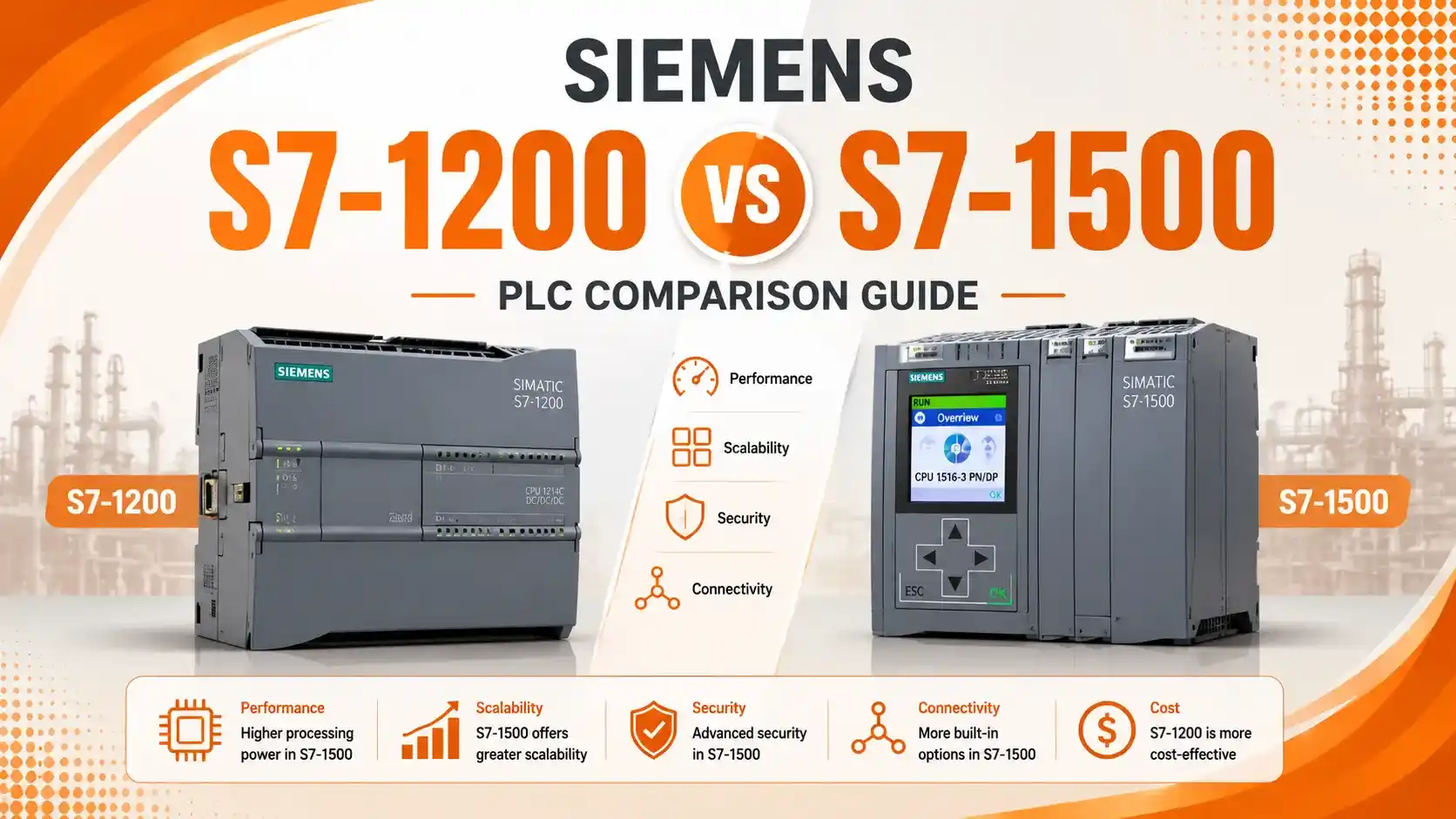
A useful mental shortcut, often used by engineers coming from Allen-Bradley platforms, is that the S7-1200 occupies roughly the market position of a CompactLogix, while the S7-1500 occupies the position of a ControlLogix.
Real Life Example
Think of the S7-1200 like a compact hatchback: efficient, affordable, perfectly capable of daily driving and light hauling within its design limits. The S7-1500 is more like a heavy-duty truck: it can do everything the hatchback does and far more, hauling heavier loads, coordinating multiple trailers, and handling terrain the smaller vehicle simply isn't built for. Choosing between them isn't about which is "better," it's about matching the vehicle to the actual job.
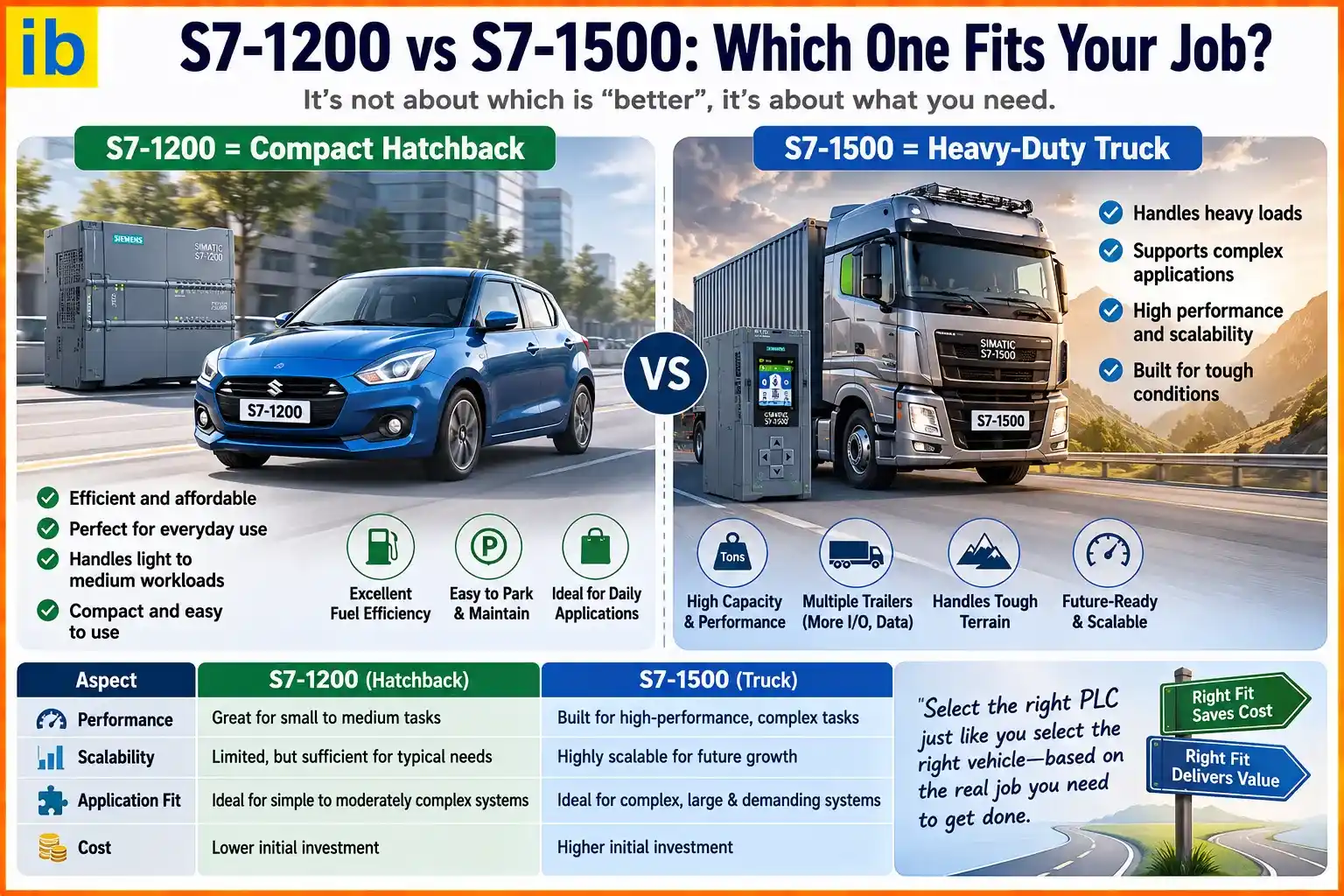
S7-1200 vs S7-1500
🔹 Siemens S7-1200
🔷 Siemens S7-1500
Comparison Table
Which One Should You Choose?
| Application Requirement | Recommended PLC |
|---|---|
| Standalone machine, under 100 I/O points | S7-1200 |
| Tight budget, simple logic | S7-1200 |
| Plant-wide, multi-machine coordination | S7-1500 |
| Advanced motion control, camming, kinematics | S7-1500 |
| PROFIBUS DP legacy device integration | S7-1500 |
| SIL 3 / PLe advanced safety requirements | S7-1500 |
| CPU redundancy required | S7-1500 |
| Learning platform on a personal budget | S7-1200 |
Applications
Packaging Machines
S7-1200 handles compact, standalone packaging equipment cost-effectively.
Bottling Lines
Higher I/O count bottling lines commonly require the S7-1500's expanded I/O capacity.
Multi-Axis Robotics
S7-1500 T-CPUs support the multi-axis synchronization robotics applications need.
Batch Process Control
S7-1500's GRAPH programming suits sequential batch and recipe-driven processes.
Small Machine Retrofits
S7-1200 offers a cost-effective upgrade path for simple legacy machine control.
High-Reliability Processes
S7-1500 CPU redundancy protects continuous processes from unplanned controller downtime.
Frequently Asked Questions
- Rabwell PLC, S7-1500 vs S7-1200: Which Siemens PLC Fits Your Project?
- Industrial Monitor Direct, S7-1200 vs S7-1500: Key Differences and Selection Guide
- SimplyBuy Global, Siemens S7-1200 vs S7-1500: Choose the Right Siemens S7 PLC
What We Learn Today
- The S7-1200 and S7-1500 share TIA Portal and PROFINET, but target very different scales of automation
- S7-1200 suits compact, standalone, cost-sensitive machines under roughly 100 I/O points
- S7-1500 scales to plant-wide automation with STL/GRAPH programming, redundancy, and advanced motion control
- Code migrates easily from S7-1200 up to S7-1500, but not smoothly in reverse
- New Siemens features typically appear on the S7-1500 first, reaching the S7-1200 in later TIA Portal versions