
The Pt100 vs Pt1000 question comes down to nominal resistance at 0°C: 100 Ω versus 1000 Ω at ice point.
Both share the same platinum material, the same temperature range, and the same temperature coefficient. The practical differences appear in sensitivity, lead wire error, self-heating, and transmitter compatibility.
This guide covers every Pt100 vs Pt1000 difference that matters for sensor selection, wiring, and measurement accuracy.
In the Pt100 vs Pt1000 comparison: both use platinum, IEC 60751, TCR 0.00385 Ω/Ω/°C. The Pt1000 is ten times more sensitive. The same 1 Ω lead wire resistance causes 2.6°C error in a Pt100 but only 0.26°C in a Pt1000.
Pt100 vs Pt1000: Why the Resistance Value Matters
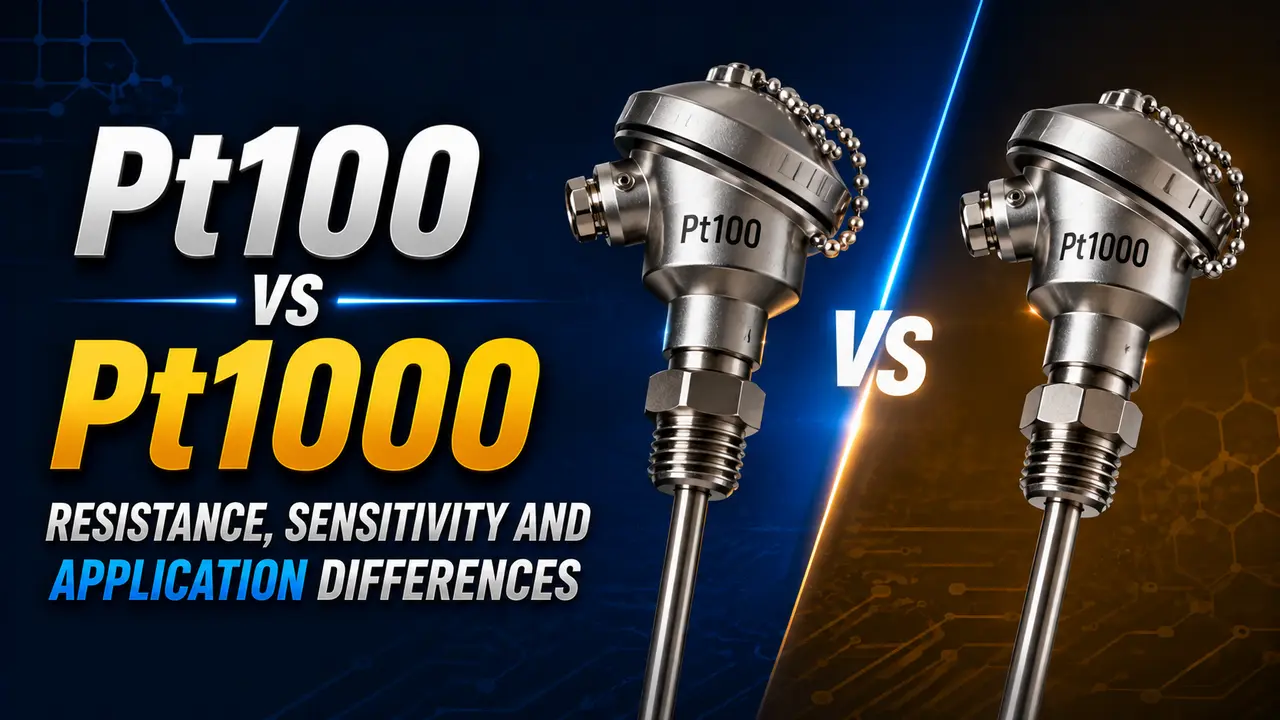
Both Pt100 and Pt1000 are platinum resistance thermometers (RTDs). Platinum resistance increases linearly with temperature.
At 0°C, the Pt100 = 100 Ω and the Pt1000 = 1000 Ω. This 10:1 ratio is the only electrical difference between them.
Three consequences follow from this ratio: the sensitivity difference, the lead wire error difference, and the self-heating difference. Each affects which sensor is appropriate for your application. Click any term to expand.
Pt100 vs Pt1000 Resistance at Key Temperatures
The resistance of a platinum RTD follows the Callendar-Van Dusen equation. For practical engineering purposes, the linear approximation is accurate to within 0.5% over the range 0 to 400°C:
R₀: nominal resistance at 0°C (100 Ω for Pt100, 1000 Ω for Pt1000)
α: temperature coefficient of resistance = 0.00385 Ω/Ω/°C (IEC 60751)
T: temperature in °C
At 100°C: Pt100 = 100 × (1 + 0.00385 × 100) = 138.5 Ω
At 100°C: Pt1000 = 1000 × (1 + 0.00385 × 100) = 1385 Ω
| Temperature | Pt100 Resistance (Ω) | Pt1000 Resistance (Ω) | Difference |
|---|---|---|---|
| minus 200°C | 18.52 | 185.2 | Pt1000 is 10× higher -- always |
| minus 50°C | 80.31 | 803.1 | Pt1000 is 10× higher -- always |
| 0°C (ice point) | 100.00 | 1000.0 | Nominal reference values per IEC 60751 |
| 25°C | 109.73 | 1097.3 | Difference is 9.73 Ω vs 97.3 Ω from 0°C |
| 100°C | 138.51 | 1385.1 | 38.51 Ω change vs 385.1 Ω change from 0°C |
| 200°C | 175.86 | 1758.6 | 75.86 Ω change vs 758.6 Ω change from 0°C |
| 400°C | 247.09 | 2470.9 | Pt100 usable to 600°C; Pt1000 typically to 400°C |
| 600°C | 313.71 | 3137.1 | Pt100 preferred above 400°C with suitable transmitter |
Pt100 vs Pt1000: Full Comparison
| Parameter | Pt100 | Pt1000 |
|---|---|---|
| Nominal resistance at 0°C | 100 Ω | 1000 Ω |
| Sensitivity | 0.385 Ω/°C | 3.85 Ω/°C |
| Temperature range | minus 200°C to 600°C (wire-wound); minus 50°C to 150°C (thin-film) | minus 200°C to 400°C typical |
| TCR (IEC 60751) | 0.00385 Ω/Ω/°C | 0.00385 Ω/Ω/°C -- identical |
| Lead wire error (2-wire, 1 Ω lead) | Approximately 2.6°C error | Approximately 0.26°C error -- 10× better |
| Recommended wiring | 3-wire or 4-wire for accuracy | 2-wire acceptable for most applications |
| Self-heating per mA excitation | Lower (P = I² × 100) | Higher (P = I² × 1000) -- needs lower excitation current |
| Noise immunity | Lower signal per degree -- more sensitive to interference | Higher signal per degree -- better noise immunity |
| Industrial transmitter support | Universal -- all process transmitters support Pt100 | Good -- most modern transmitters support Pt1000; check older instruments |
| Common applications | Industrial process control, oil and gas, power generation, food processing | HVAC, refrigeration, automotive, building automation, machine building |
Lead Wire Error: The Most Critical Pt100 vs Pt1000 Difference
The lead wire resistance error is the main reason to choose Pt1000 over Pt100 in certain installations. Copper wires have a resistance of approximately 0.017 Ω per metre per mm² cross section.
A 10-metre cable with 0.5 mm² conductors adds 0.34 Ω per wire, totalling 0.68 Ω in a 2-wire circuit.
Sensitivity: 0.385 Ω/°C for Pt100, 3.85 Ω/°C for Pt1000
Example: 10 m cable, 0.5 mm² conductors, R_lead = 0.68 Ω
Pt100 error = 0.68 / 0.385 = 1.77°C
Pt1000 error = 0.68 / 3.85 = 0.18°C
This is why the Pt100 needs 3-wire or 4-wire connections for accuracy. For the Pt1000, 0.68 Ω is only 0.068% of total sensor resistance, making 2-wire error acceptable for most applications.
See the RTD sensor connections guide for 2-wire, 3-wire, and 4-wire wiring diagrams.
Pt100 vs Pt1000 Resistance and Lead Error Calculator
When to Choose Pt100 vs Pt1000
Choose Pt100 when:
You need highest accuracy with 3 or 4-wire wiring. You are measuring above 400°C. Your transmitter supports only Pt100. Your application is standard industrial process control.
See the RTD working principle guide for Pt100 construction details.
Choose Pt1000 when:
You are using a 2-wire configuration with cable runs longer than 5 metres. Your application is HVAC, refrigeration, automotive, or building automation.
Also suited to electronics with limited ADC resolution and battery-powered loggers where low excitation current matters.
Pt100 in 4-wire for highest accuracy
Laboratory and high-precision process applications use 4-wire Pt100. The 4-wire connection eliminates all lead resistance effects.
This combination remains the gold standard for precision temperature measurement. See the Pt100 calibration guide and the temperature transmitter calibration guide.
Replacing one with the other
A Pt100 and a Pt1000 cannot be interchanged without reconfiguring the transmitter.
A Pt1000 installed on a Pt100 transmitter reads ten times higher than expected. Always match sensor type to transmitter configuration. See the RTD and thermocouple guide.
Watch: Pt100 vs Pt1000 RTD Sensor Differences Explained
Pt100 vs Pt1000 Questions
External References
- Pt100 and Pt1000 Sensors: Important Facts and Differences -- WIKA Blog (updated 2026)
- PT100 vs PT1000 RTDs: What's the Difference? -- Minco (2025)
What We Learn Today
- Pt100 vs Pt1000: both are platinum RTDs following IEC 60751 with identical TCR (0.00385 Ω/Ω/°C). The only electrical difference is the nominal resistance at 0°C -- 100 Ω vs 1000 Ω.
- Sensitivity: Pt100 = 0.385 Ω/°C, Pt1000 = 3.85 Ω/°C. The Pt1000 produces ten times more signal per degree.
- Lead wire error (2-wire): the same 1 Ω of lead causes 2.6°C error in a Pt100 but only 0.26°C in a Pt1000. Use Pt1000 for long 2-wire cable runs.
- Use Pt100 (3-wire or 4-wire) for highest accuracy industrial process control and for temperatures above 400°C.
- Use Pt1000 for HVAC, building automation, refrigeration, and 2-wire long-cable installations where lead error is a concern.
- Never replace a Pt100 with a Pt1000 (or vice versa) without reconfiguring the transmitter. The resistance values are ten times apart and the output will be completely wrong.