
A TV remote control works because a tiny transistor, hidden behind a plastic window, can feel infrared light the same way an ordinary transistor feels a base current.
That single idea, light standing in for current, is the whole story of the phototransistor.
A phototransistor is a light-sensitive bipolar transistor whose base-collector junction absorbs incoming light and converts it into a small photocurrent, which the transistor then amplifies into a much larger output current.
Light detection sounds like it should need a photodiode and a separate amplifier circuit. Most of the time, it doesn't.
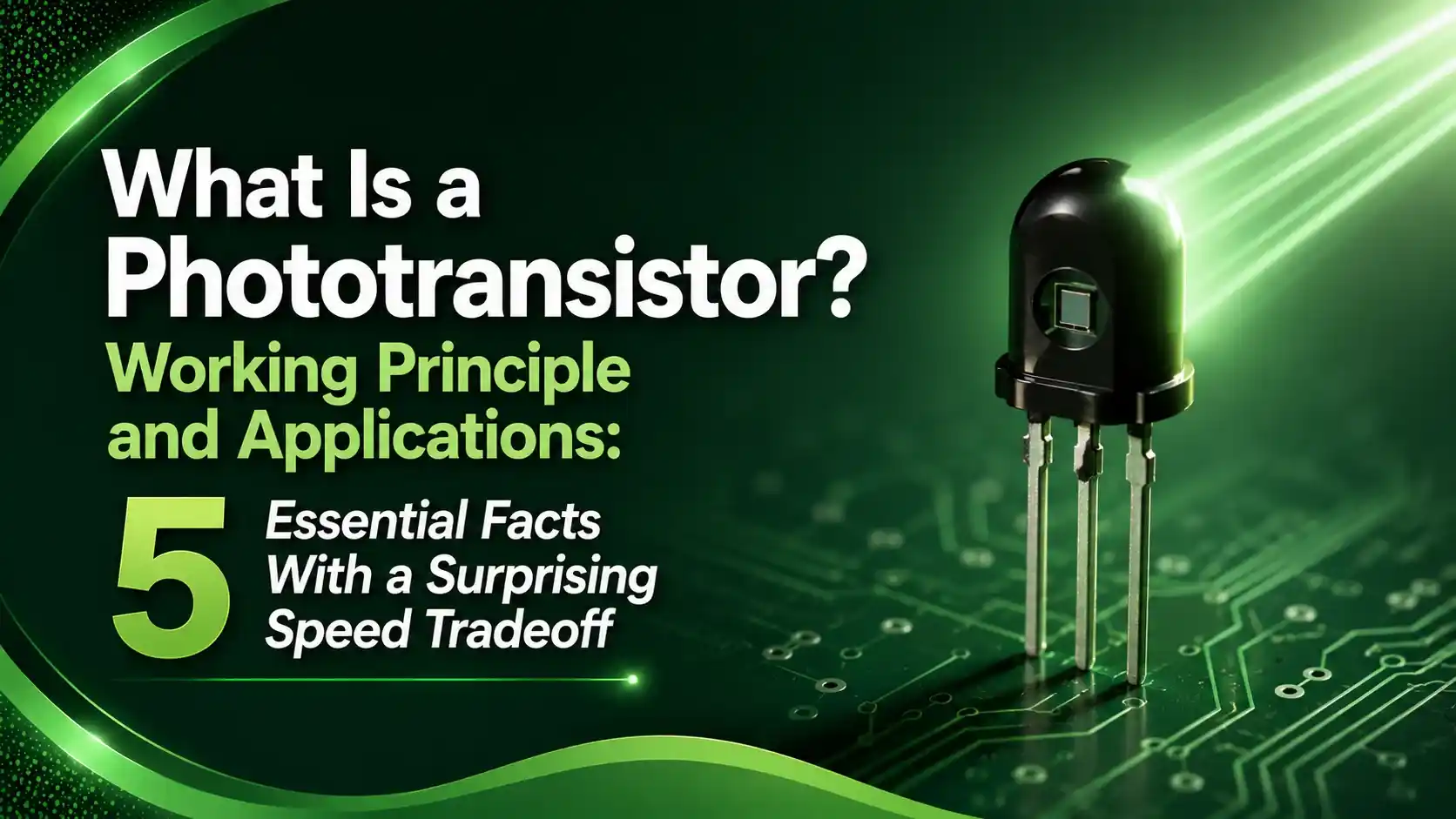
A phototransistor quietly does both jobs in one device, and that combination is exactly why it shows up in so many everyday products without anyone noticing it's there.
Picture the base of an ordinary NPN transistor. Normally, a tiny current flowing into that base is what controls the much larger current flowing from collector to emitter.
A phototransistor removes the base wire and replaces it with a transparent window instead. Light falling through that window generates the same effect a base current would, only now it's photons doing the triggering, not electrons pushed in from outside.
According to Digi-Key's engineering resources, this internal amplification is exactly what separates a phototransistor from a plain photodiode, and it's the reason phototransistors can drive small loads directly without extra circuitry.
That convenience does come with tradeoffs, though, and understanding them is what separates a phototransistor used well from one fighting the wrong application.
This guide walks through the physics, the math behind the gain, and exactly where these devices earn their keep in real designs.
5 Essential Facts About How a Phototransistor Works
These five points cover the structure, the math, and the real limits every photo-transistor design runs into.
Light Replaces Base Current
The base-collector junction is exposed to light instead of being wired to an external base current source.
Collector Current Follows a Simple Gain Formula
Output current equals the transistor's current gain multiplied by the tiny photocurrent the light itself generates.
High Sensitivity Comes With Slower Response
The larger junction needed to catch more light also adds capacitance, and that capacitance is what limits switching speed.
Photo-Darlington Variants Push Gain Even Higher
Adding a second transistor stage multiplies gain further, following the same principle covered in our Darlington pair article, at the cost of even slower response.
Peak Response Sits in the Near Infrared
Most silicon phototransistors respond best around 850 to 940 nanometers, matching common infrared LED sources.
Phototransistor vs Photodiode
Both detect light using the same basic semiconductor physics, but they trade sensitivity for speed in opposite directions, a distinction covered well in Electronics Tutorials' phototransistor reference.
Photodiode
No internal gain, so output current stays in microamps. Extremely fast, often responding in nanoseconds.
Phototransistor
Built in current gain pushes output into the milliamp range. Response time is typically microseconds instead.
Inside the Light-Sensitive Junction
Picture the photo-transistor as a photodiode and a transistor built into the same piece of silicon.
According to RP Photonics' technical reference, the same amplification that boosts the signal also amplifies photocurrent noise and dark current, which is why a photo-transistor's higher output doesn't automatically mean better detection sensitivity than a photodiode.
Interactive Collector Current Formula
Enter the transistor's current gain and the photocurrent generated by the incident light to see the amplified output current calculated live.
Phototransistor vs Photodiode vs Photo-Darlington Specs
Here's how the three light detection options compare on the numbers that matter most for selection, based on real Vishay phototransistor datasheets.
| Parameter | Photodiode | Phototransistor | Photo-Darlington |
|---|---|---|---|
| Typical output current | Microamps | Milliamps | Several milliamps |
| Typical response time | Nanoseconds | Microseconds | Tens to hundreds of microseconds |
| Internal gain | None | 100 to 1,000 | Product of two transistor gains |
| External amplifier needed | Usually yes | Usually no | No |
Where Photo-transistors Are Used
From consumer electronics to industrial sensing, photo-transistors appear in far more products than most people realize, as Digi-Key's application guide details across dozens of real device types.
Optocouplers
Electrically isolating two circuits while still passing a signal.
TV and Remote Controls
Detecting infrared pulses from a handheld remote transmitter.
Smoke Detectors
Sensing light scattered by smoke particles in the detection chamber.
Line Following Robots
Detecting contrast between a dark line and a light surface.
Security Systems
Slotted opto-switches and beam-break intrusion sensors.
Fiber Optic Receivers
Converting light pulses back into electrical signals.
Do's and Don'ts of Using a Phototransistor
Following RP Photonics' detector selection guidance alongside these practical points avoids the most common photo-transistor design mistakes.
✓ Do
- Match the light source wavelength to the photo-transistor's peak response
- Use a photodiode instead when genuinely fast response time is required
- Shield the device from unwanted ambient light in precision applications
- Check dark current specs when detecting very low light levels
✗ Don't
- Assume higher gain always means better overall detection performance
- Ignore temperature sensitivity, since beta shifts noticeably with heat
- Use a phototransistor for high speed optical data communication links
- Forget that a photo-Darlington trades even more speed for more gain
Dark Current: The Signal That Never Fully Turns Off
Even in complete darkness, a photo-transistor still leaks a tiny amount of collector current, called dark current.
According to Vishay's own BPW77NA datasheet, this leakage typically sits around 100 nanoamps at room temperature, but it climbs sharply as the device heats up.
In low light applications, dark current sets a real floor on how faint a signal the phototransistor can reliably distinguish from pure noise.
Reference Materials on Phototransistors
FAQs on Phototransistors
External References
- The Basics of Photodiodes and Phototransistors and How to Apply Them, Digi-Key
- Phototransistors, RP Photonics Encyclopedia
- Phototransistor Photo Detectors, Vishay
- Phototransistor Basics and How a Phototransistor Works, Electronics Tutorials
- BPW77NA, BPW77NB Phototransistor Datasheet, Vishay Semiconductors
What we learn today
- A phototransistor is a bipolar transistor whose base-collector junction is exposed to light, letting photons replace an injected base current.
- Collector current follows Ic equals beta times Iphoto, amplifying a tiny photocurrent into a much larger, usable output.
- Compared to a photodiode, a phototransistor trades speed for sensitivity: microamp, nanosecond response becomes milliamp, microsecond response.
- Photo-Darlington variants push gain even higher by adding a second transistor stage, at the cost of an even slower response.
- Most silicon phototransistors peak in the near infrared, typically 850 to 940 nanometers, matching common IR LED sources used in remotes and sensors.