
A pump or compressor must meet its production target, yet it must never cross a pressure or temperature limit. Selector based strategies let a second controller take over smoothly whenever a constraint gets close, then hand control back.
Many loops have one normal goal and one or more limits that must never be crossed. Selectors in the DCS pick whichever controller output is safest and hand control back when the limit clears.
What Is Override Control?
Override control is a strategy in which two or more controllers share one final element, and a high or low selector passes only one of their outputs to the valve or drive. The normal controller runs most of the time, while a constraint controller takes over when a limit is approached, extending ideas from PID controller types.
This article covers process selectors, not the bypass of safety signals. For that other meaning of the word, read safety signal override explained.
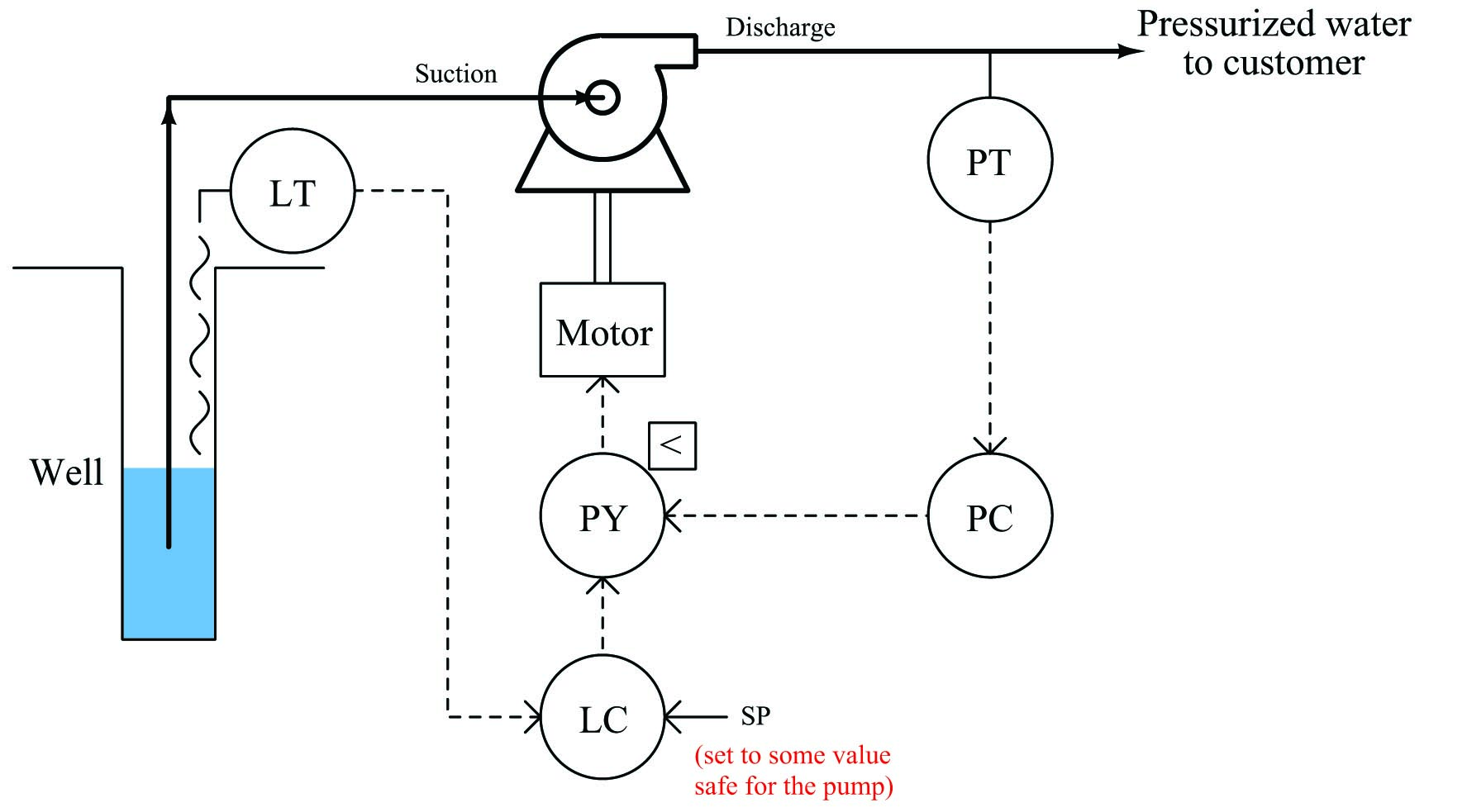
Control.com calls this soft override, because the constraint controller acts gradually through PID action instead of a hard trip. The shutdown system still remains as the last layer.
High and Low Select in Override Control
Control.com explains that a high select function outputs the greatest of its inputs, and a low select outputs the least. The choice depends on which direction makes the process safer.
Passes the smallest output.
Passes the largest output.
Passes the middle of three inputs.
Think about the fail position of the valve before choosing the selector. A fail closed valve and a fail open valve can need opposite selectors for the same constraint, much like the direction logic in cascade control.
Typical Override Control Examples
Compressor systems use selectors heavily, along with the anti surge loop covered in compressor anti surge controller. The DCS usually builds these schemes from standard blocks, see DCS function block programming.
Integral Windup in Override Control
Control.com points out the main problem: the deselected controller still sees an error, so its integral action keeps ramping toward 0 or 100 percent. When the process later needs it, that controller takes a long time to unwind and respond.
Control.com lists three fixes: disable integral action in the unselected controller, feed the selected output back as external reset, or use back calculation. External reset feedback is the classic and cleanest method.
F. G. Shinskey explains that with external reset, each controller output equals its proportional term plus the filtered selected output. The idle controller therefore stays close to the active signal and can take over quickly, which also matters when you tune PID controllers.
Selector Logic Formula
High select output = maximum of (Output A, Output B)
Example, low select protecting a pump:
Flow controller output A = 72.0 percent
Pressure limit controller output B = 58.0 percent
Selected output = 58.0 percent, pressure controller B in control
In override control the selector simply compares numbers, so both outputs must use the same range and direction. Mixing a reverse acting output with a direct acting one is a common commissioning error.
Selector Calculator
Try raising output B above output A to see the normal controller regain control. Then switch to high select to see the opposite behaviour.
5 Essential Override Control Design Steps
Tune each controller separately while the others are held, then test the switchover as a whole. Our guide on how to tune a PID controller covers the basics.
- Keeps the plant running near limits.
- Smooth takeover without trips.
- Uses standard DCS blocks.
- Protects equipment continuously.
- Integral windup if reset is not handled.
- Harder to troubleshoot for operators.
- Needs careful direction and range checks.
- Not a substitute for a safety system.
Show operators which controller is in control on the faceplate. Selectors are one of many DCS control strategies used in a distributed control system.
External Reset Feedback PDF
Introduction to Selector Overrides Video
Override Control FAQ
Related Articles
- What Is Cascade Control
- DCS Control Strategies
- PID Controller Types Explained
- Compressor Anti Surge Controller
- Safety Signal Override Explained
External References
- The Power of External Reset Feedback, F. G. Shinskey
- Limit, Selector and Override Controls, Control.com
- Integral Windup, Wikipedia
What We Learn Today
- Override control lets a constraint controller take over through a selector.
- Low select passes the least output and high select the greatest.
- External reset feedback prevents windup and gives bumpless takeover.