
Sulfuric acid. Sodium hypochlorite. Hydrofluoric acid. Get the wetted material wrong here, and it's not a maintenance issue.
Ok, let me explain it properly. A failed sensor in corrosive service can mean a leak, a safety incident, or a very costly tank shutdown. Material selection isn't a detail, it's the whole decision.
Level measurement in corrosive chemicals depends on selecting sensor wetted materials, seals, and housings that resist chemical attack, since the wrong probe, diaphragm, or gasket material can fail within weeks even when the underlying measurement technology itself is a good fit for the application.
Level Measurement in Corrosive Chemicals: What Actually Fails First
Level measurement in corrosive chemicals rarely fails because the sensing principle was wrong. It fails because a wetted part, a gasket, or a housing seal wasn't rated for the specific chemical involved.
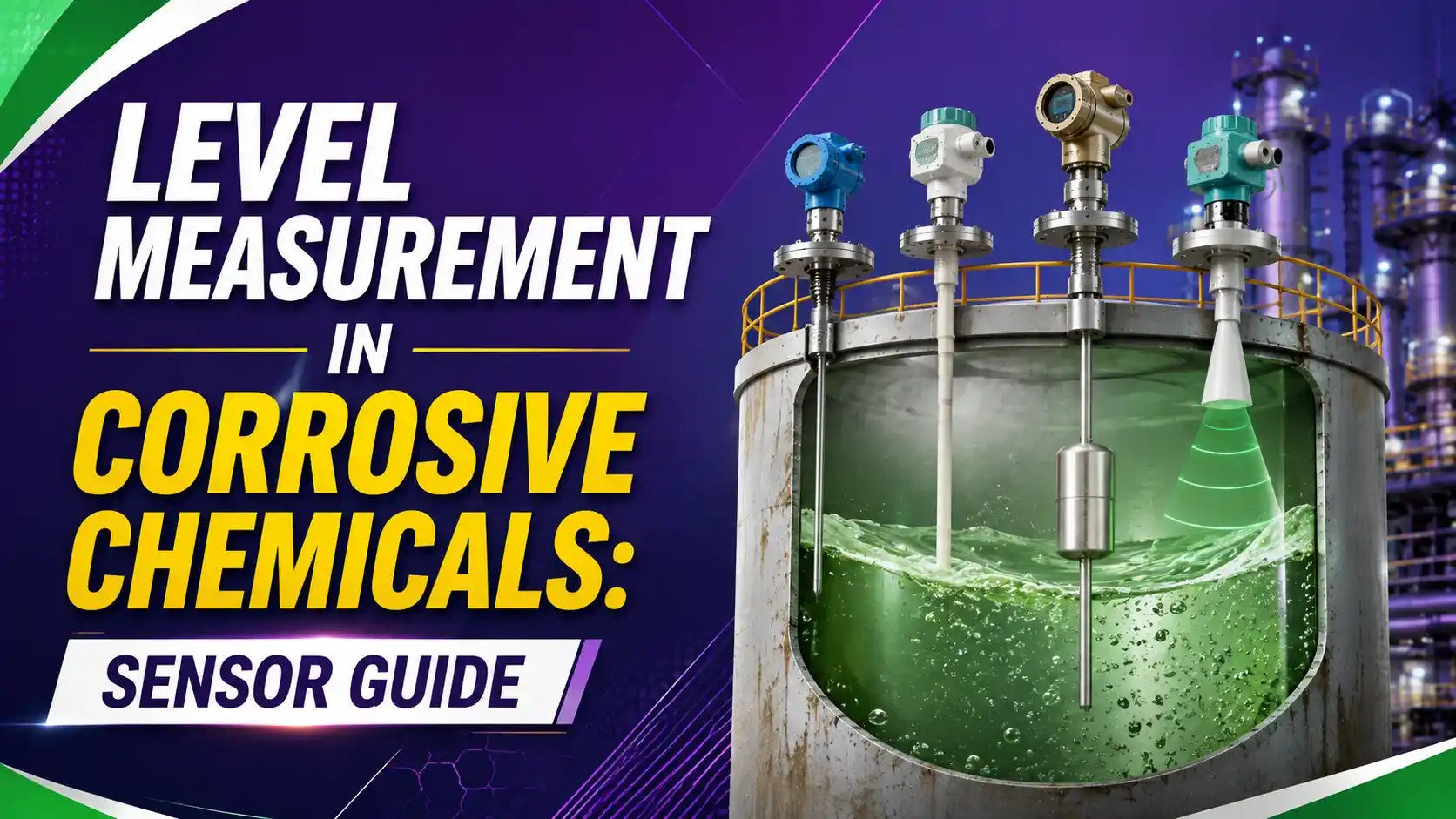
Have you got it? Good, because this reframes the whole selection process. The question isn't "which technology measures level best," it's "which technology can survive this exact chemical, at this exact concentration and temperature, long enough to be worth installing."
A stainless steel probe that would last decades in water can be pitted through in months by chlorides. A standard elastomer seal can swell and fail within days in a strong solvent.
This is why corrosive service demands a materials-first mindset, something we also touch on in our guide to selecting the right level sensor.
Six Ways Corrosive Chemicals Attack Level Sensors
Wetted Metal Attack
Acids, chlorides, and caustics attack unsuitable metals through pitting, general corrosion, or stress cracking. A probe or diaphragm in the wrong alloy can fail long before its expected service life.
Elastomer Seal Degradation
O-rings and gaskets swell, harden, or dissolve when the elastomer isn't chemically compatible. A single failed seal can turn a level sensor into a leak point.
Vapor and Fume Attack on Housings
Corrosive fumes don't stay in the tank. They attack terminal compartments, connectors, and enclosure seals from the outside, even on parts never touched by the liquid.
Crystallization and Buildup
Some corrosive chemicals crystallize or precipitate on contact with air or a cooler surface. That buildup can coat a probe, jam a float, or block a stilling well.
Galvanic Corrosion at Dissimilar Metals
Mixing incompatible metals at a process connection, for example a carbon steel fitting against a stainless probe, creates a galvanic cell that accelerates corrosion right at that joint.
Temperature-Accelerated Attack
Corrosion rate roughly doubles for many chemical reactions with every 10°C rise. A material that's marginal at ambient temperature can fail quickly in a heated corrosive process.
Which Level Technology Fits Corrosive Service
Every technology below can work in corrosive service, but only with the right wetted materials. The table reflects typical field practice, not a fixed rule for every chemical.
| Technology | Corrosive Service Notes | Verdict |
|---|---|---|
| Non-contact radar | No wetted process contact except the antenna, PTFE or PFA antenna handles most chemicals well | Strongly recommended |
| Guided wave radar | Probe is wetted, needs a PFA or Hastelloy-coated probe rated for the specific chemical | Good, with correct probe material |
| Hydrostatic (DP) with remote seal | Chemical seal keeps the process fluid off the transmitter body entirely, only the seal diaphragm is wetted | Strongly recommended for aggressive chemicals |
| Ultrasonic (non-contact) | No wetted contact, but housing and transducer face must resist corrosive vapor | Good for many aggressive vapors |
| Capacitance | PTFE-insulated probe works for many chemicals, bare metal probes generally do not | Caution, insulation material critical |
| Magnetic level gauge | Float is fully wetted and must match the chemical exactly, chamber material also critical | Caution, float material is the deciding factor |
Cause 1 in Detail: Choosing Wetted Materials That Actually Survive
This is worth its own section, because getting it wrong here undoes every other good decision in the selection process.
Start with the chemical's full data: concentration, temperature range, and any trace contaminants. A material rated for 98% sulfuric acid can fail quickly in a dilute solution, since dilution sometimes makes an acid more aggressive, not less.
For a closer look at how these plastics actually compare, this PTFE vs FEP vs PFA comparison is a useful reference.
Have you got it? Good. When in doubt, a manufacturer's chemical compatibility chart, cross-checked against actual concentration and temperature, beats a general assumption every time.
Why Remote Diaphragm Seals Are the Go-To for Aggressive Chemicals
A remote diaphragm seal isolates the transmitter completely from the process liquid. Only a small diaphragm, made from a chemically resistant alloy or coated material, actually touches the chemical.
A capillary tube filled with an inert fill fluid transmits the pressure signal back to the transmitter body, which can then sit in a safer location entirely outside the corrosive environment.
Try It: Diaphragm Seal Elevation Correction Calculator
When a remote seal system is mounted with its capillary fill fluid at a different elevation than the transmitter, that height difference adds a pressure error that must be corrected during calibration.
Let Us Take an Example
A remote diaphragm seal system measures level in a sodium hypochlorite storage tank.
The transmitter, for safety reasons, is mounted in a ventilated cabinet 2.2 meters below the seal, connected by a capillary filled with an inert silicone-based fill fluid of density 980 kg/m³.
ρfill = 980 kg/m³
h = 2.2 m
Seal position: above the transmitter
Step 1:
ΔP = ρfill × 9.81 × h
ΔP = 980 × 9.81 × 2.2
ΔP = 21.15 kPa
Step 2:
Convert to psi: 21.15 × 0.1450377
≈ 3.068 psi
Step 3:
Since the seal sits above the transmitter, this 3.068 psi is added into the zero configuration as a positive elevation correction.
Have you got it? Good. Skip this correction, and the transmitter reads roughly 3 psi off at every point across the tank, a huge error that has nothing to do with the sensor's accuracy and everything to do with capillary mounting.
Ok, let me explain why this matters so much for corrosive chemicals specifically. Remote seals exist precisely because the process is too aggressive for a direct-mount transmitter. Getting the elevation correction wrong defeats the entire purpose of choosing this safer configuration.
Cause 2 in Detail: Vapor Attack on Non-Wetted Parts
It's easy to focus entirely on wetted parts and forget the vapor space above the liquid.
Many corrosive chemicals off-gas fumes that are just as aggressive as the liquid itself. Chlorine-based chemicals and strong acids are common examples.
These fumes attack terminal compartments, cable glands, and enclosure seals from outside. A sensor with perfect wetted materials can still fail if its housing rating doesn't match the vapor environment.
Look for a purged or positively pressurized enclosure, corrosion-resistant coatings on the housing, and cable entries rated for the specific fume exposure.
A PTFE-sleeved submersible design, as described in this selection guide for corrosive tanks, is one practical way to protect both the wetted probe and the cable jacket at once.
A Step-by-Step Sensor Selection Approach
Document the exact chemical and conditions
Get the chemical name, concentration range, temperature range, and any trace contaminants before evaluating any sensor.
Check a verified compatibility chart
Cross-reference the material against a manufacturer's chemical compatibility chart at the actual concentration and temperature, not a general rating.
Favor non-contact or remote-seal designs
Where the budget allows, prefer technologies that minimize or eliminate direct wetted contact with the corrosive chemical.
Rate the housing for vapor exposure
Confirm enclosure and cable entry ratings against the vapor environment, not just the liquid itself.
Avoid dissimilar metal contact
Check every wetted joint for galvanic compatibility, especially at process connections and fittings.
Plan an inspection schedule
Even correctly specified materials benefit from a periodic visual inspection, since corrosive service leaves little margin for surprises.
Good Practices for Corrosive Chemical Level Measurement
✓ Do
- Get exact chemical concentration and temperature data before selecting any wetted material
- Use remote diaphragm seals for highly aggressive or hazardous chemicals whenever practical
- Rate the enclosure and cable entries for the actual vapor exposure, not just the liquid
- Apply the elevation correction accurately for any capillary-connected remote seal system
✗ Don't
- Assume 316 stainless is "corrosion resistant enough" without checking the specific chemical
- Mix dissimilar metals at a wetted process connection without checking galvanic compatibility
- Ignore vapor space corrosion just because the wetted parts are correctly specified
- Skip the fill fluid elevation correction on a remote seal installation
Worth Reading if You Want to Go Deeper
Questions Students and Technicians Often Ask
External References
- Selecting Liquid Level Sensors for Corrosive Applications, Icon Process Controls
- Diaphragm Seal Capillary Connection, Mid-West Instrument
- PTFE vs. FEP vs. PFA: Choosing for Wastewater Instruments, BCST Group
- PTFE Submersible Level Transmitter: Selection Guide for Corrosive Tanks, Industrial Monitor Direct
What we learn today
- Level measurement in corrosive chemicals usually fails at the wetted material, seal, or housing level, not because the wrong sensing technology was chosen.
- The six main risks are wetted metal attack, elastomer seal degradation, vapor attack on housings, crystallization buildup, galvanic corrosion, and temperature-accelerated attack.
- Remote diaphragm seals isolate the transmitter from aggressive chemicals, but require an accurate elevation correction based on capillary fill fluid density and mounting height.
- A worked example showed a 2.2 m elevation difference with a 980 kg/m³ fill fluid producing a 21.15 kPa (3.068 psi) correction that must be applied during calibration.
- Selecting the right technology means checking compatibility at the actual chemical concentration and temperature, not relying on a general material rating.