
Globe valves, ball valves, and butterfly valves are the three most common valve types in process plants.
Each type handles flow differently. The right choice depends on pressure, temperature, fluid type, pipe size, and control requirement.
This guide compares all three valve types. See the flow characteristics guide for how trim characteristic selection works alongside valve type selection.
The globe valve is the standard choice for modulating control. The ball valve is the standard choice for tight shutoff on clean fluids.
The butterfly valve is the standard choice for large-diameter low-pressure service. Choosing between them means matching performance profile to process requirements.
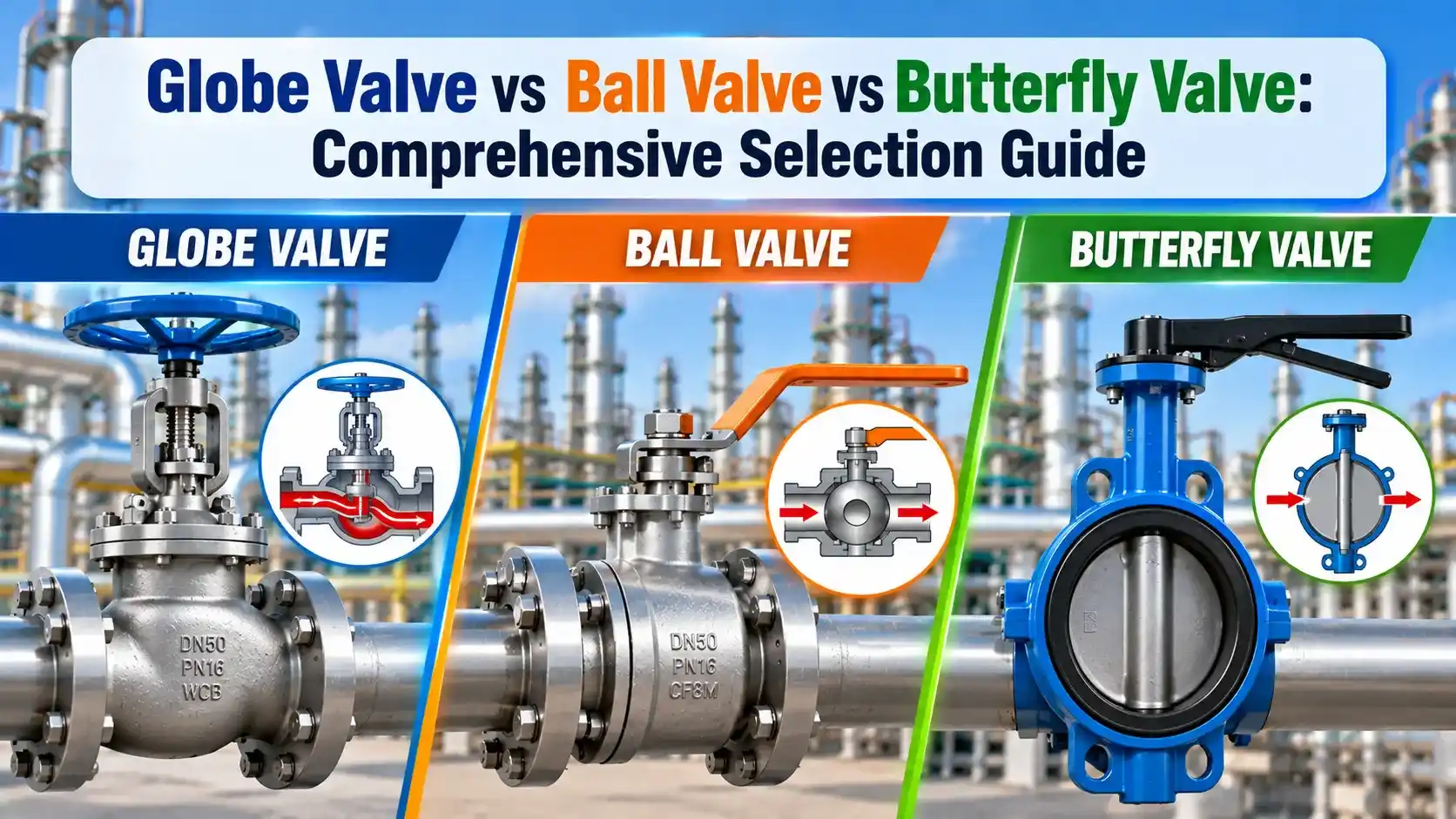
Globe Valve, Ball Valve and Butterfly Valve: Core Differences
All three valve types regulate flow, but they do it by completely different mechanisms.
A globe valve uses a plug that moves linearly into and out of a circular seat orifice.
A ball valve uses a sphere with a through-bore that rotates 90°.
A butterfly valve uses a disc that rotates 90° to align with or block the pipe cross-section.
The ball valve, by contrast, is named for its spherical internal closure element — the ball with a through-bore that rotates to align with the pipe flow path.
The butterfly valve is named for the shape made by the disc and its two protruding shaft ends when viewed from the front: it resembles a butterfly with outstretched wings.
Globe Valve: Best Throttling Performance of the Three
A globe valve moves a plug linearly toward or away from a circular seat ring.
This directly changes the flow area between the plug face and the seat, giving a predictable relationship between stem position and flow rate.
Throttling: The globe valve is the best throttling valve of the three.
Rangeability of 50:1 is standard with a contoured plug. Flow characteristic (equal percentage, linear, quick opening) is determined by the plug shape.
Pressure drop: High. The S-shaped flow path reverses flow twice, concentrating the pressure drop at the trim.
This is intentional for control accuracy but results in higher permanent pressure loss than a ball or butterfly valve. See the choked flow guide for high-DP implications.
Shutoff: ANSI Class IV to Class V standard (metal seated). Class VI achievable with soft-seated designs. Suitable for most process control shut-off requirements.
Size range: DN15 to DN300 is the practical range. At larger sizes, the heavy actuator needed to overcome plug-seat forces and dynamic fluid forces makes globe valves uneconomical.
A globe valve is designed to spend most of its life throttling at partial opening. Fully seating the plug against the seat thousands of times for isolation cycles wears the seat and plug rapidly, degrading shutoff class.
Use a ball valve or gate valve for isolation duty and a separate globe valve for throttling control on the same line if both functions are needed.
For a DN100 (4-inch) globe valve at full open, a typical Cv is 160 to 220. For a DN100 full-bore ball valve at full open, a typical Cv is 1,100 to 1,400.
This six-fold difference in Cv at full open means that a globe valve sized for control at 60% travel still creates a significant pressure loss at full flow — which matters on energy-cost-sensitive high-flow lines.
Ball Valve: Best for Tight Shutoff on Clean Fluids
A ball valve has a sphere with a circular through-bore.
Rotating the ball 90° aligns the bore with the pipe (fully open) or places the solid wall against the seat rings (fully closed).
At fully open, a full-bore ball valve creates essentially no pressure loss — the bore diameter matches the pipe bore and the flow path is straight through.
This is the lowest pressure loss of any valve type.
Shutoff: Excellent. Soft-seated ball valves (PTFE or Nylon seats) achieve ANSI Class VI (bubble-tight). Metal-seated designs achieve Class IV to V for higher temperatures.
Throttling: Limited for standard ball valves. At 30 to 60% open, a crescent-shaped jet erodes seat rings and causes vibration.
V-port ball valves (a V-shaped notch instead of a round bore) are an exception and can throttle with rangeability up to 300:1.
Size range: DN15 to DN600 for most applications. Larger sizes exist but become very expensive and heavy. Ball valves are the dominant isolation valve up to about DN300 on high-pressure clean-fluid services.
The crescent-shaped flow opening at 30 to 60% open creates very high local velocities — often 3 to 5 times higher than the pipe velocity. These velocities erode the soft PTFE seat rings within weeks and cause vibration-induced fatigue on the valve body and downstream piping.
If throttling is required, specify a V-port ball valve. See the butterfly vs ball valve guide for how V-port compares to butterfly for throttling service.
At cryogenic temperatures, PTFE seats can shrink and lose their sealing contact. Low-temperature carbon steel and austenitic stainless steel bodies are required to avoid brittle fracture.
Cryogenic ball valves also have an extended bonnet (a long neck between the ball and the actuator) to keep the packing and actuator at ambient temperature while the ball operates in the cryogenic process. This prevents ice formation on the packing and actuator seals.
Butterfly Valve: Best for Large Diameter and Low-Pressure Service
A butterfly valve uses a disc mounted on a central shaft, rotating 90° from fully open (parallel to flow) to fully closed (perpendicular to flow).
Unlike the ball valve, the disc is always present in the flow path, creating a small permanent pressure loss even when fully open.
Throttling: Moderate. Standard centric butterfly valves have a rangeability of about 20:1 and poor linearity below 20° and above 70° disc opening.
Double-offset and triple-offset designs improve this to 30:1 to 50:1 with better linearity.
Shutoff: Standard centric designs achieve ANSI Class II or III. Double-offset designs achieve Class IV.
Triple-offset metal-seated designs achieve Class V or VI — comparable to a globe or ball valve, at a fraction of the weight and cost at large pipe sizes.
Pressure drop: Low compared to a globe valve. The disc in the open position causes some obstruction, but far less than the S-shaped globe valve flow path.
Pressure loss is much higher than a full-bore ball valve at the same pipe size.
Size range: DN50 to DN1200 and beyond. Butterfly valves dominate large-diameter water, cooling water, firewater, air, and gas systems where globe or ball valve weight and cost would be prohibitive.
The disc protrudes into the adjoining pipe flanges at the open position on wafer-style butterfly valves. A standard butterfly valve disc can clash with pipe elbows, reducers, or other valves installed within two pipe diameters of the butterfly. The manufacturer must provide a disc swing radius, which is compared to the available installation space.
Lug-style and double-flanged butterfly valves have a larger body and avoid some of these clearance issues, but at higher cost and weight.
Three geometric offsets (shaft offset horizontally, shaft offset axially, and a conical seat geometry) cause the disc to make contact with the seat only in the last fraction of a degree of closing rotation — with no rubbing friction throughout 0 to 89° of travel.
This gives the triple-offset butterfly valve an essentially unlimited cycle life, ANSI Class V to VI shutoff, and pressure ratings up to 600 lb class — making it a viable alternative to the globe valve on large-diameter high-pressure services where weight and cost would otherwise be prohibitive.
Globe Valve vs Ball Valve vs Butterfly Valve: Side-by-Side
| Parameter | Globe Valve | Ball Valve | Butterfly Valve |
|---|---|---|---|
| Operating mechanism | Linear stem: plug moves into circular seat orifice | Quarter-turn: sphere rotates 90° | Quarter-turn: disc rotates 90° on central shaft |
| Throttling performance | Excellent: 50:1 rangeability, predictable flow characteristic | Poor (standard); Good with V-port (up to 300:1) | Moderate: 20:1 standard; 50:1 triple-offset |
| Shutoff class (ANSI) | Class IV to V (metal); Class VI (soft seat) | Class VI (soft seat PTFE); Class IV to V (metal seat) | Class II to III (standard); Class V to VI (triple-offset metal seat) |
| Permanent pressure loss (fully open) | High: S-shaped flow path, high Cv reduction | Near zero (full-bore); moderate (reduced-bore) | Low to moderate: disc always in flow path |
| Rangeability | 50:1 (contoured plug) | 10:1 standard; 300:1 V-port | 20:1 standard; 50:1 triple-offset |
| Actuator type | Sliding stem (linear): diaphragm or piston actuator | Quarter-turn: rack and pinion, scotch yoke, or electric | Quarter-turn: same as ball valve |
| Pipe size range | DN15 to DN300 (practical) | DN15 to DN600 | DN50 to DN1200 and above |
| Weight at large sizes | Very heavy: full actuator force on sliding stem | Heavy at large sizes | Light: disc and quarter-turn actuator are compact |
| Relative cost (same pipe size) | Medium | Low to medium | Lowest at large sizes |
| Dirty fluid / slurry | Poor: internal reversal, plug seat traps solids | Poor (standard bore); acceptable (full-bore with frequent cycling) | Good for low-solids suspension; poor for abrasive slurry |
| Cryogenic service | Acceptable with extended bonnet | Good with extended bonnet and low-temp materials | Limited: elastomeric seat suffers at cryogenic temperatures |
| Best for | Modulating control, high DP, fine throttling, chemical and petrochemical process control | Tight block valve isolation, clean fluid on-off, low pressure loss, cryogenic service | Large-diameter water, gas, air, cooling water, firewater, utility isolation and coarse throttling |
Globe vs Ball vs Butterfly: Valve Selection Tool
Watch: Globe, Ball and Butterfly Valve Types Explained (2025)
Globe Valve vs Ball Valve vs Butterfly Valve Questions
External References
- Control Valve Handbook — Valve Selection and Sizing | Emerson Fisher (5th Edition)
- Ball Valve Product Range and Selection Guide | Flowserve (2025)
What We Learn Today
- Globe valve: best for modulating throttling control (50:1 rangeability), high DP service, and Class IV to VI shutoff. Use for flow, pressure, and temperature control loops at DN15 to DN300.
- Ball valve: best for tight isolation on clean fluids (Class VI soft-seated), near-zero pressure loss when fully open, and quarter-turn operation. Do not throttle a standard ball valve at partial opening.
- Butterfly valve: best for large-diameter service (DN300 and above), low weight and cost, and utility or firewater isolation. Triple-offset designs match globe and ball valve shutoff performance at large sizes.