
Both valves look almost identical on the shelf, use the same tapered stem, and are sold side by side in the same pneumatic fittings catalog.
Yet swapping one for the other in the wrong spot on a cylinder can leave an actuator jerking instead of moving smoothly.
Flow Control vs Needle Valve comes down to one internal detail, a built in bypass check valve, which decides whether the device throttles air in one direction or in both.
We will cover how each valve throttles air internally, the single design difference that separates them, and when to choose meter in versus meter out control on an actuator.
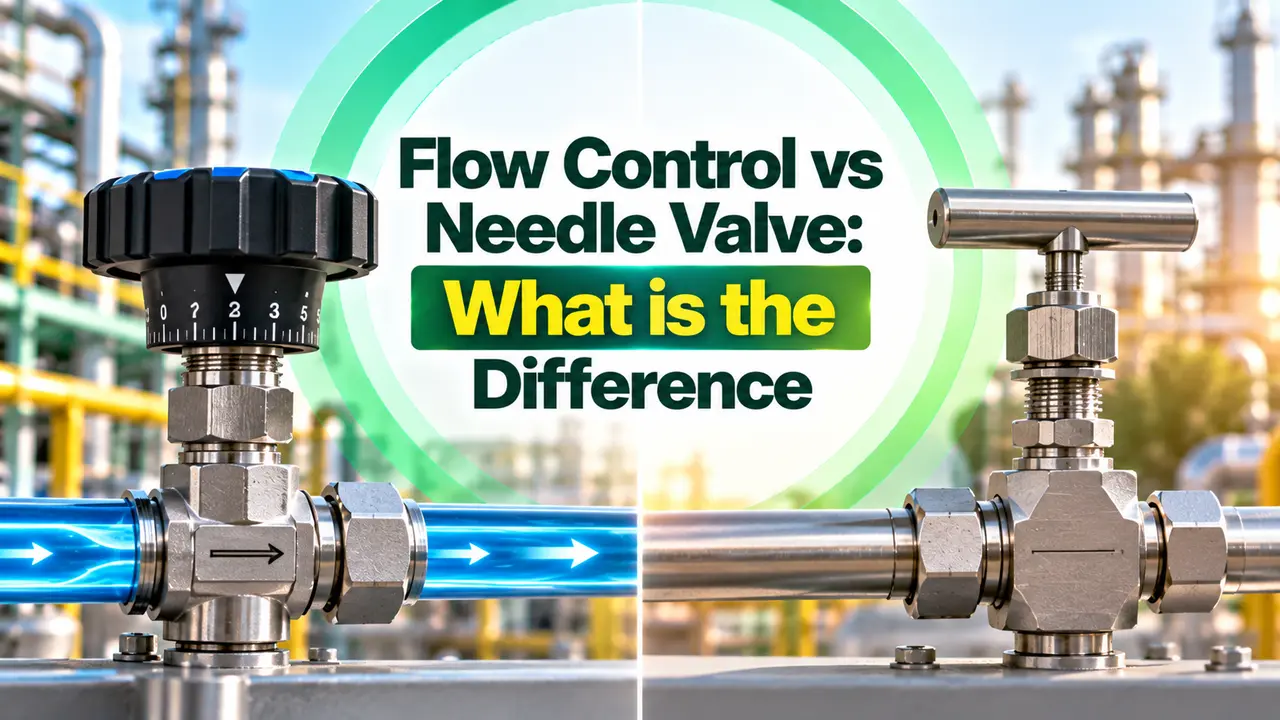
What Both Valve Types Have in Common
A needle valve and a flow control valve both use a finely threaded stem that moves a tapered plunger in or out of a fixed orifice.
Turning the stem gradually changes how much of that orifice is open, so air entering the input port gets throttled by an amount the operator sets by hand.
That fine threading is exactly what gives both valve types smooth, repeatable adjustment instead of the abrupt jump you would get from a simple on or off shutoff valve.
The One Difference That Actually Matters
A needle valve restricts airflow in both directions equally, with no bypass path at all, since it is simply a variable restriction sitting in the line.
A flow control valve adds a small check valve in parallel with that same needle and orifice, and that check valve is the entire difference between the two devices.
| Feature | Needle Valve | Flow Control Valve |
|---|---|---|
| Restricts flow | Both directions | One direction only |
| Bypass check valve | None | Built in, opens on reverse flow |
| Reverse direction flow | Also throttled | Free and unrestricted |
| Typical use | Instrumentation isolation, sampling, gauge lines | Pneumatic cylinder speed control |
That check valve stays closed while air moves through the controlled direction, forcing it through the narrow orifice, then opens the moment flow reverses so air rushes back through freely.
Needle Valve
Same restriction both ways, common on gauge isolation, sample lines, and calibration stands where symmetry is exactly what you want.
Flow Control Valve
Restriction one way, free flow the other, built specifically to set actuator speed without slowing the return stroke too.
Meter In and Meter Out, Explained
A flow control valve can be installed in two positions relative to an actuator, and the name simply describes where the restriction sits.
Meter out is the industry default for a standard double acting cylinder because the trapped exhaust builds a controlled backpressure, cushioning the piston through its whole stroke.
Selecting the Right Valve for the Job
Watch: How a Flow Control Valve Works
Flow Control vs Needle Valve Questions Engineers Ask
Related Articles on This Site
- Valve Actuator Types and Applications
- What Is a Valve Manifold
- Solenoid Valve Working Principle
- Control Valve Flow Coefficient
- Pneumatic Manifold Selection
External References
What We Learn Today
- Flow Control vs Needle Valve comes down to one bypass check valve, which makes one directional and the other symmetric.
- Meter out is the default speed control position, while meter in only suits spring return or hanging vertical loads.
- Both valves share the same threaded stem and tapered plunger mechanism for smooth, repeatable adjustment.