
Field instruments have long talked through slow fieldbus links or a 4 to 20 mA signal with a little HART on top. A new two wire physical layer now carries full Ethernet, power and intrinsic safety all the way to the transmitter.
Process plants need long cables, loop power and hazardous area protection, which ordinary Ethernet cannot provide. The Advanced Physical Layer solves all three on a single twisted pair.

What Is Ethernet APL?
Ethernet APL, the Ethernet Advanced Physical Layer, is a two wire Ethernet standard that carries data and power to field instruments over long distances, including hazardous areas. It lets transmitters and valves join the same IP network as controllers, instead of using FOUNDATION fieldbus or analog signals.
It is based on IEEE 802.3cg, known as 10BASE T1L, with extra rules for process plants. The protocols above it can be PROFINET, EtherNet/IP, HART IP or OPC UA.
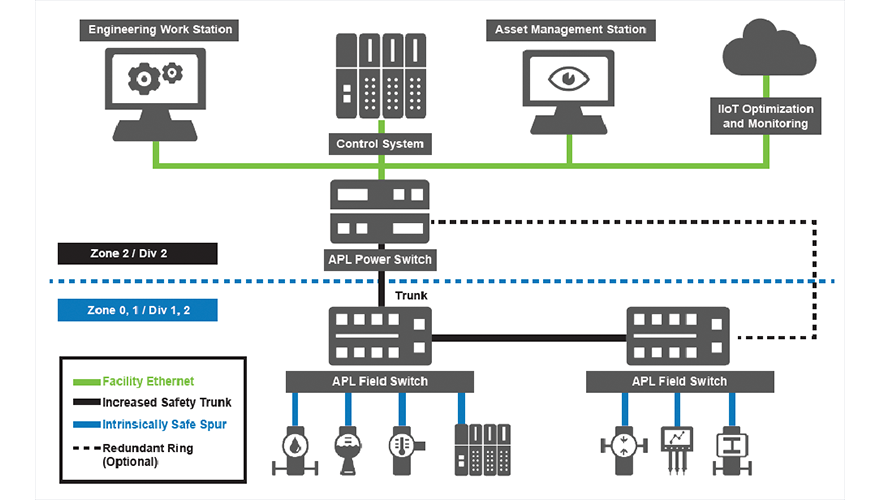
Control Global reports a speed of 10 Mbit/s, over 300 times faster than FOUNDATION fieldbus H1 at 31.25 kbit/s. It also notes backing from 12 automation companies plus several standards bodies.
Compared with the 4 to 20 mA signal, one cable now carries many variables and diagnostics at once.
How the Trunk and Spur Layout Works
Control Global gives the trunk limit as 1000 m and each spur as up to 200 m, all on a single pair. Pepperl+Fuchs states the trunk can carry up to 92 W to power field switches and devices.
Standard office Ethernet stops at 100 m per segment, as explained in Ethernet cable length and types. The long reach is a major reason plants choose this technology.
Intrinsic Safety with 2 WISE
2 WISE, the two wire intrinsically safe Ethernet concept, defines simple rules for connecting devices in hazardous zones. Engineers compare port and device parameters instead of doing a full loop calculation, much like the approach in intrinsically safe instruments.
Trunks usually run with increased safety protection into Zone 1, while spurs are intrinsically safe and can reach Zone 0. Area rules are covered in hazardous area classification.
| Item | Ethernet APL | FOUNDATION Fieldbus H1 | HART |
|---|---|---|---|
| Data rate | 10 Mbit/s | 31.25 kbit/s | 1.2 kbit/s |
| Trunk length | Up to 1000 m | Up to 1900 m | Loop based |
| Protocols | PROFINET, EtherNet/IP, OPC UA | FF only | HART only |
| IP addressing | Yes | No | Only with HART IP |
5 Powerful Benefits of Ethernet APL
Because devices speak PROFINET or EtherNet/IP directly, no gateway is needed. Asset tools reach every instrument over the network.
Higher layers such as OPC UA can read rich device data for maintenance and analytics.
Transfer Time Formula
Bits = kB × 8000
Example, 100 kB of device configuration:
800000 bits ÷ 10000000 bit/s = 0.080 s with Ethernet APL
800000 ÷ 31250 = 25.6 s with H1
800000 ÷ 1200 = 666.7 s with HART
Real links add protocol overhead, so treat these as best case figures. The ratio between them stays about the same.
Data Transfer Calculator
Uploading a full device configuration or a valve signature shows the difference most clearly. Faster uploads save time in commissioning.
Ethernet APL Pros and Cons
- Full Ethernet speed at field level.
- Long trunk and spur distances.
- Intrinsic safety built into the design.
- Direct IP access to every device.
- New devices and switches needed.
- Engineers need Ethernet skills.
- Cyber security reaches the field.
- Device range still growing.
Migration can be gradual, with existing HART loops kept alongside new Ethernet APL devices. Integration choices are discussed in DCS fieldbus integration.
APL Project Technology PDF
Endress+Hauser Introduction Video
Ethernet APL FAQ
Related Articles
- FOUNDATION Fieldbus Explained
- PROFINET Communication Guide
- How HART Protocol Works
- OPC UA Explained
- Hazardous Area Classification
External References
- Technology for Ethernet to the Field of Process Plants, APL Project
- Advanced Physical Layer Standard, Control Global
- Ethernet over Twisted Pair, Wikipedia
What We Learn Today
- Ethernet APL brings 10 Mbit/s Ethernet to field devices on two wires.
- Trunks reach 1000 m and spurs 200 m with loop power.
- 2 WISE rules make intrinsic safety simple in hazardous areas.