
A logarithmic unit that turns huge ratios into small, easy numbers and lets you add gains instead of multiplying them.
The decibel expresses the ratio between two power or voltage levels on a logarithmic scale. Engineers use it because gains and losses simply add, and huge ranges fit into manageable numbers.
What Is a Decibel in Electronics?
A decibel in electronics is a logarithmic way of expressing the ratio of two power, voltage or current levels. It appears in amplifier gain, filter response, signal to noise ratio, cable loss and RF power.
The bel is the base 10 logarithm of a power ratio, and a decibel is one tenth of a bel. The unit keeps numbers small, since a million to one power ratio is only 60 dB.
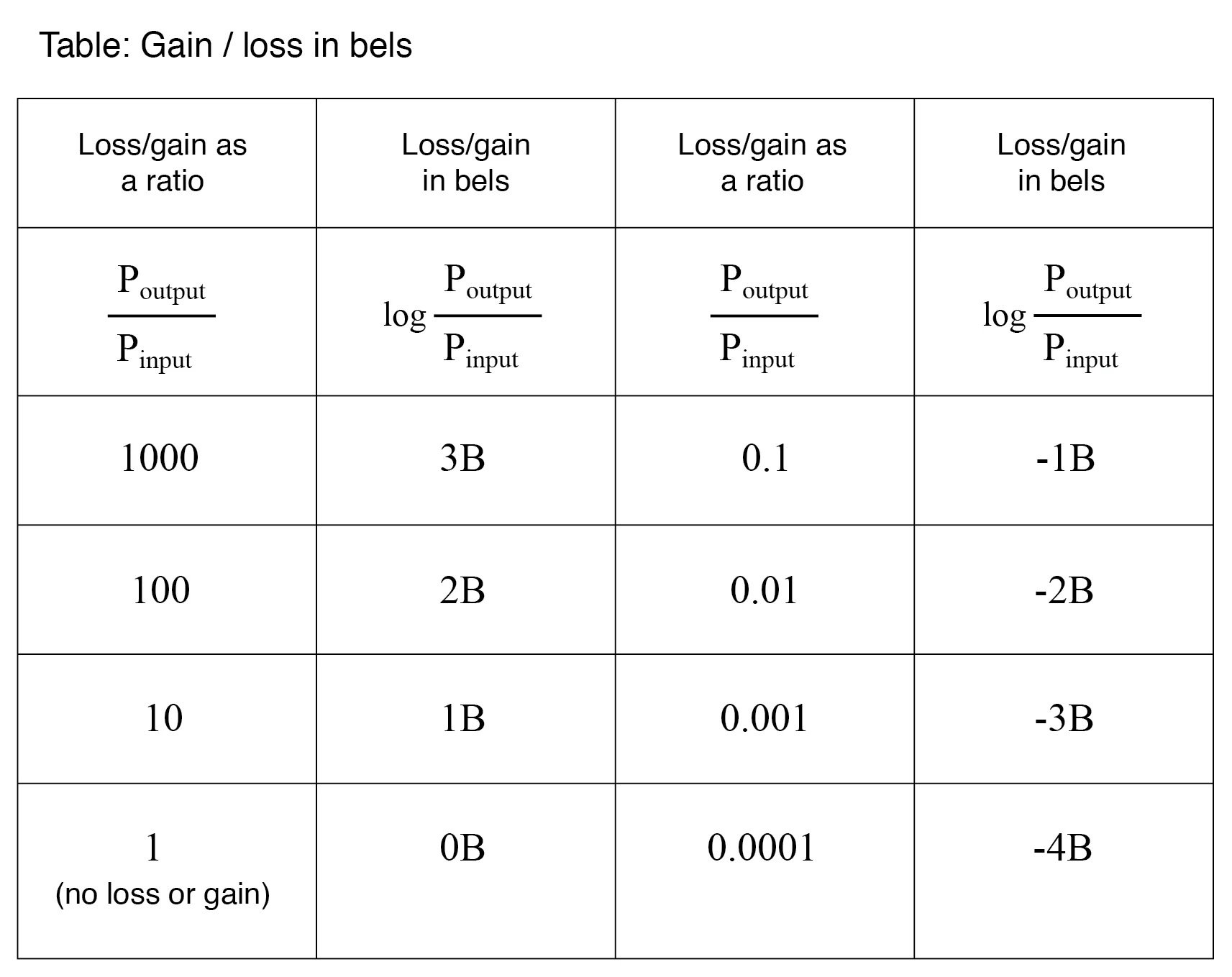
TME notes that the logarithmic approach allows huge ranges to be expressed intuitively and matches how human senses respond to sound and light.
A plain dB value is always a ratio between two quantities. When a reference is fixed, such as 1 mW, the unit gains a suffix like dBm and becomes an absolute level.
Power and Voltage Decibel Formulas
Voltage or current: dB = 20 × log10(V2 ÷ V1)
dBm = 10 × log10(P ÷ 1 mW)
Worked gain chain:
Input = minus 10 dBm = 0.1 mW
Amplifier gain = 20 dB, cable loss = 3 dB
Net gain = 20 minus 3 = 17 dB
Output = minus 10 + 17 = 7 dBm
7 dBm = 1 mW × 10^(0.7) ≈ 5.01 mW
The factor is 20 for voltage because power is proportional to voltage squared. Both formulas give the same dB value when source and load impedances are equal.
Voltage dB values assume RMS values, explained in RMS value explained. Comparing peak with RMS values gives wrong results.
6 Easy Rules for the Decibel in Electronics
These rules let you estimate quickly without a calculator. For example, 23 dB of power gain is 20 dB plus 3 dB, so 100 times 2, which is 200 times.
The minus 3 dB point is also the cutoff of a filter, where output power falls to half, as used in RC low pass and high pass filters.
Common Decibel References
| Unit | Reference | Typical Use |
|---|---|---|
| dB | Ratio, no reference | Gain, loss, attenuation |
| dBm | 1 mW | RF and telecom power |
| dBW | 1 W | High power transmitters |
| dBV | 1 V RMS | Consumer audio and measurement |
| dBu | 0.775 V RMS | Professional audio |
| dBi | Isotropic antenna | Antenna gain |
The dBu reference of 0.775 V comes from 1 mW into 600 Ω, an old telephone standard. dBV uses a round 1 V reference instead.
Because dBm is based on power, the voltage for a given dBm depends on impedance. At 50 Ω, 0 dBm is about 0.224 V RMS.
Decibel in Electronics Signal Chains
Signal chains become simple addition and subtraction in dB. That is why RF engineers build link budgets entirely in decibels.
In amplifier design, gain of a common emitter amplifier or op amp stage is often quoted in dB for easy comparison.
Common mode rejection is also given in dB, as covered in differential amplifier and CMRR.
Where the Decibel in Electronics Is Used
Negative dB values simply mean loss or attenuation. A 20 dB attenuator reduces voltage to one tenth.
Oscilloscopes and spectrum analyzers often display in dBV or dBm directly. Knowing the reference and impedance setting avoids reading errors of several dB during troubleshooting.
When reading datasheets, always check whether a value is a ratio in dB or an absolute level in dBm or dBV.
Decibel Calculator
Negative results are written with the word minus to show loss. Try equal values to confirm the gain is zero.
- Huge ranges become small numbers.
- Gains and losses simply add.
- Matches human perception of sound.
- Standard across audio, RF and instrumentation.
- Mixing 10 log and 20 log formulas.
- Treating dBm as a ratio.
- Ignoring impedance with dBm and voltage.
- Comparing peak and RMS values.
Keysight Decibel Application Note
EEVblog Decibel Tutorial Video
Decibel FAQ
Related Articles
- Signal to Noise Ratio Calculator
- RMS Value Explained
- RC Low Pass and High Pass Filter
- Op Amp Basics
- Electrical Units of Measure
External References
- Understanding the Decibel, Keysight
- dB, dBm and dBV Guide, TME
- Decibels Textbook Chapter, All About Circuits
- Decibel, Wikipedia
What We Learn Today
- Power uses 10 log and voltage uses 20 log of the ratio.
- Suffixes like dBm and dBV turn ratios into absolute levels.
- Gains and losses in dB add, which simplifies signal chains.