
Cause and Effect Matrix (C&E Diagram) in Safety Systems Explained
Every emergency shutdown system boils down to one question, answered thousands of times over: if this happens, what should shut down? A cause and effect matrix is where that answer gets written down before it ever reaches a single line of PLC code.
A cause and effect matrix, or C&E diagram, documents exactly which safety actions should occur in response to which process conditions. This guide explains the matrix structure, its symbols, a worked tank example, and why this single document sits at the center of emergency shutdown system design.
What is a Cause and Effect Matrix?
A cause and effect matrix is a tabular document that maps process conditions, called causes, to the safety actions they should trigger, called effects. It is the primary design and specification document for Emergency Shutdown (ESD) systems and Fire and Gas (F&G) detection systems, translating a plant's safety philosophy into a precise, auditable table that both engineers and the control system logic can follow exactly.
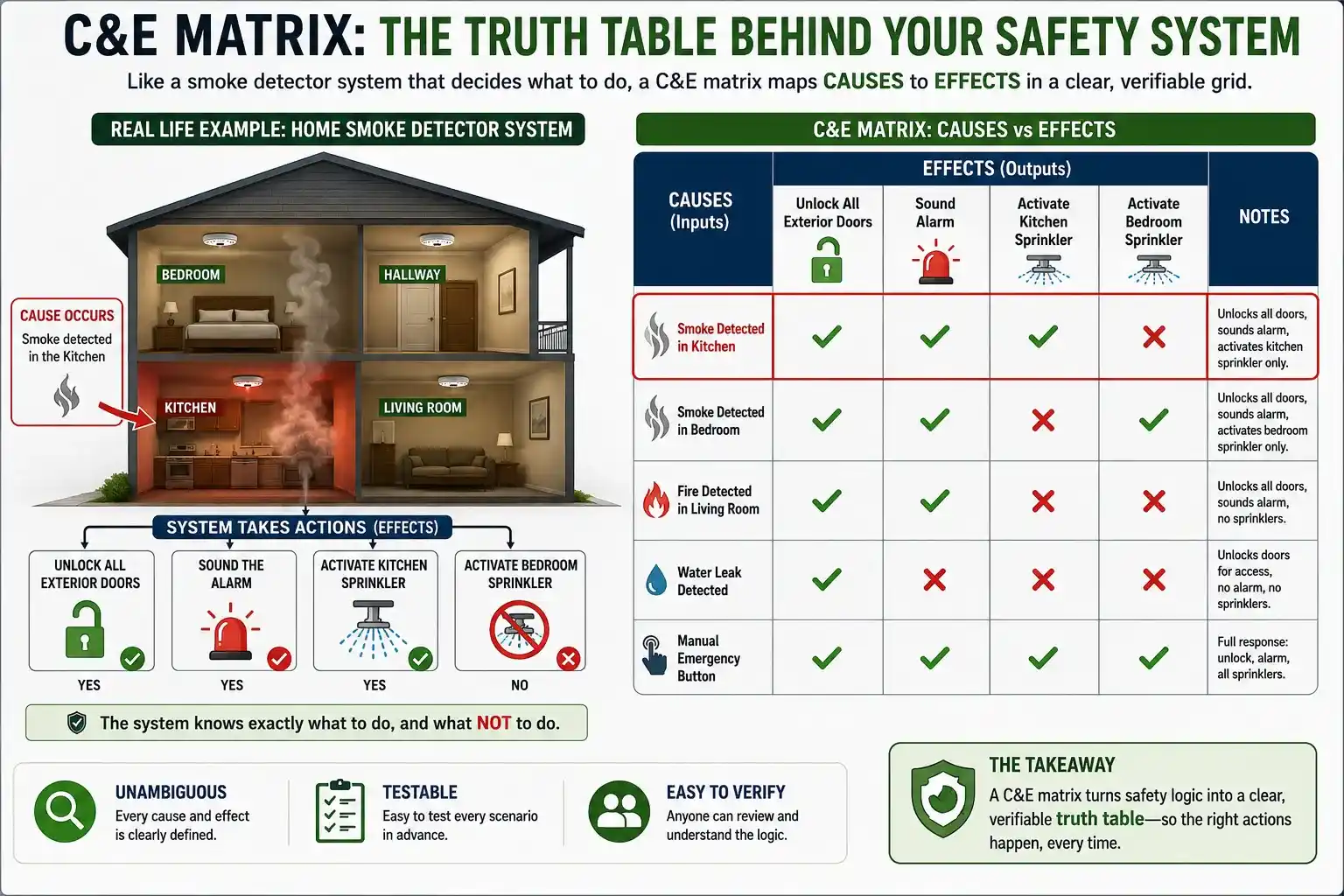
The matrix format itself is simple: causes are listed down the left side, effects are listed across the top, and a mark at the intersection of a cause row and an effect column indicates that this specific cause triggers that specific effect. Despite that simplicity, the C&E matrix is one of the most heavily reviewed documents in a process safety design package, because every intersection represents a decision with real consequences if it is wrong.
Real Life Example
Think of a C&E matrix like the truth table behind a home smoke detector system tied to your door locks and sprinklers. If smoke is detected in the kitchen, the matrix might say: unlock all exterior doors, sound the alarm, and activate the kitchen sprinkler, but not the bedroom sprinkler. Written out as a grid of causes against effects, that logic becomes unambiguous, testable, and easy for anyone to verify, whether they wrote the original fire safety plan or not.
Cause and Effect Matrix Symbols
Direct Activation
The effect is triggered immediately when the cause occurs.
Time Delay
The effect is triggered after a defined time delay following the cause.
Permissive
The cause permits the effect to occur but does not trigger it directly.
Worked Example: A Simple Storage Tank
Consider a tank fitted with a level transmitter (LT-101), a pressure transmitter (PT-101), an inlet valve (XV-101), and an outlet pump (P-101). A simplified C&E matrix for this tank might look like this:
| Cause | Close XV-101 (Inlet Valve) | Stop P-101 (Outlet Pump) | Sound Alarm |
|---|---|---|---|
| LT-101 High High Level | X | X | |
| LT-101 Low Low Level | X | X | |
| PT-101 High High Pressure | X | X | X |
| Manual ESD Pushbutton | X | X | X |
Reading this matrix is straightforward: if LT-101 detects a high high level, the inlet valve XV-101 closes and an alarm sounds, but the outlet pump keeps running to drain the tank. If LT-101 detects a low low level instead, the pump stops to protect it from running dry, while the inlet valve stays open. A high high pressure reading or a manual pushbutton triggers every effect at once, a full shutdown.
How a Cause and Effect Matrix Gets Built
Identify Causes
List every process upset, alarm, and switch from the P&IDs that should trigger a safety response.
Identify Effects
List every equipment action, valve closure, pump stop, or alarm, the safety system can command.
Mark Intersections
Mark each cause-effect relationship with X, T, or P based on the required safety response.
Review and Test
Cross-check with operations, then verify every intersection during FAT, SAT, and commissioning.
Applications of Cause and Effect Matrices
Emergency Shutdown (ESD)
C&E matrices form the core specification for plant and unit-level shutdown systems.
Fire and Gas Systems
Detector causes map to deluge, alarm, and isolation effects across process areas.
Package Equipment
Compressor and pump skids use C&E matrices to define local trip and interlock logic.
Batch Interlocks
Batch process safety interlocks are documented the same way as continuous ESD logic.
Commissioning and Testing
The matrix doubles as a checklist for I/O checkout and periodic proof testing.
Six Sigma and QA
The same tabular cause-effect format supports quality root cause tracking outside safety systems too.
Common C&E Matrix Mistakes
✅ Do This
- Cross-reference every cause and effect against the actual P&IDs and tag numbers
- Involve operators in review, not just design engineers
- Test every single intersection during FAT, SAT, and commissioning
- Re-verify the matrix on a set schedule and after any process change
❌ Avoid This
- Confusing X, T, and P markings, which represent very different safety behaviors
- Leaving the matrix unreviewed after a process modification
- Skipping cross-checks with operations, who often catch scenarios engineers miss
- Testing motors and pumps live instead of in simulation mode during verification
Cause and Effect Matrix: Video Walkthrough
Frequently Asked Questions About Cause and Effect Matrices
- Control Design, How to Use a Cause-and-Effect Matrix
- Automation Forum, Cause and Effect Drawing in Process Instrumentation
- World of Instrumentation, Understanding Cause and Effect: A Comprehensive Guide
What We Learn Today
- A cause and effect matrix maps process causes to the safety effects they must trigger, in a simple grid format
- X, T, and P symbols distinguish immediate activation, time-delayed activation, and permissive relationships
- The matrix is the central specification document for ESD and fire and gas system design
- Every intersection must be tested during commissioning, and the matrix should be re-verified periodically
- Operations input during review catches practical scenarios that a purely theoretical design pass can miss