
A capacitor that still shows the right microfarads can quietly fail a power supply because of a few hundred milliohms of hidden resistance.
Real capacitors are not ideal. Every one has a small series resistance from leads, plates, electrolyte and dielectric loss, and that resistance decides how hot the part runs and how much ripple it lets through.
What Is Capacitor ESR?
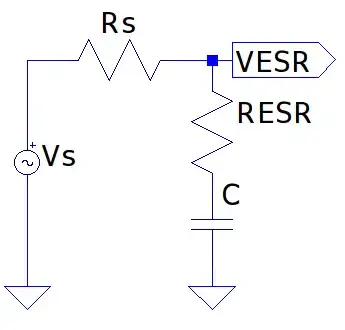
Capacitor ESR, or equivalent series resistance, is the single resistor value that represents all the losses inside a real capacitor when it is modelled as an ideal capacitance in series with a resistance. It adds to the reactance described in impedance and reactance.
IET Labs explains that ESR represents total loss, including metal resistance, leakage and dielectric loss. That is why it is always higher than the physical resistance of the leads and plates alone.
ESR depends on frequency and temperature. It usually falls as frequency rises toward the resonance point and rises sharply in the cold.
The basic behaviour of the ideal part is covered in capacitor working principle. ESR is what separates that ideal from a real component.
5 Hidden Effects of High ESR
All About Circuits lists I²R losses, noise and extra voltage drop as the main penalties of high ESR. In switch mode supplies these effects often decide capacitor choice more than capacitance.
A buck converter output ripple is often dominated by capacitor ESR rather than the capacitance itself.
ESR Formulas With Example
Power loss P = I ripple rms² × ESR
Ripple voltage ΔV ≈ ΔI × ESR
Worked example, 1000 µF electrolytic:
DF = 0.12 at 120 Hz
ESR = 0.12 ÷ (2π × 120 × 0.001) = 0.159 Ω
Ripple current 2 A rms, P = 4 × 0.159 = 0.64 W
Ripple from a 2 A step ≈ 0.32 V
Many datasheets give the dissipation factor instead of ESR, so this conversion is useful. All About Circuits notes that makers specify ESR inconsistently, and some give neither value.
Ripple current is an RMS quantity, explained in RMS value. Datasheets also list a maximum ripple current that keeps heating safe.
Typical Capacitor ESR by Type
| Type | Typical ESR | Notes |
|---|---|---|
| Aluminium electrolytic | Tens of mΩ to several Ω | Rises with age and cold |
| Aluminium polymer | About 5 to 30 mΩ | Stable, long life |
| Tantalum MnO2 | About 0.1 to 1 Ω | ESR helps loop stability |
| MLCC ceramic | A few mΩ | Very low, can cause ringing |
| Film | Low mΩ range | Excellent for high ripple AC |
The failure behaviour of these types is compared in electrolytic vs ceramic vs tantalum failure modes. Choosing the right family is explained in capacitor types.
Very low ESR is not always best. Some older linear regulators need a minimum capacitor ESR for stability, so check the regulator datasheet.
How to Measure Capacitor ESR
All About Circuits notes that ordinary ESR meters work up to about 100 kHz, while resonant line methods measure ultra low values at hundreds of MHz. For most repair work, a handheld meter is enough, as long as readings are compared with a known good part of the same value and voltage.
An oscilloscope and function generator can also estimate ESR with a series resistor, a method shown in the video below. In circuit readings are possible because the low test voltage does not turn on semiconductors.
Where Capacitor ESR Matters Most
Decoupling performance depends on ESR and ESL together, see how decoupling capacitors work. Ageing supplies in panels are covered in power supply ageing.
ESR and Ripple Calculator
Compare the heating with the ripple rating in the datasheet. If it is close, use a polymer part or parallel capacitors to share the current.
- Less heating and longer life.
- Lower ripple voltage.
- Better transient response.
- Higher ripple current rating.
- May destabilise some regulators.
- Can cause ringing with inductance.
- Costs more.
- ESR still rises with age.
IET Labs ESR Application Note
Measure ESR With an Oscilloscope
Capacitor ESR FAQ
Related Articles
- Capacitor Working Principle
- Capacitor Types Explained
- Capacitor Failure Modes
- How Decoupling Capacitors Work
- Buck Converter Working Principle
External References
- ESR of Capacitors, IET Labs
- Determining ESR of Capacitors, All About Circuits
- Equivalent Series Resistance, Wikipedia
What We Learn Today
- Capacitor ESR lumps all internal losses into one series resistor.
- It sets ripple heating, output ripple and capacitor life.
- Measure at the right frequency and compare with a new part.