
A magnetic flow meter measures a signal of only a few hundred microvolts, so any stray voltage on the liquid can swamp it. Correct fluid grounding gives the meter a quiet reference and turns a jumping reading into a steady, trustworthy one.
Most unstable magmeter readings trace back to poor fluid grounding rather than a faulty meter. This guide shows when to fit grounding rings, how to choose the material and how to install them correctly.
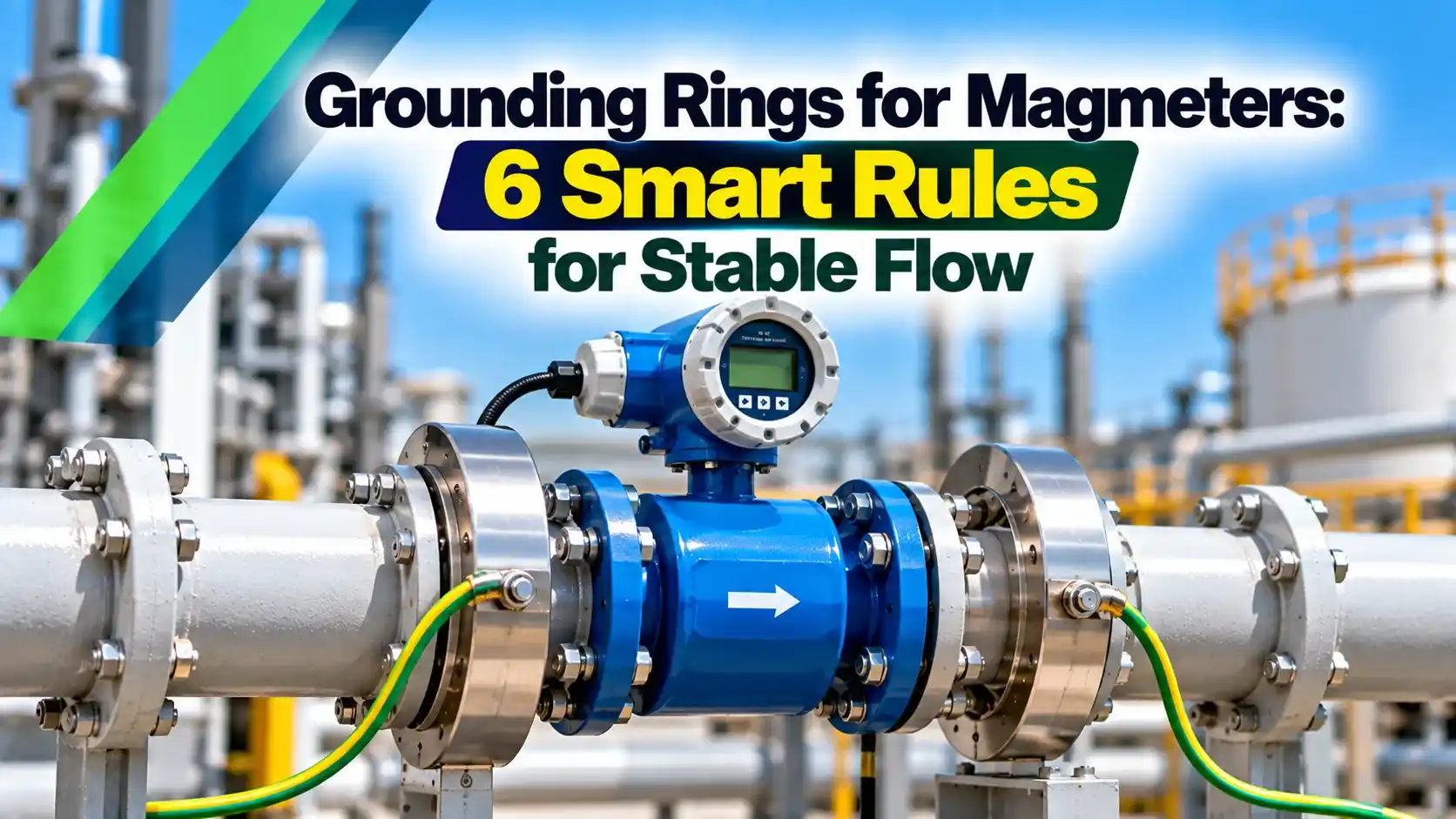
What Are Magmeter Grounding Rings?
Grounding rings are thin metal discs with a bore equal to the meter bore, clamped between the flanges of a magnetic flow meter and the pipe so that they touch the flowing liquid. They connect the process liquid to the meter ground and give the electromagnetic flow meter a stable reference potential.
On a bare metal pipe, the pipe itself does this job, because the liquid touches the metal wall. When the pipe is plastic, or lined with rubber, PTFE or cement, the liquid is electrically floating, and the meter needs another path to reach it.
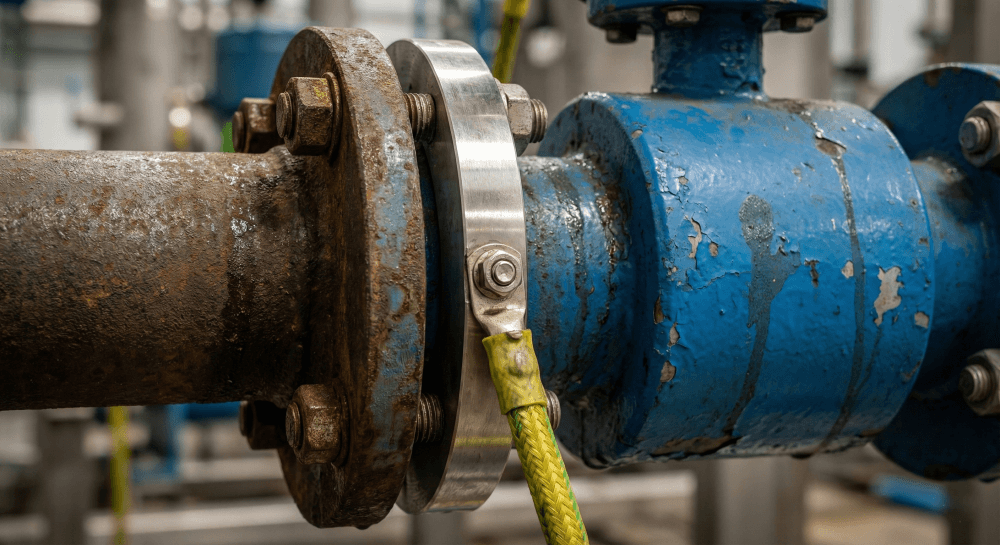
Yokogawa describes grounding rings as a way to remove stray electrical energy that builds up in the process, and notes that versions with a raised lip also protect the liner edge. That lip matters on abrasive slurries, where the leading edge of a soft liner wears first.
Why the Flow Signal Is So Easily Disturbed
A magmeter works on Faraday law of electromagnetic induction. The coils create a magnetic field across the pipe, the moving conductive liquid acts as a conductor, and two electrodes pick up a voltage proportional to velocity.
E = induced voltage at the electrodes
k = meter constant
B = magnetic flux density
D = distance between electrodes, the inner diameter
v = mean flow velocity
Emerson Rosemount states that the flow signal is typically about 100 µV per foot per second of velocity
At 2 m/s = 6.56 ft/s, signal ≈ 656 µV
Emerson notes in its grounding technical note that the flow signal is only around 100 microvolts per foot per second. A few millivolts of stray voltage on the liquid is therefore many times larger than the real flow signal.
The transmitter measures the electrode voltage against its own reference, which must be at the same potential as the liquid. If the liquid floats relative to that reference, the difference appears as noise, zero shift or a reading that wanders, much like a ground loop in an analog signal.
Celectric states that about 80 percent of magmeter reading problems can be traced to improper solution ground connections. Checking grounding first often saves a needless meter replacement.
Signal to Noise Calculator
The calculator converts velocity to feet per second and multiplies by the 100 µV figure, so 2 m/s gives about 656 µV. A stray voltage of 5 mV is then 7.62 times the flow signal, which no transmitter can reject without proper grounding rings.
When Do You Need Grounding Rings?
| Pipe Type | Liquid Contact | Grounding Need |
|---|---|---|
| Bare carbon or stainless steel | Pipe wall touches liquid | Ground straps to pipe flanges, no rings needed |
| Metal pipe with internal lining | Lining insulates liquid | Grounding rings or lining protectors |
| PVC, HDPE, FRP or other plastic | No metal contact at all | Grounding rings or lining protectors |
| Electrolytic or cathodic protection line | Large DC currents present | Grounding rings with special isolation scheme |
Emerson lists the cases where grounding rings are preferred over a grounding electrode. These include fluid conductivity below 100 µS/cm, wafer style sensors in lined or plastic pipe, a risk of coating at the bottom of the pipe and electrolytic or cathodic protection service.
Low conductivity liquids such as demineralised water need special attention, since the meter already works close to its minimum limit. The basics of electrical conductivity explain why a larger contact area gives a steadier reference.
Before ordering a meter for a new line, ask the piping engineer for the exact pipe material and lining. Many grounding problems start when a lined spool is added later and nobody updates the meter specification.
Grounding Rings vs Grounding Electrode
Flat metal discs between meter and pipe flanges, wetted over the full circumference.
A third electrode inside the meter tube, usually at the bottom, touching the liquid.
Rings with a raised lip that also shield the liner edge.
Braided or flat conductors between meter flanges and pipe flanges.
Emerson explains that a grounding electrode is easier to install and cheaper, while grounding rings give a larger surface area connection to the liquid. That larger area also limits the effect of the conductivity of the adjacent piping.
A single electrode can coat with scale or grease, and then its contact becomes poor. The liner and electrode selection for wastewater guide shows why coating is common in sewage and sludge lines.
- Large wetted area gives a stable reference.
- Works on plastic and lined pipe.
- Lip versions protect liner edges.
- Reliable with stray currents and low conductivity.
- Extra cost, especially in exotic metals.
- Adds face to face length and two gaskets.
- Wrong material can corrode quickly.
- Must be sized to the meter bore, not the pipe.
Selecting Grounding Rings Material
The ring material must resist the process liquid at least as well as the measuring electrodes. Celectric advises matching the grounding ring or grounding electrode material to the measuring electrode material for chemical compatibility.
| Material | Typical Service | Note |
|---|---|---|
| 316L stainless steel | Water, wastewater, mild chemicals | Standard choice, lowest cost |
| Hastelloy C | Chlorides, seawater, many acids | Good all round corrosion resistance |
| Titanium | Wet chlorine, hypochlorite, seawater | Avoid dry chlorine and hydrofluoric acid |
| Tantalum | Hot concentrated acids | Very expensive, check alkalis |
| Platinum iridium | Extremely aggressive media | Used when nothing else survives |
Yokogawa lists stainless steel, Hastelloy, titanium, tantalum and platinum iridium among available ring materials. ONICON offers 316 stainless steel as standard, with Monel and Hastelloy as alternatives, in sizes from 1 inch to 42 inch.
ONICON supplies its grounding rings in pairs, one upstream and one downstream of the meter. Its catalog states that the ring size should always match the meter size rather than the original pipe size.
6 Smart Rules for Installing Grounding Rings
A ring with a bore smaller than the liner creates a step that disturbs the flow profile, while a larger bore leaves the liner edge exposed. Follow the flange and straight run guidance in magnetic flow meter sizing and installation together with these rules.
Ground straps should be short, wide and bolted to clean metal, never to a painted flange face. The same good practice applies to earthing in industrial process plants, where bonding quality decides noise levels.
Use a torque wrench and the gasket maker torque values on PTFE lined meters. Overtightened flanges cold flow the PTFE liner and can cause leaks at the grounding rings months later.
Stray Currents, Electrolytic Cells and Cathodic Protection
Emerson warns that electrolytic processes can carry DC currents of thousands of amperes through the liquid. For such lines it recommends isolating the meter from earth, fitting two grounding rings so the current is shunted around the measuring section and using a 37 Hz coil drive frequency.
On pipelines with cathodic protection, only the anode should be connected to earth. Emerson states that all other equipment, including the magmeter, must be isolated from earth, otherwise the meter body becomes an unwanted current path, a situation explained in floating versus grounded voltage.
In these cases the transmitter power supply should also be isolated, and signal wiring must use shielded twisted pair cable with the shield grounded at one point only. Always follow the specific manufacturer drawing for the scheme.
Troubleshooting Grounding Problems
- Reading jumps or drifts at zero flow with a full pipe.
- Ground straps are loose, painted over or missing.
- Ring material shows pitting or coating.
- Gaskets protrude into the bore or are off centre.
- Pipe was changed to plastic or lined without adding rings.
- Electrode resistance or coating diagnostics show a warning.
- Nearby welding or VFD cables share the same ground path.
If noise remains after grounding is corrected, check coil and signal cable routing and the transmitter settings. The magnetic flow meter troubleshooting guide covers empty pipe, coating and wiring faults in more detail.
Measure the potential between the liquid, the rings and the local earth with a high impedance meter, and compare with good plant practice from grounding techniques. A difference of more than a few hundred millivolts usually points to a bonding fault.
Where Grounding Rings Are Used
Where grounding becomes too difficult, some users compare other principles, as shown in ultrasonic vs magnetic flow meter differences. For most conductive liquids, though, a correctly grounded magmeter remains the most accurate and maintenance free choice.
Rosemount Grounding Technical Note PDF
Magmeter Grounding Procedure Video
Grounding Rings FAQ
They are thin metal discs fitted between the meter flanges and the pipe flanges. Their inner bore touches the flowing liquid and connects it electrically to the meter ground terminal.
This gives the transmitter a stable reference potential for its very small flow signal. Without it, stray voltages on the liquid appear as noise and unstable readings.
They are needed when the pipe is plastic, or metal with an insulating internal lining. In both cases the liquid has no direct contact with grounded metal.
Emerson also prefers them for conductivity below 100 µS/cm and for wafer sensors in such pipes. Electrolytic and cathodic protection service is another case where rings are the recommended choice.
A built in grounding electrode is cheaper and easier to install than separate rings. It works well on clean liquids where the meter sits in metal pipe.
It has a much smaller contact area and can coat with scale or grease. For difficult liquids, lined lines or stray currents, rings give a more reliable reference.
The ring must resist the process liquid at least as well as the measuring electrodes. 316L stainless steel suits water and wastewater, while Hastelloy handles many chlorides.
Titanium, tantalum or platinum iridium are used for strongly aggressive acids and chlorine service. Always confirm the choice with a corrosion resistance table or with the meter maker before ordering.
Traditionally two rings are fitted, one on the upstream flange and one on the downstream flange. ONICON supplies them in pairs with four gaskets for a standard flanged installation.
Celectric notes that some modern transmitter designs need only one ring on the line. Follow the manufacturer installation drawing carefully, since the grounding scheme can differ between models.
A ring bore smaller than the liner creates a step that disturbs the velocity profile. A larger bore leaves the liner edge exposed to flow and wear.
ONICON therefore advises sizing each ring to the meter bore, not to the original pipe. This matters most when reducers are used to install a meter smaller than the line.
First check that the straps are bolted to clean bare metal and connected to the meter ground terminal. Then inspect the rings and electrodes for coating, pitting or corrosion.
Next review cable routing, shield grounding and any nearby variable speed drives. Measure the voltage between liquid and earth to confirm that the bonding is really effective.
Related Articles
- Electromagnetic Flow Meter Working Principle
- Magnetic Flow Meter Troubleshooting
- Magnetic Flow Meter Sizing and Installation
- PEX Liners for Magnetic Flowmeters
- Ground Loop Causes and Prevention
External References
- Installation and Grounding of Magmeters, Emerson Rosemount
- Grounding Ring vs Grounding Electrode, Celectric
- Magnetic Flow Meter, Wikipedia
What We Learn Today
- A magmeter flow signal is only about 100 µV per foot per second, so a few millivolts of stray voltage on the liquid can swamp the reading.
- Grounding rings are needed on plastic or lined pipe, for low conductivity liquids below 100 µS/cm and in electrolytic or cathodic protection service.
- Choose ring material equal to or better than the electrodes, size it to the meter bore, gasket both faces and bond it with short straps.