
At higher frequencies, current crowds toward the surface of a conductor and the centre does almost nothing.
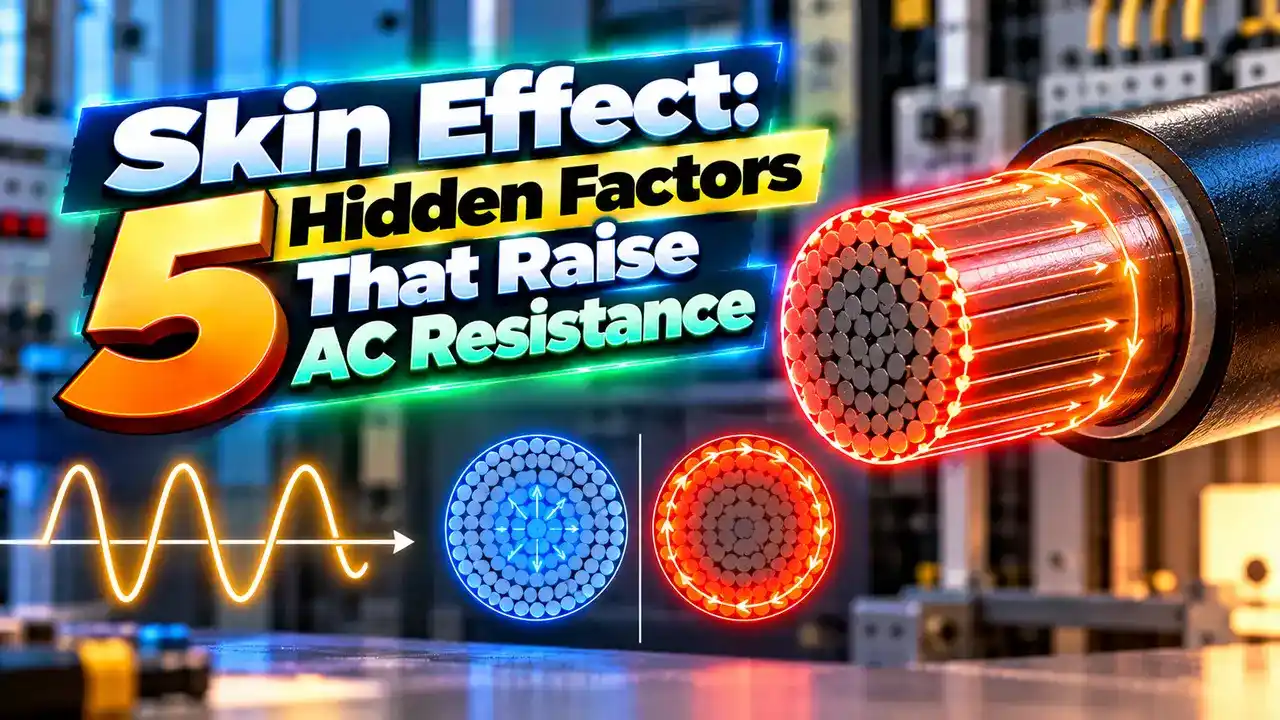
Skin effect is the tendency of alternating current to flow mostly near the surface of a conductor. It raises AC resistance and heat, especially in large conductors and at high frequencies.
What Is Skin Effect?
Skin effect is the uneven distribution of alternating current in a conductor, with current density highest at the surface and lowest at the centre. With DC, current spreads evenly, which is one of the practical differences between AC and DC.
Changing current creates a changing magnetic field inside the conductor. That field induces eddy currents that oppose flow at the centre and reinforce it near the surface.
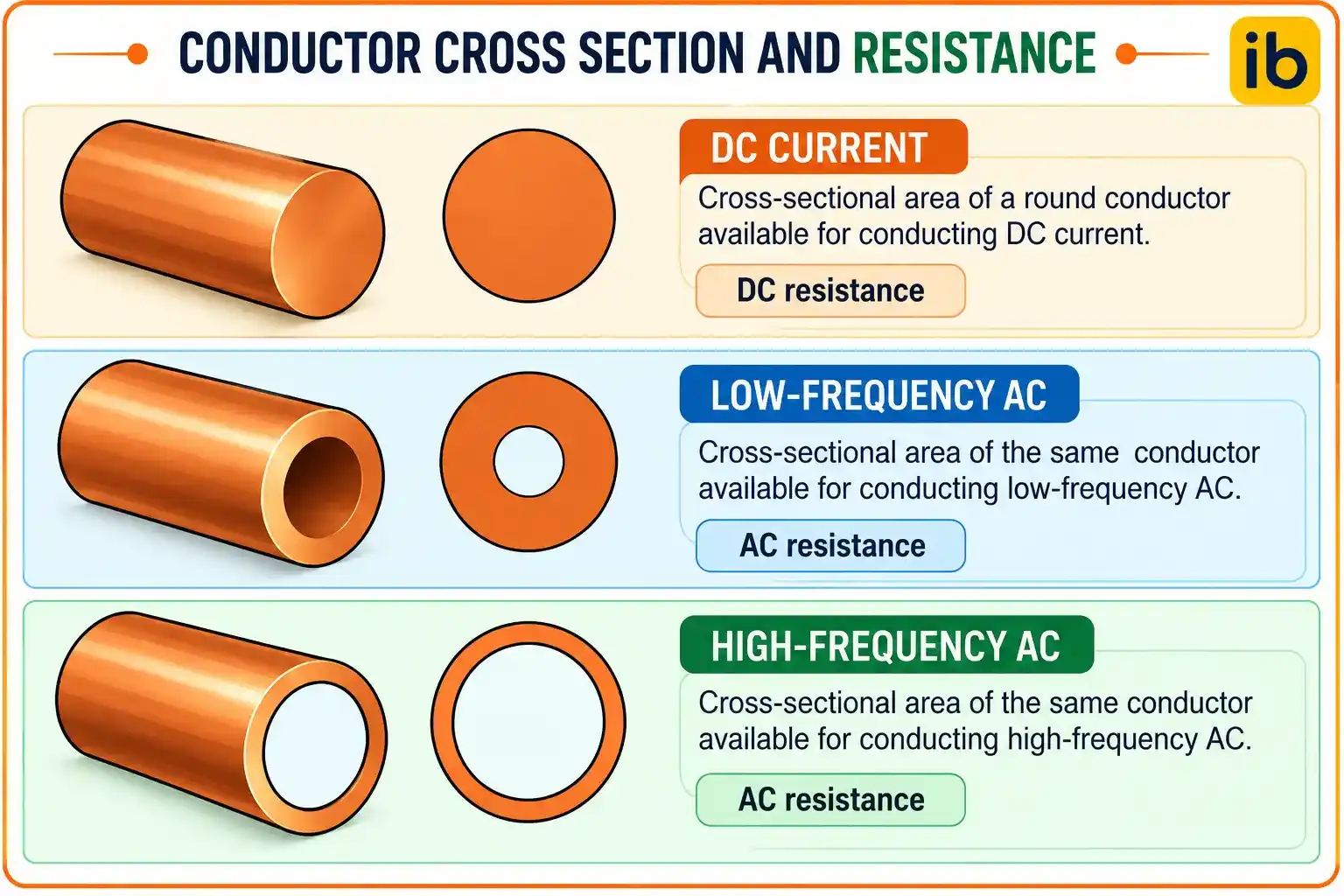
The result is a smaller effective area carrying current. Smaller area means higher AC resistance and more I²R heating than the DC resistance suggests.
This matters for resistance calculations in large busbars, cables, transformer windings and every high frequency circuit.
Skin Depth Formula With Copper Values
δ = skin depth, where current falls to about 37 percent
ρ = resistivity, copper 1.72 × 10^(minus 8) Ω·m
f = frequency, μ0 = 4π × 10^(minus 7), μr = relative permeability
Copper at 50 Hz:
δ = √(1.72e(minus 8) ÷ (π × 50 × 4π × 10^(minus 7)))
δ ≈ 9.3 mm at 50 Hz
At 1 kHz ≈ 2.1 mm, at 1 MHz ≈ 0.066 mm
A copper conductor thicker than about twice the skin depth wastes its centre at that frequency. At 50 Hz this only matters for conductors wider than roughly 18 to 20 mm.
At switching frequencies of tens of kHz, skin depth drops below half a millimetre. That is why high frequency transformers and inductors use special wire.
5 Hidden Factors That Control Current Crowding
Factor 3 explains why steel is a poor AC conductor even though it carries DC reasonably well. Its high permeability pushes current into a very thin surface layer.
Factor 5, the proximity effect, adds to this crowding in multi conductor cables and windings. It is a major reason large busbars are sized with AC correction factors.
Current Crowding and Harmonics
Harmonic currents from drives and rectifiers have higher frequencies, so they suffer more crowding. Our guide on power harmonics explains where these currents come from.
This is one reason K rated transformers and derated neutrals are used in buildings full of electronic loads. The extra AC resistance at harmonic frequencies adds heat.
Measuring THD helps estimate how much extra heating to expect.
Skin Depth by Frequency
| Frequency | Copper Skin Depth | Practical Meaning |
|---|---|---|
| 50 Hz | About 9.3 mm | Matters only for large busbars |
| 1 kHz | About 2.1 mm | Medium frequency heating coils |
| 20 kHz | About 0.47 mm | SMPS transformers need litz wire |
| 1 MHz | About 0.066 mm | RF current flows in a thin layer |
| 100 MHz | About 0.0066 mm | Surface finish dominates losses |
These values come from the skin depth formula for copper. Aluminium skin depth is about 1.3 times larger at the same frequency.
In high speed PCBs, the same effect increases trace loss at GHz frequencies, which is one topic in signal integrity for high speed PCBs.
Practical Ways to Reduce Losses
Litz wire only helps when each strand is thinner than the skin depth and strands are transposed. Otherwise the proximity effect cancels the benefit.
Induction heating uses skin effect on purpose, concentrating heat at the surface of a part. Similar physics lets an inductor lose efficiency at high frequency.
Skin Effect in Large Power Cables
Very large copper cables, typically above about 1000 mm², use segmental conductors made of insulated sectors. This construction reduces skin effect and lowers AC resistance noticeably.
Cable current ratings in manufacturer tables already include AC resistance at 50 Hz. Our guide on cable sizing and ampacity shows why these tabulated values should be used instead of DC resistance.
Parallel runs of smaller cables are another practical way to limit this crowding on heavy feeders. They also make installation easier on tight cable trays.
Skin Depth Calculator
Use 28.2 for aluminium. Try a relative permeability of 1000 to see how thin the skin becomes in steel.
- AC resistance is always higher than DC resistance.
- Effect grows with frequency and conductor size.
- Litz wire and flat bars reduce losses.
- Harmonics make the effect worse.
- Using DC resistance for large AC busbars.
- Ignoring harmonics in cable heating.
- Using solid wire in high frequency magnetics.
- Forgetting the proximity effect in windings.
AC Resistance of Wire Application Note
Current Crowding Video Explanation
Skin Effect FAQ
Related Articles
- Difference Between AC and DC
- What Is Resistance
- Busbar Sizing Calculation Guide
- Impedance and Reactance in AC Circuits
- Power Harmonics Explained
External References
- What Is the Skin Effect, All About Circuits
- AC Losses in Transmission Lines, Electrical4U
- AC Resistance of Wire, IET Labs
- Skin Effect, Wikipedia
What We Learn Today
- AC current crowds toward the surface, raising AC resistance and heat.
- Skin depth falls with frequency, conductivity and permeability.
- Litz wire, flat bars and hollow conductors reduce the losses.