
When every RTU, PLC and relay agrees on the time, alarms and events line up and root cause analysis becomes easy.
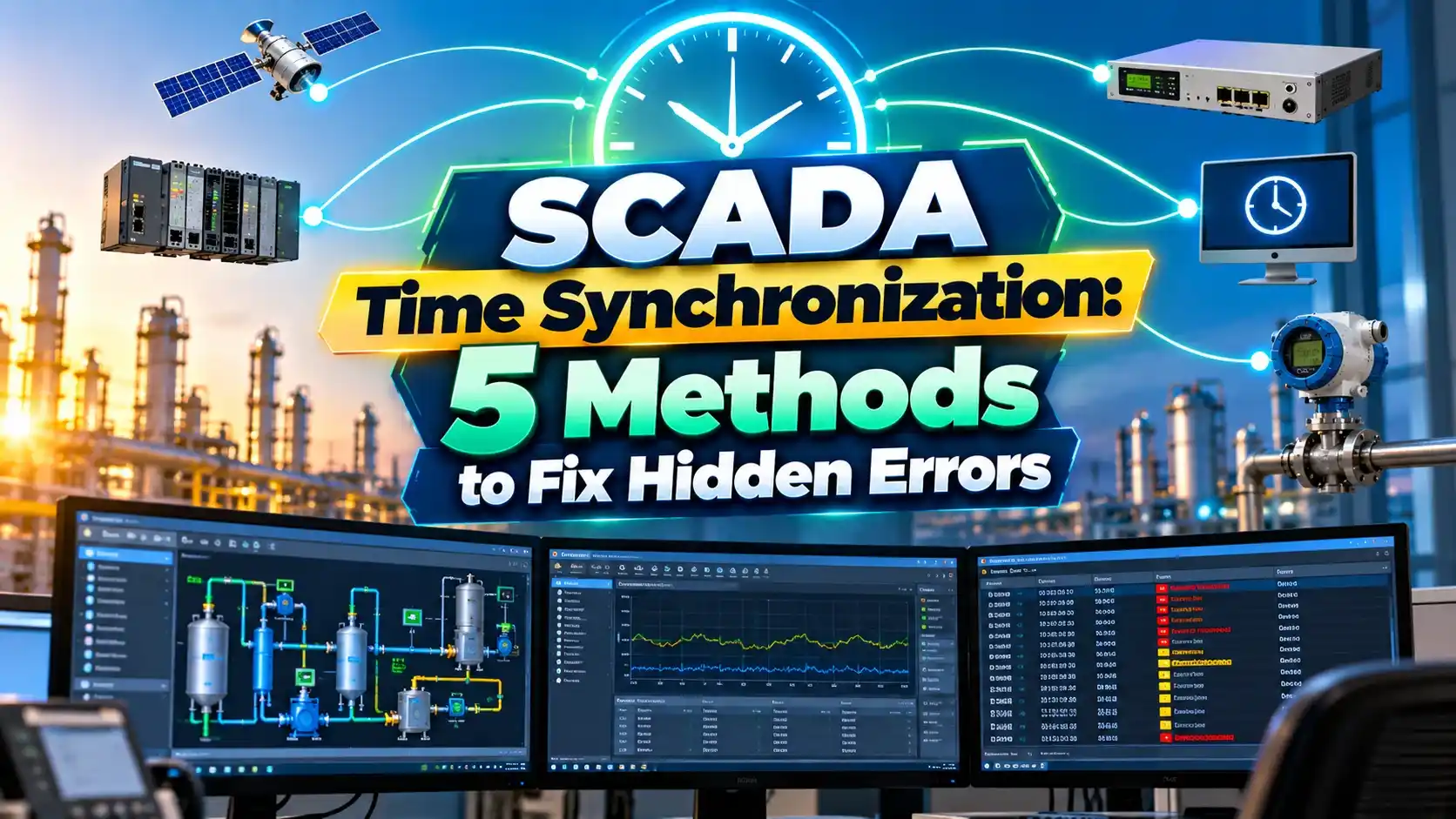
SCADA time synchronization keeps the clocks of servers, RTUs, PLCs and relays aligned to one reference. Without it, the event log can show a trip before its cause and send engineers down the wrong path.
What Is SCADA Time Synchronization?
SCADA time synchronization is the process of aligning the internal clocks of every device in a control system to a common, accurate time source. It lets the SCADA system place every alarm, event and trend sample on one shared timeline.
Each controller has a quartz clock that drifts by several parts per million. Left alone, two devices can disagree by seconds within days, which ruins event analysis.

Accurate time is essential for sequence of events recording, where the order of trips a few milliseconds apart tells you what failed first. It also matters for historian data, energy billing and regulatory reports.
Substations and power plants need the tightest accuracy because protection relays operate within milliseconds. Water and oil pipelines can usually live with looser limits.
5 Time Synchronization Methods
Network Time Protocol over Ethernet, typically 1 to 10 ms on a LAN.
Simplified NTP used in small devices with lighter processing.
Hardware timestamped protocol reaching 1 to 10 µs, and below 1 µs with good design.
Dedicated time code cable from a clock to each device.
Satellite receiver that provides the master reference for all other methods.
NTP and SNTP run over the normal network, so they are cheap and easy. PTP needs switches that support it to reach its full accuracy.
IRIG B needs separate wiring but gives accurate time to devices without network timing support. Many sites use a mix of methods fed from one GPS clock.
How NTP and PTP Differ
NTP clients ask a server for the time and estimate network delay from the round trip. Software timestamping and variable delay limit accuracy to milliseconds.
PTP adds hardware timestamps at the network port and uses boundary or transparent clocks in switches. This removes most delay uncertainty and reaches microsecond accuracy.
For large networks, check that your SCADA and DCS network switches support PTP before choosing it. Without that support, PTP accuracy drops close to NTP levels.
Clock Drift Formula With a Worked Example
Worked example:
Quartz clock error = 20 ppm
20 ppm = 20 µs per second
Per hour: 20 µs × 3600 = 72 ms
Per day: 20 µs × 86400 = 1.728 s
If NTP corrects every 64 seconds:
Maximum drift between syncs = 20 × 64 = 1280 µs = 1.28 ms
The example shows why a free running clock becomes useless within a day. Regular synchronization keeps drift tiny between corrections.
Shorter poll intervals reduce drift but add network load. Most SCADA designs balance the two with intervals between 16 and 1024 seconds for NTP.
Accuracy Needed by Application
| Application | Typical Need | Suitable Method |
|---|---|---|
| SCADA servers and HMI | About 10 ms | NTP |
| RTU event logging | About 1 ms | SNTP or NTP with GPS |
| Protection relays | Below 1 ms | IRIG B or PTP |
| Digital substation sampled values | About 1 µs | PTP |
| Historian trends | About 1 s | NTP |
| Motion control | Below 1 µs | PTP |
Digital substations built on IEC 61850 use PTP for sampled values. Their merging units must align current and voltage samples within microseconds.
Telemetry protocols also carry time. DNP3 and IEC 60870 5 104 include time sync commands and timestamps on every event.
4 Steps to Design SCADA Time Synchronization
Redundant GPS clocks protect against antenna faults and lightning damage. Good clocks also hold time accurately for hours if satellite signals are lost.
Treat time servers as critical assets in your SCADA network security plan. A spoofed time source can confuse logs and hide an attack.
Where Accurate Time Matters Most
A process historian merges data from many controllers. Without good SCADA time synchronization, trends from two sites can look out of step even when the process was steady.
Always store time in UTC inside devices and convert to local time only on displays. This avoids confusion at daylight saving changes in other countries.
Clock Drift Calculator
Compare the result with the accuracy your application needs. If the drift is close to that limit, shorten the interval or use a better method.
- Correct order of alarms and events.
- Faster root cause analysis.
- Reliable historian correlation.
- Compliance with grid and audit rules.
- Devices left on local time instead of UTC.
- Switches that do not support PTP.
- Single GPS clock without backup.
- Unmonitored devices drifting silently.
NTP and PTP in SCADA White Paper
IEEE 1588 PTP Video Lesson
SCADA Time Synchronization FAQ
Related Articles
- Sequence of Events Recording in DCS
- How SCADA Systems Work
- IEC 61850 Substation Automation
- SCADA Historian Integration
- SCADA Redundancy Architecture
External References
- PTP vs NTP in Industrial Networks and SCADA, Mikrodev
- Time Synchronization in Substation Automation, EEP
- Precision Time Protocol, Wikipedia
- Network Time Protocol, Wikipedia
- NTP Referenced SCADA Synchronization, SoC e
What We Learn Today
- Accurate shared time lets alarms and events line up in the correct order.
- NTP gives millisecond accuracy, while PTP and IRIG B reach microseconds.
- A GPS reference, capable switches and offset monitoring keep the system trustworthy.