TOC Analyzer Working Principle and Water Quality Applications

Share:
Process Analyzers
TOC Analyzer Working Principle and Water Quality Applications

A TOC analyzer measures the mass of carbon bound in organic compounds dissolved in a water sample. It is a key water quality parameter in pharmaceutical manufacturing, semiconductor fabrication, and wastewater treatment.

All TOC analyzers work by the same three-step process: remove or quantify inorganic carbon, oxidise all remaining organic compounds to CO2, and measure the CO2 produced to calculate the TOC concentration.

TOC vs TC vs IC Combustion Oxidation UV Persulfate NDIR Detection Pharmaceutical Water

TOC is expressed in mg/L or ppb. Ultrapure water for semiconductor fabrication must contain less than 1 ppb TOC.

Pharmaceutical purified water under USP 643 must be below 500 ppb. Potable water limits are typically below 2 mg/L.

Hello everyone, today we are going to learn about the TOC analyzer working principle and its water quality applications.

We will cover what TOC, TC, and IC mean, the three main oxidation methods used in TOC analyzers (combustion, UV persulfate, and wet chemical), how CO2 is detected after oxidation, the calibration procedure, and the key industrial and regulatory applications of online TOC monitoring.
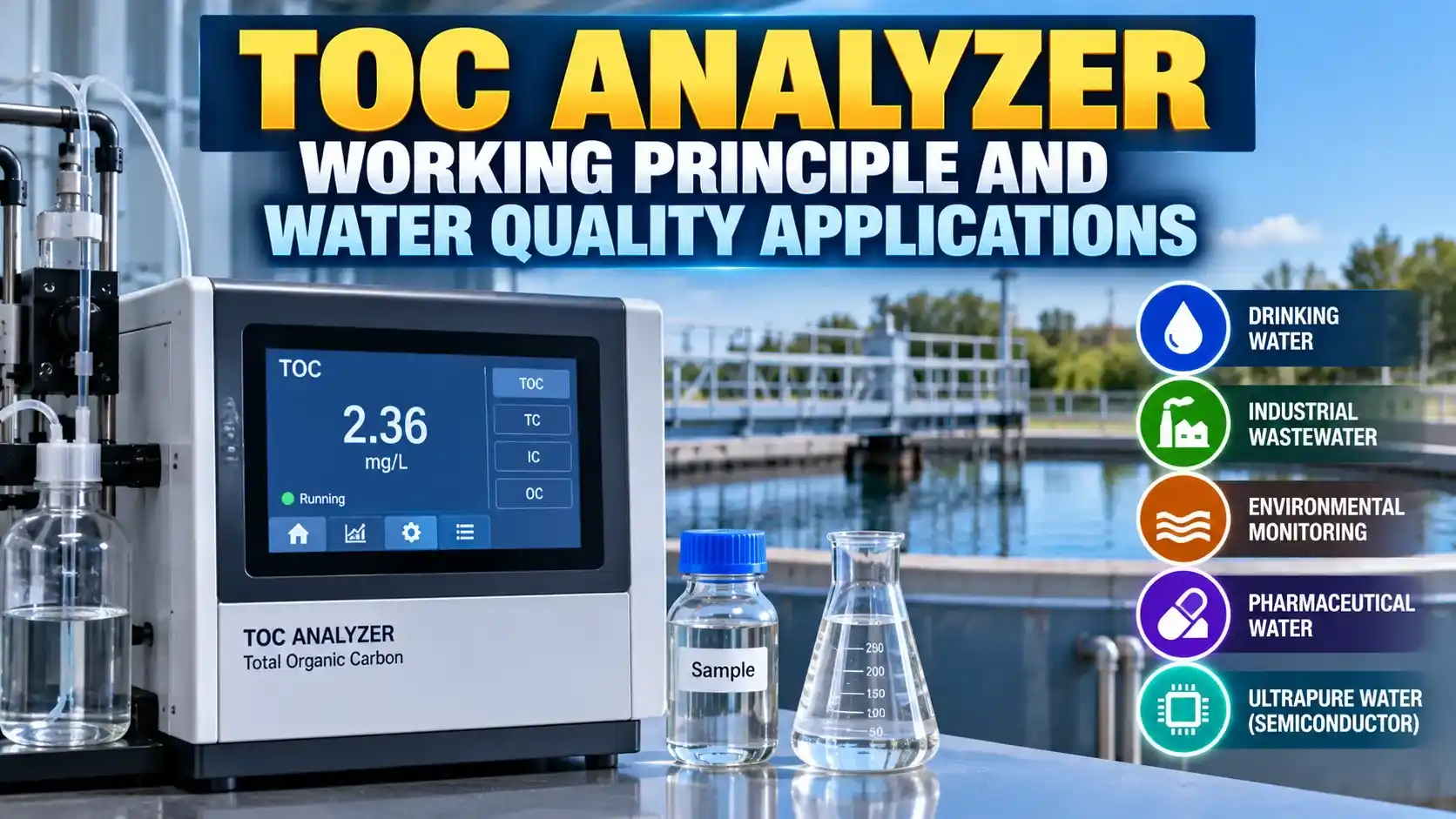
TOC analyzer

What Is TOC and How Does It Differ from TC and IC?

Total Carbon (TC) is the sum of all carbon-containing species in a water sample: organic and inorganic. The inorganic carbon (IC) fraction comes mainly from dissolved CO2, bicarbonates, and carbonates.

TOC is the carbon bound in organic compounds.

The relationship is: TOC = TC minus IC

A TOC analyzer either measures TC and IC separately and calculates the difference, or removes IC by acidifying and sparging before oxidation (the NPOC method). Most online analyzers use NPOC.

Dissolved organic carbon (DOC) is TOC measured on a filtered sample (0.45 micron filter). In most treated water applications, TOC and DOC are used interchangeably because particulates are negligible.

Advertisement

Three Oxidation Methods Used in TOC Analyzers

The oxidation method determines how organic compounds in the water sample are converted to CO2 for measurement. Each method has different oxidation efficiency, matrix suitability, and detection limit.

Combustion Oxidation (680 degrees C)

The water sample is injected into a combustion furnace at 680 to 900 degrees C packed with a platinum catalyst. All organic compounds are oxidised to CO2 at this temperature.

Best for: high TOC samples (0.5 to 30,000 mg/L), samples with complex matrices, samples with high particulate content. Used in environmental labs and industrial wastewater.

UV Persulfate Oxidation

The water sample is acidified to convert IC to CO2 and sparged to remove it. Persulfate reagent is added and the sample is irradiated with UV light.

Hydroxyl radicals from UV photolysis of persulfate oxidise organic compounds to CO2.

Best for: low to medium TOC (0 to 25 mg/L), clean water matrices (pharmaceutical, semiconductor, drinking water). Most common method in online process TOC analyzers.

Wet Chemical Oxidation

The water sample is combined with a strong oxidising reagent (persulfate, dichromate, or ceric sulfate) and heated to 100 to 130 degrees C. The reagent oxidises organic compounds to CO2.

Best for: online monitoring of industrial wastewater with moderate TOC, matrices where UV absorption would reduce the persulfate method's efficiency (coloured or turbid samples).

Three Steps Every TOC Analyzer Follows

Step 1: IC removal
The sample is acidified (typically with hydrochloric or phosphoric acid) to convert all inorganic carbonate and bicarbonate species to CO2 gas. This CO2 is then removed by sparging the sample with nitrogen or purified air for a fixed time. After sparging, the only carbon remaining in the sample is the organic fraction. This step is skipped in some combustion analyzers that measure TC and IC separately and calculate TOC by subtraction.
Step 2: oxidation
The IC-free sample is oxidised by one of the three methods above. For combustion oxidation, the sample is injected into the high-temperature furnace via a syringe. For UV persulfate, persulfate reagent is injected into the sample stream and UV lamps irradiate the flowing sample in a spiral or helical quartz coil. For wet chemical, the sample is mixed with reagent and heated in a reaction chamber. All methods convert organic carbon to CO2.
Step 3: CO2 detection
The CO2 produced in Step 2 is stripped from the sample by an inert carrier gas (nitrogen or oxygen-free air) and passed to the detector. The CO2 concentration in the carrier gas is measured and converted to a TOC reading by the analyzer's calibration curve. The signal conditioning guide covers the 4-20 mA output used to transmit the TOC reading to the DCS. The two most common detection methods are NDIR (Non-Dispersive Infrared, which measures CO2 at 4.26 microns) and membrane conductometry (where CO2 permeates a gas-permeable membrane into a DI water stream and is measured as a conductivity change).

CO2 Detection Methods: NDIR vs Membrane Conductometry

ParameterNDIR DetectionMembrane Conductometry
PrincipleCO2 absorbs infrared light at 4.26 microns. The reduction in transmitted IR intensity is proportional to CO2 concentration. Uses the same NDIR cell principle as the gas analyzers discussed in the NDIR article.CO2 permeates a hydrophobic gas-permeable membrane from the liquid sample into a pure water stream. The dissolved CO2 lowers the conductivity of the pure water stream. The conductivity change is measured and converted to CO2 concentration.
Detection range0.1 mg/L to thousands of mg/L depending on cell path length and sample flowSub-ppb (0.001 mg/L) to approximately 25 mg/L. Preferred for ultrapure water TOC measurement at ppb levels.
SensitivityGood for process water and wastewater (ppm range)Excellent for ultrapure and pharmaceutical water (ppb range). Can detect less than 0.1 ppb TOC.
Matrix sensitivitySome gases in the carrier stream (H2O, SO2) can interfere with the 4.26 micron CO2 band. A membrane dryer removes moisture before the NDIR cell.Only CO2 permeates the hydrophobic membrane. Other gases and dissolved species do not cross, giving high selectivity. Temperature control of the conductivity cell is critical.
Typical applicationIndustrial wastewater, environmental monitoring, drinking water, process water (0.1 to 1000 mg/L range)Pharmaceutical water (USP 643), semiconductor ultrapure water, high-purity process water where TOC must be below 500 ppb
Advertisement

TOC Analyzer Calibration and Validation

TOC analyzers are calibrated using certified reference standard solutions. The most widely used calibration standard is sucrose or potassium hydrogen phthalate (KHP) dissolved in ultrapure water to a known TOC concentration.

Zero calibration
Ultrapure water (TOC below the detection limit of the analyzer, typically below 0.1 ppb) is used as the zero standard. For analyzers using reagents, the reagent blank must also be characterised. The blank TOC contribution from the reagent is subtracted from all readings. Reagent-free methods (combustion) do not have a reagent blank but must use a blank water standard that is verified to be below the method detection limit.
Span calibration
A certified KHP or sucrose standard at a concentration within the measurement range is prepared in TOC-free water. For a 0 to 500 ppb range, a 200 to 400 ppb standard is typically used. The analyzer is adjusted so its reading matches the certified standard concentration. KHP is preferred over sucrose for pharmaceutical applications because it is stable and traceable as a primary standard. Sucrose is used by some manufacturers because it represents a range of molecular weights typical of process contamination.
System suitability (USP 643)
Under USP standard 643 for Pharmaceutical Waters, system suitability must be demonstrated before each use. This requires passing three tests: the reagent water test (TOC of the system water below 500 ppb absolute or below 0.10 times the TOC of the standard), the standard solution test (standard recovery between 85 and 115%), and the sucrose solution test which confirms oxidation efficiency. The sucrose test specifically challenges the oxidation step because sucrose is harder to oxidise than the KHP calibration standard.
Calibration interval
Online process TOC analyzers in continuous service are typically calibrated every 4 to 12 weeks depending on the application. Pharmaceutical analyzers under GMP regulation may require daily system suitability and weekly or monthly full calibration, with records maintained for the duration specified by the quality management system. Calibration is also required after any maintenance that affects the measurement path: pump replacement, reagent change, lamp replacement, or cell cleaning.
KHP vs sucrose as a TOC calibration standard: Potassium hydrogen phthalate (KHP) is easy to prepare, highly stable, and available as a primary standard. It oxidises readily in most TOC methods. Sucrose is used as a system suitability check rather than the primary calibration standard in USP 643 because it is a larger, more complex molecule that tests whether the oxidation method is performing efficiently. An analyzer that reads correctly on KHP but reads low on the sucrose system suitability check has an oxidation efficiency problem, not a calibration problem. This distinction is important when troubleshooting a failing system suitability test.

Water Quality Applications of TOC Analyzers

Pharmaceutical water
USP standard 643 (Total Organic Carbon) mandates TOC monitoring of Purified Water (PW) and Water for Injection (WFI) in pharmaceutical manufacturing. The limit for both is 500 ppb (0.5 mg/L). Online TOC monitors are installed at the point of use in PW/WFI distribution loops and feed a SCADA or DCS system that triggers an alarm and can close a divert valve to prevent out-of-spec water from reaching a critical process. See the conductivity sensor guide for the complementary conductivity limit monitoring that accompanies TOC in pharmaceutical water systems.
Semiconductor fabrication
Ultrapure water (UPW) used in semiconductor wafer rinsing must achieve TOC below 1 ppb to prevent organic contamination of the silicon wafer surface. Even sub-ppb levels of organic compounds can affect photolithography, gate oxide quality, and die yield. Online TOC analyzers with membrane conductometry detection are installed at multiple points in the UPW distribution loop and at the tool inlet. A single point out-of-spec triggers an immediate alert to the fab operations team.
Drinking water
TOC in drinking water is monitored as a surrogate for disinfection by-product (DBP) precursors. Organic compounds in raw water react with chlorine during disinfection to form trihalomethanes (THMs) and haloacetic acids (HAAs), which are regulated carcinogens. The US EPA Surface Water Treatment Rule sets TOC removal targets based on raw water TOC and alkalinity. Online TOC analyzers at water treatment plant inlets and after coagulation/filtration allow operators to optimise coagulant dose and verify TOC removal before disinfection.
Industrial wastewater
TOC is used as an alternative to Chemical Oxygen Demand (COD) and Biochemical Oxygen Demand (BOD) in wastewater monitoring because it provides a continuous, real-time measurement without the 5-day incubation required for BOD. A correlation between TOC and COD or BOD is established empirically for a specific wastewater matrix, then the online TOC reading is used to infer COD or BOD continuously for consent monitoring or process control. Online TOC analyzers at the consent monitoring point provide immediate warning of a discharge exceedance before the sample reaches the regulator's monitoring point.
Power plant boiler water
In power plant condensate and boiler feed water, TOC is a measure of organic contamination that can cause foaming, corrosion, and deposits in the boiler. Organic compounds entering the boiler water system break down to organic acids (formic acid, acetic acid) at high temperatures, which lower the pH of the condensate and attack the steam-water circuit. Online TOC monitoring of condensate return identifies contamination events quickly, before the affected condensate reaches the boiler drum.
Coolant water monitoring
Cooling water TOC monitoring tracks organic growth (biofilm, algae, organic process leaks) and biocide consumption in cooling towers and heat exchanger systems. A rising TOC trend in a closed cooling system that cannot be explained by inlet water quality indicates either a process fluid leak into the cooling circuit or biological growth in the system. Both are serious fouling and corrosion risks. TOC monitoring gives earlier warning than turbidity or conductivity alone for organic-source contamination. See the turbidity measurement guide for the complementary suspended solids monitoring used alongside TOC in cooling systems.

Watch: How TOC Analyzers Work

Advertisement

TOC Analyzer Questions Engineers Ask

What does a TOC analyzer actually measure?
A TOC analyzer measures the mass of carbon in organic compounds dissolved in water, reported as mg/L or ppb. It does not identify which compounds are present. All organic carbon is converted to CO2 by oxidation, and the CO2 is measured. TOC is a sum parameter indicating total organic contamination regardless of source.
What is the difference between the TC minus IC method and the NPOC method in TOC analysis?
The TC minus IC method measures total carbon, then measures inorganic carbon separately by acid sparge, and calculates TOC by subtraction. The NPOC method acidifies and sparge-strips IC first, then oxidises and measures the remaining carbon directly as TOC. NPOC is simpler and faster and is preferred where IC content is low.
Why is sucrose used in the USP 643 system suitability test instead of KHP?
KHP is easy to oxidise and stable as a primary standard. Sucrose is harder to fully oxidise and tests oxidation efficiency. An analyzer reading correctly on KHP but low on sucrose has an oxidation efficiency problem that KHP calibration alone would not detect.
What is the TOC limit for pharmaceutical Purified Water and Water for Injection?
USP standard 643 sets the limit at 500 ppb (0.5 mg/L) for both Purified Water (PW) and Water for Injection (WFI). The European Pharmacopoeia sets the same limit. Online TOC monitors in pharmaceutical water distribution loops provide continuous monitoring against this limit and must have validated calibration and system suitability records.
Can a TOC analyzer replace COD or BOD measurement in wastewater monitoring?
TOC provides continuous, real-time measurement while COD requires 2 to 3 hours and BOD requires 5 days. TOC can replace these in process control if a site-specific TOC to COD or TOC to BOD correlation is validated. This correlation converts the continuous TOC reading to an inferred COD or BOD value for consent monitoring.

Related Articles on This Site

External References

Advertisement

What We Learn Today

  • TOC equals Total Carbon minus Inorganic Carbon. A TOC analyzer removes IC by acid sparge, oxidises organic compounds to CO2 by combustion, UV persulfate, or wet chemical oxidation, then measures the CO2 by NDIR or membrane conductometry. The oxidation method determines the measurement range and matrix suitability.
  • NDIR covers ppm-range TOC in process and environmental water. Membrane conductometry achieves sub-ppb detection for pharmaceutical and semiconductor ultrapure water. USP 643 system suitability requires both KHP and sucrose standards, with acceptance criteria for pharmaceutical water monitoring.
  • Key applications include pharmaceutical PW and WFI (USP 643 limit 500 ppb), semiconductor ultrapure water (limit 1 ppb), drinking water TOC for disinfection by-product control, industrial wastewater as a COD/BOD surrogate, power plant condensate, and cooling water organic contamination monitoring.
I hope you like above blog. There is no cost associated in sharing the article in your social media. Thanks for reading!! Happy Learning!!

Leave a Reply

Your email address will not be published. Required fields are marked *