
The control valve body is the pressure-containing shell that houses the trim and determines the flow path.
Selecting the wrong body type leads to excessive pressure drop, cavitation, vibration, or a body that cannot be maintained in the installed position.
This guide covers the four main body types, their working principles, key applications, and a selection tool.
The globe control valve body is the most common type in process plants. It gives excellent throttling control, high rangeability, and predictable flow characteristics.
The other body types solve specific problems (erosion, space, mixing, or cost) that the globe body handles less well.
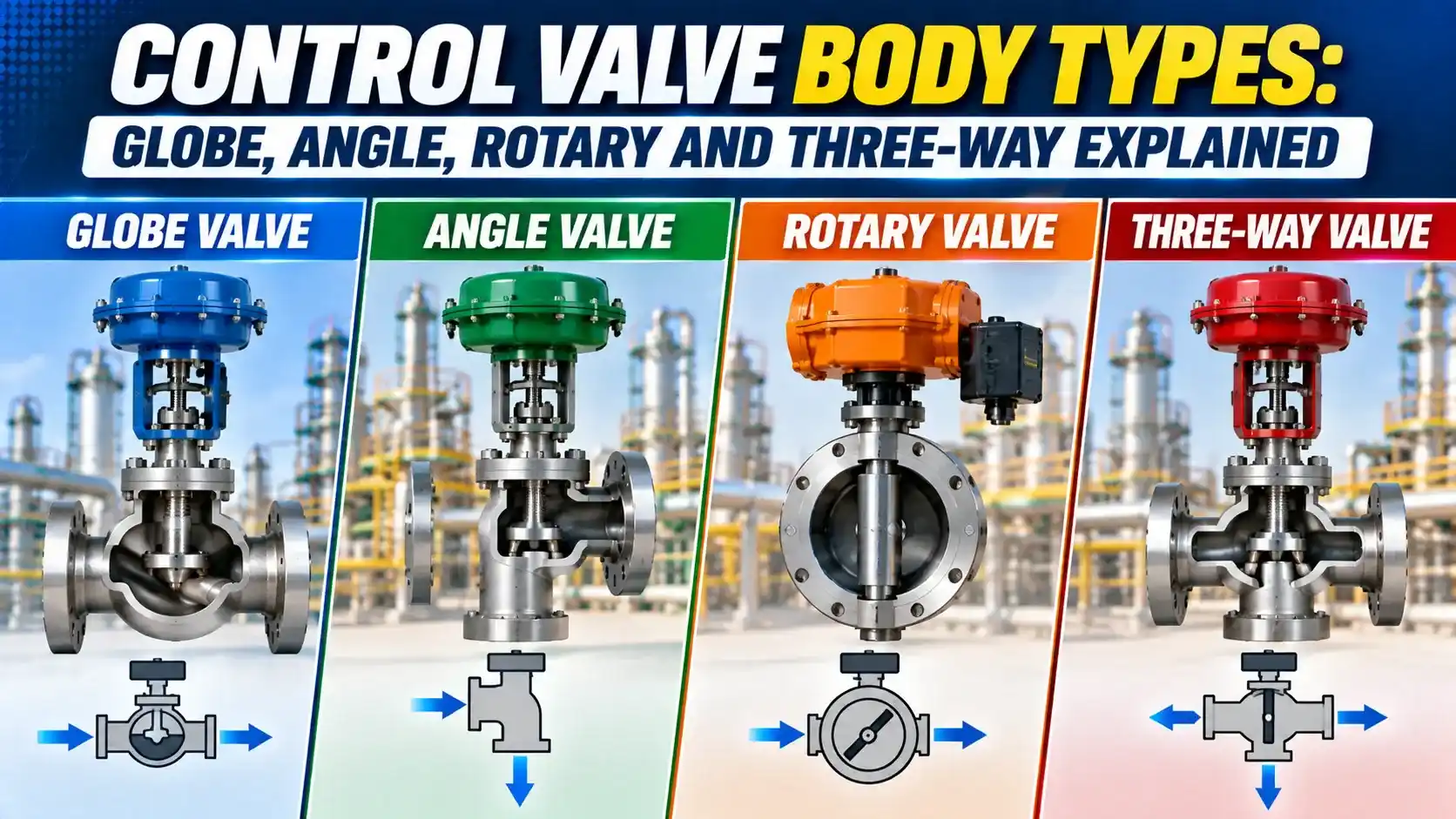
Control Valve Body: What It Is and Why It Matters
A valve body has three functions: it contains the process pressure, it directs the flow path past the trim, and it connects the valve to the pipeline.
The body type is defined by the angle between the inlet and outlet connections and the direction of plug or disc travel.
This geometry sets the pressure recovery factor (FL), velocity distribution, and installation orientation. See the control valve parts guide for how body, trim, bonnet, and actuator connect.
FL is the ratio of the actual pressure drop across the valve at choked flow to the pressure drop at the vena contracta. Globe control valve bodies have FL values of 0.85 to 0.95 — meaning they recover very little pressure after the vena contracta, which is why they can throttle effectively across a wide range.
Rotary types have FL values of 0.55 to 0.75. They are more prone to choked flow and cavitation at lower pressure drops than globe bodies, which matters during valve sizing calculations.
Four Body Types Explained
The globe body has an S-shaped internal flow path. Inlet and outlet are in line, but flow is directed up through the seat, reversed, then back down and out.
This internal reversal creates the throttling action as the plug moves toward or away from the seat.
Throttling performance: Excellent. The plug moves perpendicular to the flow, giving a predictable relationship between position and flow area.
Rangeability of 50:1 is achievable with contoured plugs. Flow characteristic (equal percentage, linear, quick opening) is determined by plug shape.
Pressure drop distribution: High. The internal flow reversal concentrates the pressure drop at the trim — intentional for control accuracy.
This also means this body absorbs more permanent pressure loss than a rotary body of the same Cv.
Typical applications: Temperature control, flow control, pressure letdown, general-purpose process control. The globe body is the default selection when no specific reason favours another body type.
A single-plug globe body on high-pressure letdown concentrates all the DP at one throttling point, creating very high fluid velocity and rapid erosion of the seat and plug.
Multi-stage trim splits the pressure drop across several restrictions in series, keeping velocity at each stage below the erosion threshold.
Modern globe control valve bodies are more often cylindrical or rectangular in external shape, but the name has remained in common use for well over a century.
The defining characteristic of a globe body is not its outer shape but the S-shaped internal flow path with a horizontal seat ring and a vertically moving plug.
An angle control valve body has inlet and outlet at 90° to each other. Flow enters horizontally and exits vertically downward, with the plug moving vertically to throttle against the seat.
Why use an angle body: The 90° flow path eliminates the internal reversal of a globe body, giving a straighter, less turbulent path.
This makes the angle body more suitable for erosive slurries, flashing fluids, and high-velocity applications where a globe body would suffer severe erosion.
Self-draining: With the outlet pointing downward, the angle body drains completely on shutdown.
This is important for hygienic applications and for services where residual fluid would freeze or cause contamination.
Typical applications: Slurry control, flashing liquid service, high-pressure steam desuperheating, vacuum systems, and installations where piping must change direction at the valve location anyway, making the 90° body a more compact solution.
In this orientation, the flash zone (where pressure drops below vapour pressure and bubbles form) is at the outlet, which is in the larger downstream pipe — not trapped inside the narrow valve trim where it would cause cavitation damage.
See the cavitation and flashing guide for how to diagnose and prevent this damage.
A rotary control valve body has a disc or ball that rotates 90° between closed and open.
The most common types are the butterfly valve, the V-port ball valve, and the eccentric rotary plug valve.
Unlike the globe body, the rotary body uses a quarter-turn actuator — not a sliding stem.
This gives high torque efficiency and allows large pipe diameters to be controlled with a smaller, lighter actuator.
Butterfly body: A disc rotates about a central shaft.
At 60 to 70° open, the disc generates turbulence around its edges. Triple-offset designs achieve rangeability of 20:1 to 50:1 and tight shutoff.
V-port ball body: A V-shaped notch in the ball rotates against a seat ring, giving equal-percentage characteristic and up to 300:1 rangeability.
Suitable for erosive slurries and fibrous media where a globe trim would block.
Eccentric rotary plug body: The plug moves in an arc — swinging away from the seat as it opens, seating with high force as it closes.
This gives tight shutoff with minimal friction throughout travel. Examples: Camflex (Masoneilan) and Vee-Ball (Fisher).
For pipe sizes above 6 inches (DN150), a rotary body is almost always specified unless the process specifically requires globe-body characteristics (tight shutoff to ANSI Class V or VI, equal percentage trim, or multi-stage pressure letdown).
See the butterfly vs ball valve guide for the detailed comparison within rotary body types.
The first offset: the shaft is off-centre horizontally. The second offset: the shaft is off-centre axially. The third offset: the seat is conical rather than planar.
Together, these offsets mean the disc makes contact with the seat only at the last fraction of a degree of closing rotation — with no sliding friction throughout the 0 to 89° travel. This gives both tight shutoff (Class V or VI) and unlimited cycle life without seal wear.
A three-way control valve body has three pipe connections: one common port and two alternate ports. It uses a single actuator to split or combine flow between two streams.
There are two operating modes: mixing (two inlets, one outlet) and diverting (one inlet, two outlets).
The same three-way body can often be used for both, but trim and flow direction are specified differently at the time of order.
Mixing mode application: Temperature control of a heat exchanger by blending hot and cold supply streams in varying proportions.
As the plug moves, the hot-to-cold ratio changes, controlling the mixed outlet temperature at constant total flow.
Diverting mode application: Bypass control — directing varying amounts of fluid through a heat exchanger while the remainder bypasses it. Total flow stays constant while the proportion through the exchanger changes.
If one inlet pressure is significantly higher than the other, the higher-pressure stream will force back through the lower-pressure inlet when the plug is near that side — causing flow instability and control oscillation.
If inlet pressures are unequal, use a two-valve arrangement with individual control valves on each stream instead of a single three-way body.
This means that in a mixing three-way valve, when the plug is at one extreme, the full flow comes from inlet A with zero from inlet B — and when at the other extreme, the full flow comes from inlet B with zero from A.
The total Cv of the three-way body is not doubled: as one flow path opens, the other closes proportionally, so the combined Cv follows the selected trim characteristic (usually linear for temperature mixing applications).
Control Valve Body Types: Side-by-Side Comparison
| Parameter | Globe Body | Angle Body | Rotary Body | Three-Way Body |
|---|---|---|---|---|
| Flow path | S-shaped (180° in, 180° out, reversed internally) | 90° turn (in line, out at right angle) | Straight-through (disc or ball rotation) | T-shaped (one common, two alternate ports) |
| Plug/disc travel | Linear (sliding stem, perpendicular to seat) | Linear (sliding stem, perpendicular to seat) | Rotary (90° quarter-turn) | Linear (sliding stem, alternates between two seats) |
| Rangeability | 50:1 (contoured plug) | 50:1 (same trim as globe) | 20:1 to 300:1 (design dependent) | 50:1 (linear characteristic per side) |
| FL (pressure recovery factor) | 0.85 to 0.95 | 0.85 to 0.90 | 0.55 to 0.75 (butterfly/ball) | 0.80 to 0.90 |
| Pressure drop handling | High: concentrates DP at trim | High: similar to globe, but straighter flow path | Lower: less internal restriction | Similar to globe |
| Slurry / erosive fluids | Poor: internal reversal traps solids | Good: straight-through flow path | Good (V-port ball): solids pass through | Not recommended |
| Self-draining | Only if specifically oriented | Yes (outlet-down orientation) | Depends on orientation | Only if specifically oriented |
| Size range | DN15 to DN300 typical | DN15 to DN200 typical | DN50 to DN1200 (butterfly) | DN15 to DN150 typical |
| Relative cost | Medium | Medium | Lower at large sizes | Higher (two-seat trim) |
| Best for | General process control, high DP, tight shutoff | Flashing, slurry, desuperheating, self-draining | Large diameter, low DP, fibrous media, on-off with throttling | Temperature mixing, bypass diverting at constant total flow |
Body Type Selector
Watch: Control Valve Types — Sliding Stem and Rotary Explained
FAQ: Control Valve Body Types
External References
- Control Valve Handbook — Chapter 2: Valve Body Assemblies | Emerson Fisher (5th Edition)
- Selecting the Right Control Valve Body Type | ISA InTech Magazine
What We Learn Today
- The globe control valve body is the standard choice: S-shaped flow path, 50:1 rangeability, FL of 0.85 to 0.95, and wide trim availability. Use it for general throttling at small to medium pipe sizes.
- Use an angle body for flashing liquids and slurry service. Use a rotary body for large pipe diameters (DN150 and above). Use a three-way body for mixing or diverting two streams at constant total flow.
- The pressure recovery factor FL determines cavitation risk: globe bodies (FL 0.85 to 0.95) are more resistant than rotary bodies (FL 0.55 to 0.75) at the same process conditions.