
A DCS can run several control strategies in parallel. PID handles most single-loop regulatory control. Cascade improves disturbance rejection by nesting two loops. Ratio maintains a proportional relationship between two flows. Feedforward corrects for a known disturbance before it reaches the controlled variable.
This guide covers all four with block diagrams, worked examples, and an interactive DCS control strategy selector.
These control strategies are not interchangeable. PID reacts after the process deviates. Feedforward acts before. Cascade tightens control against secondary disturbances. Ratio locks the relationship between two process streams. Each strategy solves a different problem.
DCS Control Strategies: Why One Loop Is Often Not Enough
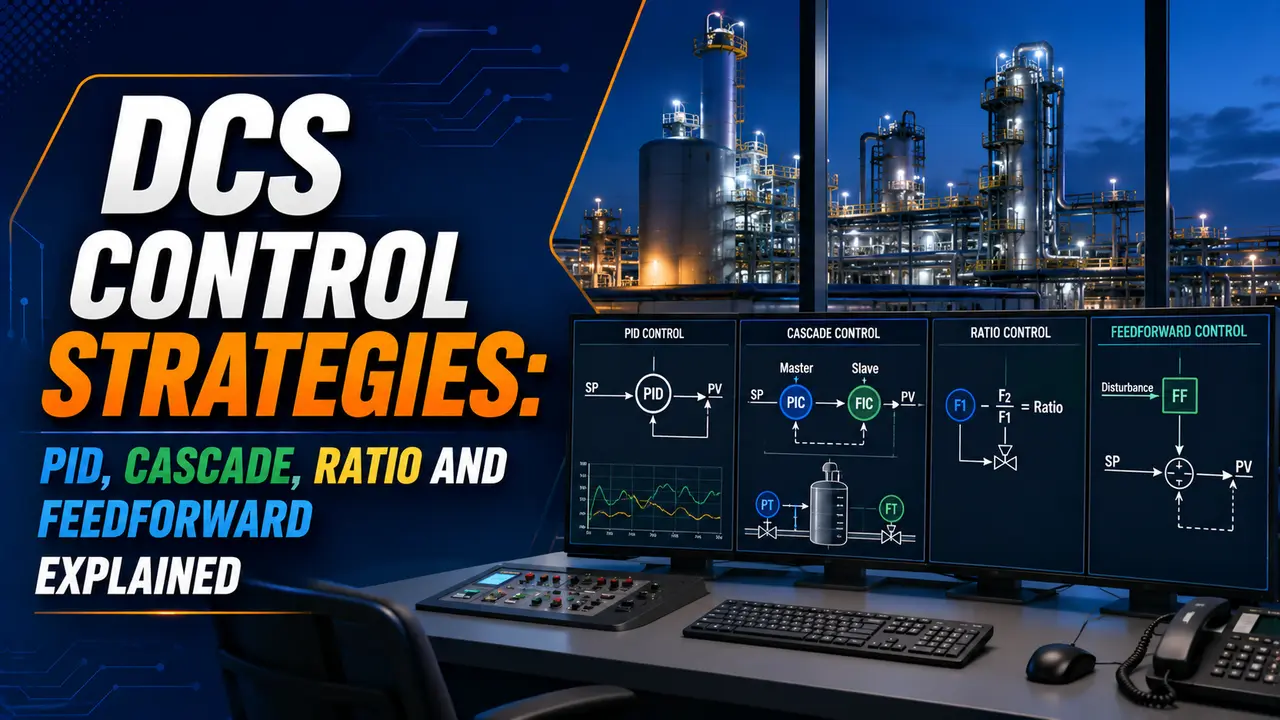
A basic PID loop measures one variable, compares it to a setpoint, and adjusts one output. That covers most regulatory control needs in a plant.
But some processes need more. A reactor with slow temperature response needs cascade control. A combustion air system tracking fuel flow uses ratio control.
A heat exchanger with variable inlet temperature needs feedforward control. Click any term to expand.
The 4 DCS Control Strategies Explained
1. PID Control -- The Foundation of DCS Regulatory Control
The PID controller compares the process variable (PV) to the setpoint (SP). The difference is the error (E). The three PID terms -- Proportional, Integral, and Derivative -- each react to the error and together produce the output to the final element (FE).
Ki: Integral gain -- eliminates steady-state offset over time
Kd: Derivative gain -- reacts to rate of change, reduces overshoot
E: Error = Setpoint minus Process Variable
PID is correct for most single-input, single-output loops where the process responds predictably to the manipulated variable. It handles slow disturbances well.
Its limitation is response speed. PID can only react after the PV has already deviated from setpoint.
When a fast disturbance arrives -- for example, sudden feed composition change -- PID allows a large transient before correcting. See the PID controller types guide and the PID tuning guide.
2. Cascade Control -- Faster Disturbance Rejection
Cascade control nests two PID loops. The primary (outer) controller measures the main variable -- for example, reactor temperature. Its output becomes the setpoint for the secondary (inner) controller.
The secondary controller corrects disturbances in the inner loop before they reach the outer loop.
The key design rule: the secondary loop must respond 3 to 10 times faster than the primary loop. If both loops have similar response speeds, cascade adds complexity without benefit. See the cascade control guide for a full worked example.
| Loop | Measures | Controls | Example |
|---|---|---|---|
| Primary (outer) | Reactor temperature (slow) | Setpoint of secondary | Temperature controller output = jacket flow SP |
| Secondary (inner) | Jacket flow (fast) | Flow control valve | Flow controller maintains jacket flow at the SP from primary |
A disturbance in jacket supply pressure changes the flow immediately. The secondary loop corrects it in seconds. The primary temperature loop never sees the disturbance -- it has been corrected before it could affect the reactor temperature.
3. Ratio Control -- Proportional Stream Tracking
Ratio control keeps two flows in a fixed proportion. One flow (the wild flow) is measured but not directly controlled.
The DCS multiplies the wild flow by the target ratio R to compute the setpoint for the controlled flow controller.
Ratio R: operator-entered target ratio (e.g. 2.5 kg air per kg fuel)
Controlled Flow SP: setpoint fed into the second flow controller (e.g. combustion air)
The most common application is combustion air control. Fuel gas is the wild flow.
The DCS multiplies the fuel flow by the air to fuel ratio to compute the air flow setpoint. The air flow controller tracks it. See the ratio control guide.
Ratio control is also used for reactant blending (maintaining stoichiometric feed ratios), dilution water control (tracking product flow to maintain concentration), and mixing two streams to a target composition.
4. Feedforward Control -- Acting Before the Disturbance Arrives
Feedforward measures a disturbance variable (DV) and applies a correction to the manipulated variable before the disturbance affects the controlled variable.
It does not close a feedback loop -- it is an open loop correction added on top of a PID controller.
A heat exchanger outlet temperature is controlled by steam flow. The main disturbance is variation in the inlet flow.
A feedforward element measures the inlet flow and corrects the steam valve position when the inlet changes. The feedback PID handles the remaining error.
Feedforward Correction: open loop correction based on measured disturbance (e.g. inlet flow change)
Both signals sum to give the final valve position
Feedforward requires a model of how the disturbance affects the process. The simplest model is a gain (ratio): if inlet flow increases by 10%, increase steam by 8%. More complete models include dead time and lead lag compensation to match the process dynamics.
Feedforward never works perfectly -- process models are never exact. That is why the PID feedback loop is always kept in place to correct the residual error. The combination of feedforward plus feedback is the tightest achievable control with conventional DCS control strategies.
DCS Control Strategy Selector
Comparing All 4 Control Strategies
| Strategy | How it works | Acts when | Best for | Limitation |
|---|---|---|---|---|
| PID | Reacts to error (SP minus PV) | After PV deviates | Most single loops, slow disturbances | Cannot anticipate fast disturbances |
| Cascade | Outer loop sets SP for inner loop | After secondary PV deviates | Slow primary with fast secondary variable | Secondary must be 3 to 10 times faster than primary |
| Ratio | Controlled flow = Wild flow times R | Every scan, tracking wild flow | Combustion, blending, dilution | Does not correct for composition -- flow ratio only |
| Feedforward | Corrects MV based on measured disturbance | Before PV is affected | Fast, measurable, significant disturbances | Needs a process model; never standalone |
Real Plant Applications of Each Strategy
Boiler Drum Level (Three Element Control)
A classic combination of control strategies. Feedforward measures steam demand. Cascade controls feedwater flow as the inner loop, with drum level PID as the outer loop.
Together they handle the shrink and swell effect. See DCS function block programming for implementation.
Reactor Temperature Control
Outer loop: reactor temperature. Inner loop: cooling water flow or jacket temperature.
Cascade is ideal here -- the jacket responds in seconds while the reactor changes over minutes. A cooling water pressure disturbance is corrected by the inner loop without the reactor ever seeing it.
Combustion Air Control
Ratio control tracks the fuel gas flow and generates the combustion air setpoint. The ratio R is set by the operator. See the ratio control guide.
Heat Exchanger Outlet Temperature
Feedforward measures the inlet flow. When flow increases, the DCS immediately increases steam flow before temperature drops.
Without feedforward, PID alone allows a temperature dip on every rate change. The DCS historian records transients to validate the feedforward benefit.
Watch: Cascade Control: DCS Loop Nesting Explained
DCS Control Strategies Questions
External References
- Beyond PID: 6 Advanced Control Strategies -- Control Engineering
- Feedforward Control Explained -- ProcessControlGuide.com
What We Learn Today
- PID is the foundation strategy -- reacts to error after the PV deviates from setpoint
- Cascade nests two loops -- inner loop must be 3 to 10 times faster than outer; tune inner first
- Ratio control makes the controlled flow track the wild flow in proportion: SP = Wild Flow times R
- Feedforward corrects for a measured disturbance before the PV is affected -- always combined with PID
- Three element boiler drum level control combines all three advanced strategies at once
- Selecting the right DCS control strategy depends on the disturbance type, speed, and measurability