
A generator sized for the running load alone can pass every check on paper and still fail the moment the biggest motor on site tries to start.
Starting current, not steady-state demand, is what actually stalls an undersized genset.
How to calculate generator size for an industrial load means sizing for the larger of two numbers: total running demand at the site's power factor, or the starting kVA needed to launch the largest motor without excessive voltage dip.
Most generator failures in industrial settings aren't from running overload. They happen the instant a large motor starts, when current can spike to 5 to 7 times its running value.
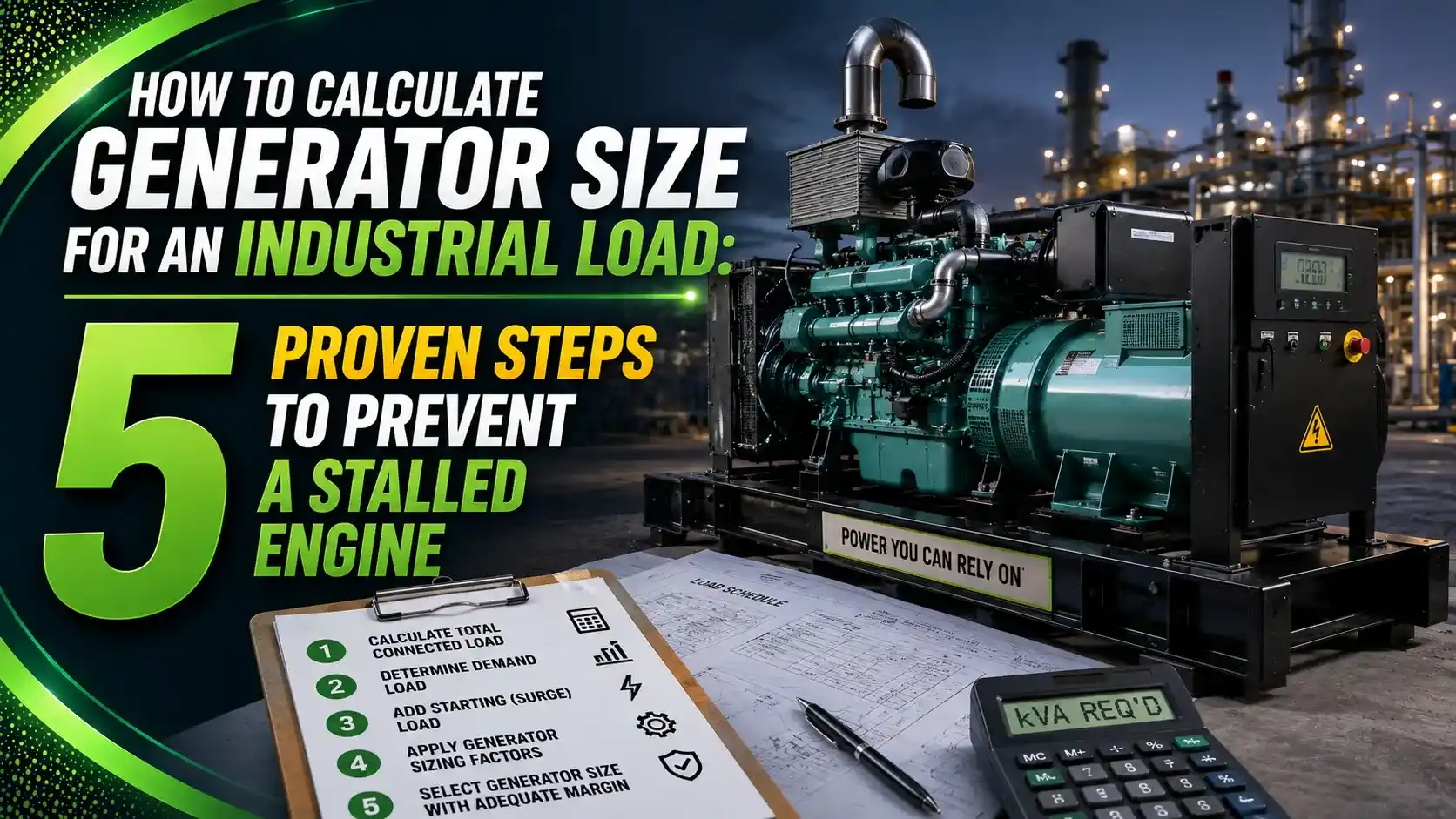
If the alternator can't supply that surge, voltage collapses, the excitation system loses control, and the engine stalls under the sudden mechanical load.

The 5 Steps to Calculate Generator Size
Work through these steps in order, since each one can change which number ultimately governs the final size.
List Every Load, Running and Starting
Sum nameplate kW for all loads that could run simultaneously, and separately note each motor's starting characteristics.
Apply a Diversity Factor
Not everything runs at once. Use roughly 0.6 to 0.85 for mixed industrial loads depending on how continuous the process is.
Calculate Starting kVA for the Largest Motor
Identify the biggest single starting event and calculate its kVA demand at the actual starting power factor.
Take the Larger of the Two Results
Compare running kVA against starting kVA. The generator must satisfy whichever number is bigger.
Apply Site Derating and Spare Capacity
Account for altitude, ambient temperature, and future load growth before finalizing the selection.
Running Load vs Starting Load
These represent two completely different demands on the same machine.
Running Load
Steady-state demand once everything is up and running. Usually the smaller number, but it's continuous.
Starting Load
A brief but severe transient, often 5 to 7 times running current at a very low power factor during motor start.
Why Undersized Generators Stall
The failure sequence is mechanical, not just electrical, and it happens fast.
Voltage dip during motor starting should generally stay below 15 to 20 percent. Push past that and other running equipment, drives, contactors, control relays, can trip or reset well before the engine itself gives up.
Sizing Formulas and a Worked Example
Both running and starting requirements reduce to a kVA figure that the generator must be able to supply.
PF = power factor (use about 0.8 for mixed industrial loads)
Example: 350 kW MCC, 0.6 diversity, largest motor 100 kW, SCR = 6
Running load = 350 x 0.6 = 210 kW -> 210 / 0.8 = 262.5 kVA
Starting kVA = 100 x 6 x 1.2 = 720 kVA
Governing requirement: 720 kVA (starting) -> select 875 kVA with margin
Starting Multiplier by Motor Starting Method
How a motor starts changes the generator sizing dramatically.
| Starting Method | Typical Multiplier | Starting Power Factor |
|---|---|---|
| Direct-On-Line (DOL) | Approximately 2x motor kW minimum, often more | 0.15 to 0.30 lagging |
| Soft Starter | Approximately 1.2 to 1.3x motor kW | Improved over DOL |
| Variable Frequency Drive (VFD) | Approximately 1.1 to 1.15x motor kW | Best of the three methods |
Site Derating: Altitude and Temperature
Unlike a transformer, a generator's engine derates because thinner air reduces combustion oxygen, not because of cooling or insulation.
| Condition | Typical Derating |
|---|---|
| Naturally aspirated diesel, per 1000 ft above sea level | Approximately 3 to 4% output loss |
| Turbocharged diesel, per 1000 ft above sea level | Approximately 1 to 2% output loss |
| High ambient temperature | Manufacturer-specific curve, consult datasheet |
Where Correct Generator Sizing Matters Most
Motor Control Centers
Multiple motors with a dominant largest-motor starting event.
Hospitals
NEC Article 700 emergency systems with life safety loads.
Data Centers
Low power factor, harmonic-rich UPS and cooling loads.
Oil and Gas Sites
Remote, often high altitude installations needing derating.
Water and Wastewater
Large pump motors with harsh DOL starting duty cycles.
Manufacturing Plants
Compressors and conveyor motors starting on a staggered schedule.
Do's and Don'ts of Generator Sizing
✓ Do
- Size for the larger of running kVA and starting kVA, never running alone
- Use the actual starting method's multiplier, not a generic rule of thumb
- Apply altitude and temperature derating for the actual installation site
- Sequence large motor starts where possible to reduce peak starting demand
✗ Don't
- Assume a generator's kW rating alone covers a low power factor load
- Ignore voltage dip limits when multiple large motors start together
- Ship a generic sizing result without verifying against manufacturer software
- Forget that DOL starting can demand 2 to 3 times the motor's running kW
Live Generator Sizing Calculator
Enter running load, power factor, diversity, and the largest motor's starting details to estimate the required generator kVA.
Load Dump: The Opposite Failure Mode
Undersizing isn't the only risk. Sudden loss of a large load, a main breaker tripping open, creates the reverse problem entirely.
In island mode, if 100 percent of the load disappears instantly, the engine can overspeed since there's no longer any mechanical resistance from the alternator.
Manufacturers specify load dump capability, typically the ability to shed 100 percent of load for 10 to 15 seconds without tripping. This needs the same careful review as motor starting during the design phase, not an afterthought.
Reference Materials on Generator Sizing
FAQs on How to Calculate Generator Size for an Industrial Load
External References
- Generator Sizing Guides, Generator Source
- How to Calculate What Size Generator You Need, General Power
- Sizing an Industrial Generator: The Ultimate Guide, Kinsley Group
- Basic Sizing for Mobile Generators, Generac
- A Brief Guide to Interpreting a SpecSizer GenSet Sizing, Caterpillar
What we learn today
- How to calculate generator size for an industrial load means comparing running kVA against motor starting kVA and sizing for whichever is larger.
- Direct-on-line motor starting can demand 2 to 3 times the motor's running kW, while soft starters and VFDs need far less.
- Undersized generators stall because voltage collapse during motor starting overwhelms the excitation system, not from steady overload.
- Voltage dip during the largest motor start should generally stay below 15 to 20 percent to protect other running equipment.
- Generators derate with altitude because thinner air reduces combustion oxygen, roughly 3 to 4 percent per 1000 feet for naturally aspirated diesel engines.