
A control valve that passes its factory leak test can still fail badly in the field.
The difference usually comes down to whether the right leakage class was specified in the first place.
Control valve seat leakage classes under ANSI/FCI 70-2 define exactly how much fluid a valve is allowed to leak once it's fully closed, using six standardized grades from loose to bubble tight.
Every control valve leaks a little when closed. That's simply a mechanical fact, since a moving plug can never seal as perfectly as a solid wall.
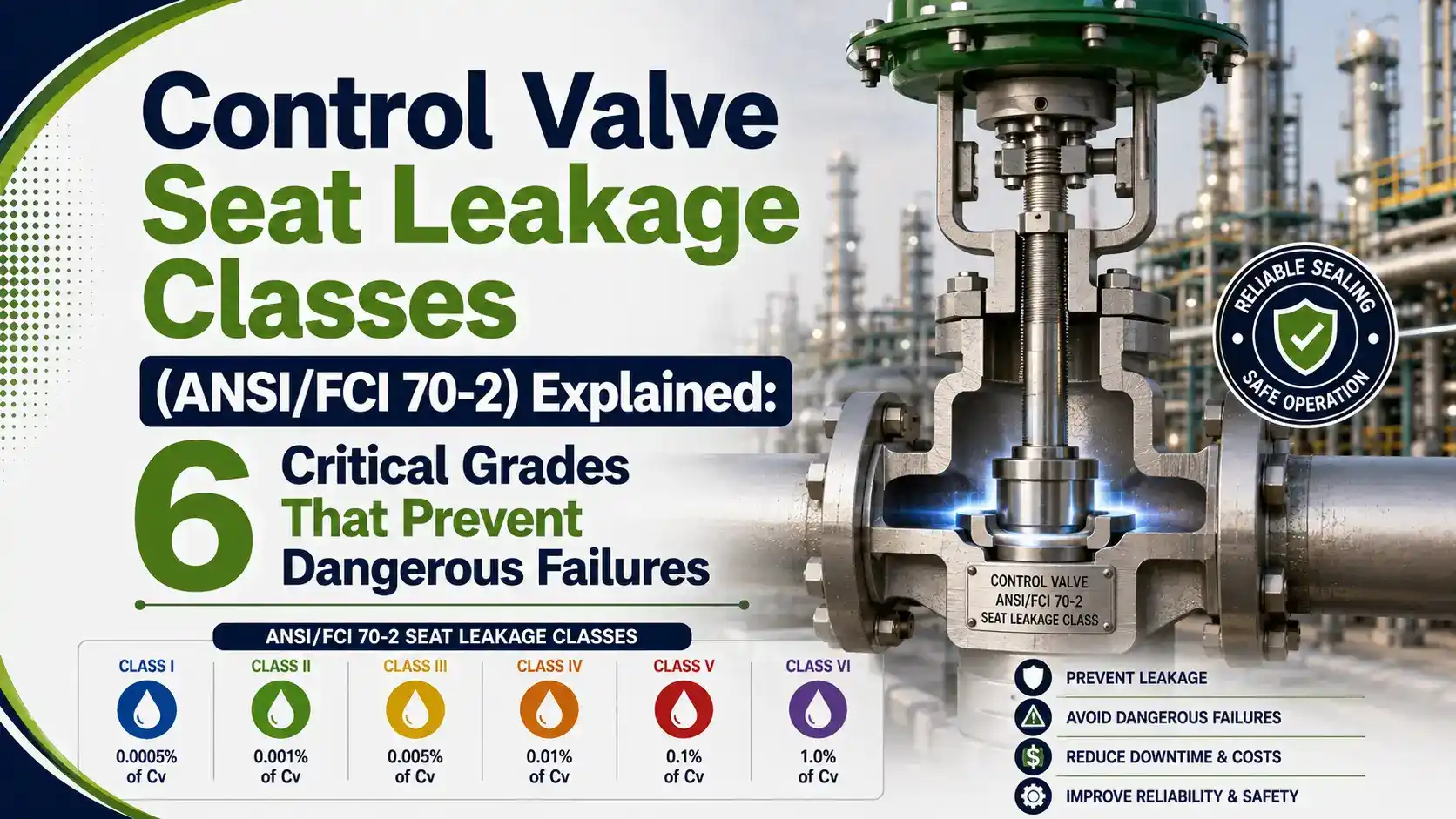
ANSI/FCI 70-2 exists to put a number on that leakage. It's the standard almost every manufacturer, EPC, and end user references when specifying shutoff performance.
The standard defines six classes, labeled I through VI. Each one sets a maximum allowable leakage rate, tested a specific way, for a specific type of valve construction.
The 6 ANSI/FCI 70-2 Control Valve Seat Leakage Classes
Here are all six classes, in order from loosest to tightest.
Class I: No Required Test
Same design intent as Class II, III, or IV, but no shop leak test is performed by agreement between user and supplier.
Class II: 0.5% of Rated Capacity
Typical of commercial double seat valves or balanced single seat valves with a piston ring seal.
Class III: 0.1% of Rated Capacity
Same basic construction as Class II, but built to a tighter seat and seal tolerance.
Class IV: 0.01% of Rated Capacity
The standard for most metal seated single seat control valves in general industrial service.
Class V: A Precise Volumetric Limit
Set as 0.0005 mL of water per minute, per inch of port diameter, per psi of differential pressure. Needs lapped metal seats.
Class VI: Bubble Tight, Soft Seated
Measured in bubbles per minute using air or nitrogen. Requires a resilient seat material like PTFE.
Metal Seated vs Soft Seated: Which Classes Apply
Not every valve construction can reach every class. The seat material draws a hard line partway through the list.
Metal Seated Valves
Can reach Class II through Class V. Class V needs hardfaced, precision lapped seats to hold that volumetric limit.
Soft Seated Valves
Reach Class VI using PTFE, RTFE, PEEK, or elastomer seating. Not suited to very high temperatures.
Why Actuator Thrust Decides Whether a Valve Actually Meets Its Class
A valve rated Class V on paper still needs real mechanical force to achieve that rating in the field.
The plug has to be driven hard into the seat to crush any microscopic gap. That force comes entirely from the actuator.
A valve engineered for Class V will perform like a Class IV, or worse, if the actuator's final seating thrust is undersized. The leakage class on the datasheet means nothing without the force to back it up.
Class V Leakage Formula and Worked Example
Class V is defined by an exact formula, not a percentage of flow capacity.
D = port diameter in inches
ΔP = differential pressure in psi across the closed valve
Example: D = 4 inches, ΔP = 500 psi
Q = 0.0005 x 4 x 500
Q = 1.0 mL per minute
Control Valve Seat Leakage Class Comparison Table
Here's how all six classes compare side by side, including the test method used for each.
| Class | Max Leakage | Test Medium | Typical Seat Type |
|---|---|---|---|
| I | No test required | N/A | Same as II, III, or IV |
| II | 0.5% of rated Cv | Air or water, 45 to 60 psi | Metal to metal |
| III | 0.1% of rated Cv | Air or water, 45 to 60 psi | Metal to metal |
| IV | 0.01% of rated Cv | Air or water, 45 to 60 psi | Metal to metal |
| V | 0.0005 mL/min per inch per psi | Water at max operating dP | Lapped metal seat |
| VI | Bubbles per minute by port size | Air or nitrogen, up to 50 psi | Soft seat (PTFE, elastomer) |
Class VI Bubble Rate by Port Diameter
Class VI leakage scales with valve size. A bigger port is allowed more bubbles per minute.
| Nominal Port Size | Max Bubbles per Minute |
|---|---|
| 1 inch or smaller | 1 |
| 1.5 to 2 inch | 2 to 3 |
| 3 inch | 6 |
| 4 inch | 11 |
| 6 inch | 27 |
| 8 inch | 45 |
Live Class V Seat Leakage Calculator
Enter port diameter and differential pressure to calculate the maximum allowable Class V leakage rate.
Where Each Leakage Class Gets Specified
Class II/III
General utility water, air, and steam services where minor leakage is acceptable.
Class IV
Standard modulating loops: temperature, pressure, and flow control.
Class V
High pressure steam letdown and boiler feedwater level control.
Class VI
Toxic gas, hazardous chemical, and ESD valve isolation service.
Refining
Hydrocarbon processing units needing tight shutoff on shutdown.
Power Generation
Steam turbine bypass and drain valve applications.
ANSI/FCI 70-2 vs API 598: Not the Same Standard
Engineers sometimes specify FCI 70-2 classes on gate or globe isolation valves. That's a mistake worth avoiding.
FCI 70-2 was written specifically for control valves that throttle. API 598 governs on and off valves meant for true isolation.
Mixing the two leads to the wrong test procedure being applied. It can also create a false sense of confidence in a valve's actual shutoff performance.
If a project genuinely needs zero visible leakage, API 598 is the correct standard to call out, not FCI 70-2.
Do's and Don'ts When Specifying Seat Leakage Class
✓ Do
- Match the class to the actual process risk, not the tightest option available
- Size the actuator's final seating thrust to the manufacturer's stated requirement
- Install a dedicated block valve if true isolation, not just control, is needed
- Specify Class V for high differential pressure steam and boiler feedwater service
✗ Don't
- Default to Class VI everywhere regardless of temperature limits
- Assume a control valve can replace a proper isolation valve for LOTO
- Ignore actuator sizing when specifying a tight shutoff class
- Confuse ANSI/FCI 70-2 with API 598, which governs isolation valves instead
Reference Materials on Control Valve Seat Leakage
FAQs on Control Valve Seat Leakage Classes
External References
- ANSI/FCI 70-2 Informational Sheet, Fluid Controls Institute
- Control Valves, Leakage Classification, Engineering ToolBox
- Class Seat Leakage and Shutoff Detail, QRC Valves
- Fisher ET, EAT, and ETR Control Valve Bulletin, Emerson
- Fisher Control Valve Handbook, Fifth Edition, Emerson
What we learn today
- ANSI/FCI 70-2 defines 6 control valve seat leakage classes, from Class I with no test to Class VI, bubble tight.
- Classes II, III, and IV use a percentage of rated valve capacity, while Class V uses an exact volumetric formula and Class VI uses bubbles per minute.
- Metal seats reach up to Class V, while Class VI needs a soft seat material like PTFE.
- Actuator seating thrust is what actually delivers the rated leakage class in the field, not the seat design alone.
- ANSI/FCI 70-2 applies to control valves specifically, not isolation valves, which instead follow standards like API 598.