
A clean 50 or 60 Hz sine wave is what every piece of electrical equipment is designed around. Power harmonics are what happens when non linear loads quietly distort that wave, and left unmanaged, they cause real, expensive damage across a plant.
Power harmonics rarely announce themselves with a dramatic failure. They show up as a transformer running a little hotter than it should, a breaker that trips for no obvious reason, or a capacitor bank that keeps blowing fuses, long before anyone traces the problem back to power harmonics in the waveform itself.
Power harmonics are distortions of the electrical waveform caused by the presence of multiple frequencies layered on top of the fundamental supply frequency. They show up wherever non linear loads are present, battery chargers, personal computers, laser printers, variable speed motor drives, and switch mode power supplies among them.
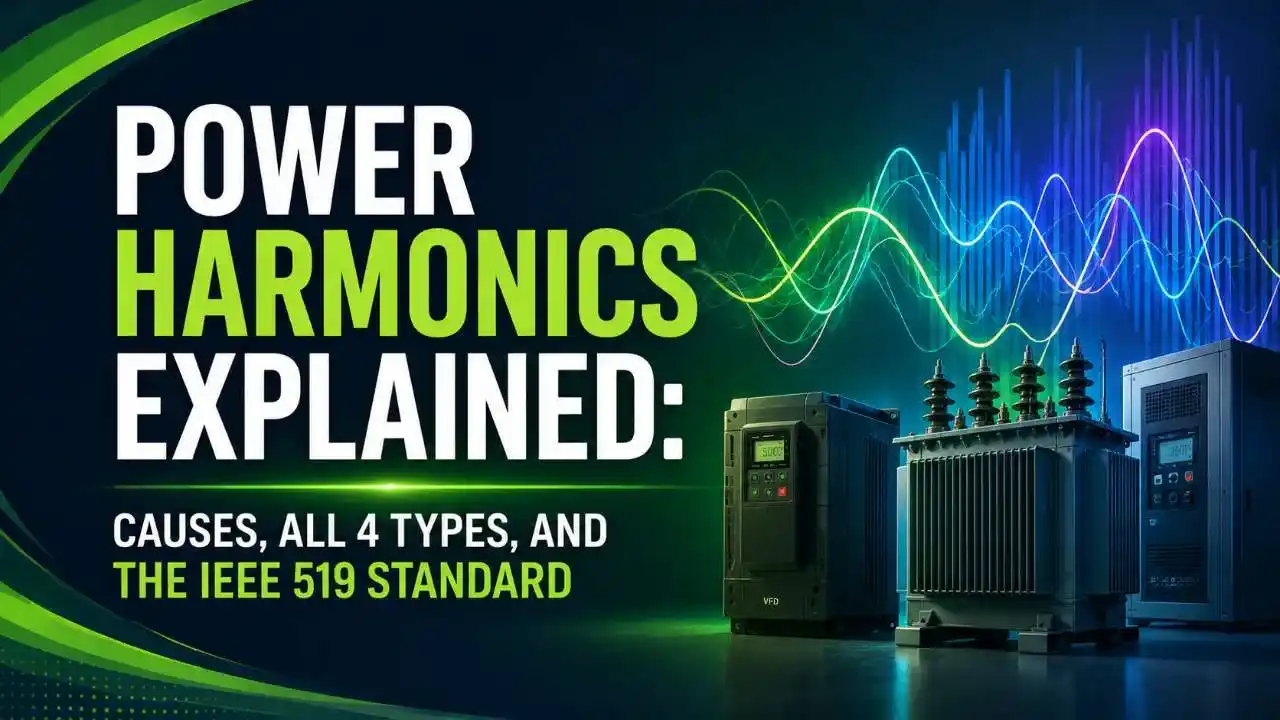
A load is called non linear specifically because the current it draws does not follow the same clean waveform as the supply voltage. This guide covers what causes power harmonics, all four core harmonic types, the damage high harmonic levels actually cause, and the IEEE 519 limits used to keep them in check.
What Causes Power Harmonics
Non linear loads draw current in short, irregular pulses rather than a smooth sine wave, and those pulses generate harmonic currents that distort the overall waveform across the system. Devices built around magnetic iron cores, transformers and generators among them, have traditionally been one of the biggest contributors to power harmonics.
Modern facilities add to this with variable frequency drives, LED lighting drivers, and computer power supplies, all of which draw current in the same non linear pattern that generates power harmonics throughout the electrical system.
The 4 Types of Power Harmonics
Every complex, distorted waveform can be broken down mathematically into a fundamental wave plus a series of harmonic components riding on top of it. The four illustrated below are the ones every electrical engineer needs to recognize by name.
Fundamental Harmonic (First Harmonic)
Base frequencyThe power supply's own base frequency, 50 Hz or 60 Hz depending on the grid, is the fundamental harmonic. Every electrical and electronic appliance is designed to operate at this frequency, and it is also referred to simply as the first harmonic.
Second Power Harmonic
Negative sequenceThe second power harmonic oscillates at 100 Hz, exactly double the fundamental frequency. When the fundamental reaches zero, the second harmonic sits at a high value, and vice versa, producing a negative sequence current in the circuit. It is also known as a negative sequence harmonic.
Illustrative waveform. Please replace with your preferred final graphic.
Third Power Harmonic
Zero sequence, triplenThe third power harmonic runs at three times the fundamental frequency, 150 Hz, and is considered especially harmful. It reaches zero at the same instant the fundamental does, producing zero sequence current in the system. This is why it is commonly called a triplen harmonic.
Illustrative waveform. Please replace with your preferred final graphic.
Fourth Power Harmonic
Positive sequenceThe fourth power harmonic runs at four times the fundamental, 200 Hz, and is a positive sequence harmonic. Third order or triplen harmonics do not cancel out the way positive sequence harmonics like the fourth and seventh, and negative sequence harmonics like the second and fifth, do. High inductive reactors are typically used to help stop third harmonic currents specifically.
Illustrative waveform. Please replace with your preferred final graphic.
Triplen harmonics, the third, sixth, and ninth, are the ones that do not cancel out across a balanced three phase system, which is exactly why they get singled out for special filtering while other harmonic pairs are left to cancel each other naturally.
Consequences of High Power Harmonics Levels
Left unmanaged, power harmonics cause motor and generator malfunctions, added efficiency losses across electrical equipment, unwanted breaker trips or blown fuses, disturbances in sensitive electronic equipment, and unexpected system resonances. The tables below summarize the most common failure patterns tied to power harmonics.
Current Harmonics Problems
| Equipment | Consequence |
|---|---|
| Transformers | Increased noise, possible insulation failure |
| Motors | Mechanical fatigue |
| Electronic loads | Disoperation |
Voltage Harmonics Problems
| Equipment | Consequence |
|---|---|
| Capacitors | Blown fuses, reduced capacitor life |
| Fuses and breakers | False or spurious operations, damaged components |
| Motors | Reduced motor life, inability to fully load the motor |
| Transformers | Increased copper losses, reduced capacity |
Watch: Harmonics and Three Phase Power Systems Explained
This video covers how harmonics from non linear loads affect three phase power systems and what mitigation looks like in practice.
Video: "Harmonics and Three Phase Power Systems Explained", via YouTube.
The IEEE 519 Standard for Power Harmonics
IEEE 519 sets voltage and current distortion limits for power harmonics at the point of common coupling, the interface between a utility and a customer. First introduced in 1981, the standard has been revised several times, with IEEE 519-2022 the current edition, following IEEE 519-1992 and IEEE 519-2014.
The standard establishes design goals for electrical systems containing both linear and non linear loads and describes exactly how the interface between sources and loads should be evaluated.
| Bus Voltage at PCC | Individual Harmonic (%) | Total Harmonic Distortion THD (%) |
|---|---|---|
| V at or below 1.0 kV | 5.0 | 8.0 |
| 1 kV to 69 kV | 3.0 | 5.0 |
| 69 kV to 161 kV | 1.5 | 2.5 |
| Above 161 kV | 1.0 | 1.5 |
How to Manage Power Harmonics in a Facility
A combination of monitoring and targeted hardware keeps power harmonics within safe limits without overspending on any single fix.
Continuous Monitoring
Track harmonic levels over time rather than relying on a single spot measurement.
Line Reactors
Add series inductance ahead of VFDs and other non linear loads to reduce harmonic current.
Harmonic Filters
Passive or active filters targeted at the specific harmonic orders causing the most trouble.
Detuned Capacitors
Capacitor banks paired with a series reactor to avoid resonance with harmonic frequencies.
Isolation Transformers
Separate sensitive loads from the harmonic sources elsewhere in the same system.
IEEE 519 Compliance Checks
Compare measured distortion against the applicable voltage class limits regularly.
FAQs on Power Harmonics
You May Also Like
What is Electromagnetic Interference (EMI)?
Harmonics and EMI are closely related distortion problems that often get confused. This guide explains what electromagnetic interference actually is, how it differs from harmonic distortion, and the shielding and grounding practices that help control it.
Read Full Article →What we learn today
- Power harmonics are waveform distortions caused by non linear loads such as VFDs, computers, and switch mode power supplies.
- The fundamental, second, third, and fourth harmonics each behave differently, with the third standing out as a zero sequence, triplen harmonic that does not cancel out.
- High harmonic levels damage transformers, motors, capacitors, and electronic loads through both current and voltage distortion pathways.
- IEEE 519 sets voltage distortion limits by voltage class at the point of common coupling, with tighter limits at higher voltages.
- Managing power harmonics takes continuous monitoring plus targeted tools like line reactors, harmonic filters, and detuned capacitor banks.