
A quiet shift is underway across the plant floor. Wireless pressure transmitters are cutting the cable and feeding entire IIoT systems with real-time data. Here is exactly how they work, how they fit into the bigger picture, and what to plan for before installing them.
A wireless pressure transmitter measures process pressure and sends that reading to a central system using radio signals instead of a wired connection.
That single change, removing the cable, is what makes these devices central to the Industrial Internet of Things. Data that once required expensive wiring runs can now reach a gateway, a cloud platform, and an operator's dashboard without a single wire leaving the transmitter.
How a Wireless Pressure Transmitter Actually Works
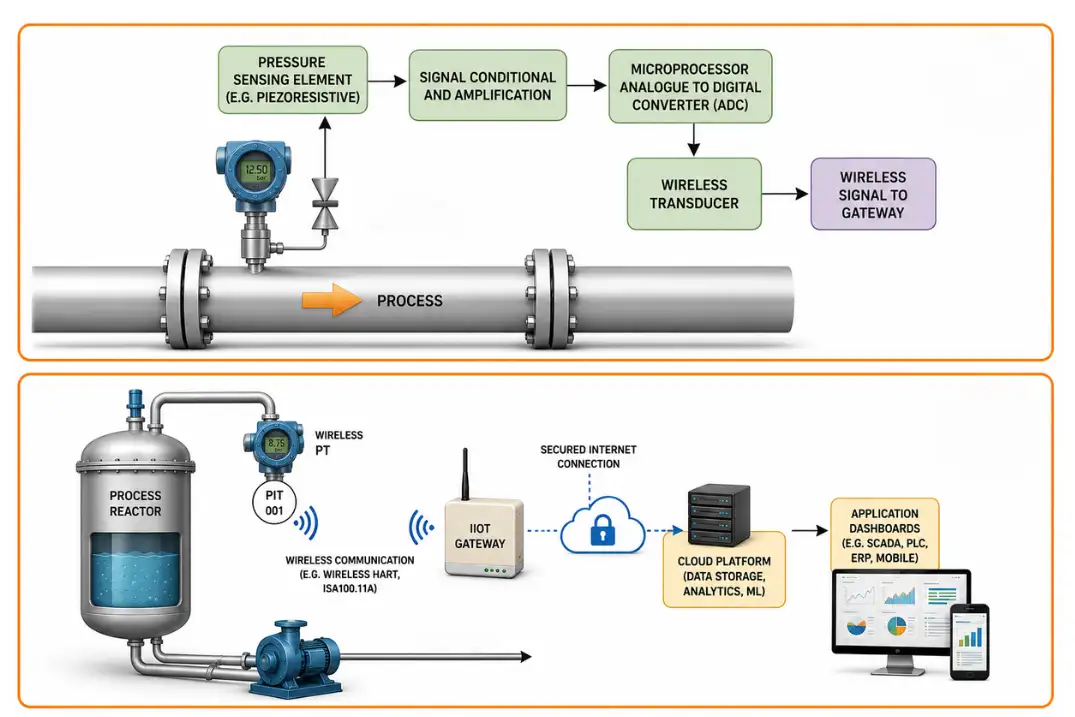
Everything starts with a sensing element that converts pressure into an electrical signal. Three sensor types show up most often in the field.
Piezoresistive
Process pressure deforms a diaphragm, which changes the resistance of embedded strain gauges. That resistance change is the raw pressure signal.
Capacitive
Pressure shifts a diaphragm sitting between two parallel plates, changing the distance between them and, with it, the capacitance.
Piezoelectric
Certain crystals generate their own electrical charge under mechanical stress, making them well suited to measuring fast, dynamic pressure changes.
Piezoresistive designs dominate general process pressure measurement, since they offer a good balance of accuracy and cost. Capacitive sensors tend to show up where very high precision matters, and piezoelectric types are reserved for genuinely fast-changing or vibration-related pressure signals.
Whichever sensor is used, the raw signal is weak and needs work. The transmitter's internal electronics condition it, amplify it, and convert it into a digital value.
The final step is where wireless technology takes over. A low-power radio transceiver broadcasts that digital reading out to a gateway or receiver, with no cable involved at any point.
Where It is used in Larger IIoT System
A wireless pressure transmitter never works alone. It is one link in a chain that carries data from the plant floor all the way to the cloud.
Field Devices
The wireless pressure transmitters themselves, mounted directly at the measurement point.
Wireless Network
The communication layer, typically WirelessHART or ISA100.11a, carrying data from transmitter to gateway.
Gateway
Collects readings from multiple transmitters, aggregates them, and passes the data on securely.
Cloud Platform
Stores the data at scale and runs the analytics, machine learning, and pattern detection that make IIoT valuable.
Applications and Control Systems
Dashboards for operators, and feedback into PLCs and SCADA systems for automated control actions.
WirelessHART vs ISA100.11a: The Two Dominant Standards
Two wireless standards handle almost all industrial pressure transmitter traffic today. Both use mesh networking and the 2.4 GHz ISM band, and both use frequency hopping to fight interference.
WirelessHART (IEC 62591)
An extension of the well-established HART protocol. It runs on a self-healing mesh network, so if one path fails, data automatically reroutes through another.
ISA100.11a
A flexible, scalable standard also built on mesh networking, designed to support a wide range of industrial applications beyond just pressure measurement.
Neither standard is objectively better across the board. The right pick usually comes down to what a plant's other instruments already use and which vendor ecosystem the facility is already invested in.
Why Go Wireless: The Real Advantages
The move to wireless is a deliberate engineering and financial decision, not just a trend.
Lower Installation Cost and Time
No cable trenching or conduit runs. Installation drops from days to hours.
Flexibility and Scalability
Adding a measurement point is as simple as mounting a transmitter and joining it to the network.
Better Predictive Maintenance
Monitoring assets once too costly to wire feeds the trend data predictive maintenance depends on.
Improved Safety
Less need to send personnel into hazardous areas, plus earlier warning of leaks or overpressure.
Better Decisions from More Data
More measurement points feeding data drives real gains in process optimization and equipment effectiveness.
Challenges Worth Planning For
None of these are reasons to avoid wireless, but each deserves real planning before rollout.
Power Management
Most wireless transmitters run on batteries. Battery life has improved significantly, but energy-efficient protocols and planning still matter, and energy harvesting is emerging as a longer-term fix.
Network Reliability and Interference
Industrial sites carry plenty of electromagnetic noise. A proper site survey during network planning is essential, even with a robust standard like WirelessHART or ISA100.11a.
Cybersecurity
Wireless transmission opens a new attack surface, so security needs to work at three levels together.
- Device-level: authentication and encryption at the transmitter itself
- Network-level: secure gateways, firewalls, and intrusion detection
- Data-level: encryption both in transit and at rest in the cloud
Integration with Legacy Systems
Connecting new wireless networks to older wired infrastructure and legacy control systems can get complicated without standardized protocols and multi-capability gateways.
Initial Investment
Transmitter and gateway hardware carries an upfront cost. The long-term return is usually strong, but that initial spend still needs justifying.
What Comes Next for Wireless Pressure Measurement
The technology is still moving quickly, and several trends are shaping where it goes next.
Smaller, Lower-Power Sensors
MEMS technology keeps shrinking sensors while cutting their power draw further.
Energy Harvesting
Future transmitters may draw power from vibration, heat, or ambient light, removing the battery entirely.
Edge Computing
More processing moves into the transmitter and gateway themselves, cutting how much data needs to reach the cloud.
AI and Machine Learning at the Edge
Transmitters may soon deliver real-time diagnostics and insights directly, not just raw pressure numbers.
Stronger Security Protocols
As threats evolve, wireless devices and networks will keep adding protection to match.
FAQs on Wireless Pressure Transmitters
What we learn today
- A wireless pressure transmitter senses pressure using a piezoresistive, capacitive, or piezoelectric element, then broadcasts the reading by radio instead of by wire.
- It fits into a five-stage IIoT chain: field device, wireless network, gateway, cloud platform, and applications or control systems.
- WirelessHART and ISA100.11a are the two dominant mesh-based standards carrying this traffic today.
- The real advantages are lower installation cost, faster deployment, better predictive maintenance, improved safety, and richer data for decisions.
- The real challenges are battery power, network interference, layered cybersecurity, legacy integration, and upfront investment, all planning problems rather than reasons to avoid the technology.