
Every IC gets classified along three separate axes at once, by signal type, by fabrication method, and by transistor count, and mixing those axes up is where most confusion starts. Here is exactly how integrated circuits are classified, with a real integration-level chart and a live IC classifier tool you can try right now.
What is an Integrated Circuit?
An integrated circuit, or IC, is a complete electronic circuit, active and passive components together, fabricated as a single unit on a small chip of semiconductor material, almost always silicon.
Before ICs existed, building even a modest circuit meant wiring together individual active and passive components by hand, one connection at a time. An IC replaces that entire assembly with a single fabricated chip, and understanding how those chips get classified is essential background for working with parts like operational amplifiers and voltage regulator ICs covered previously.
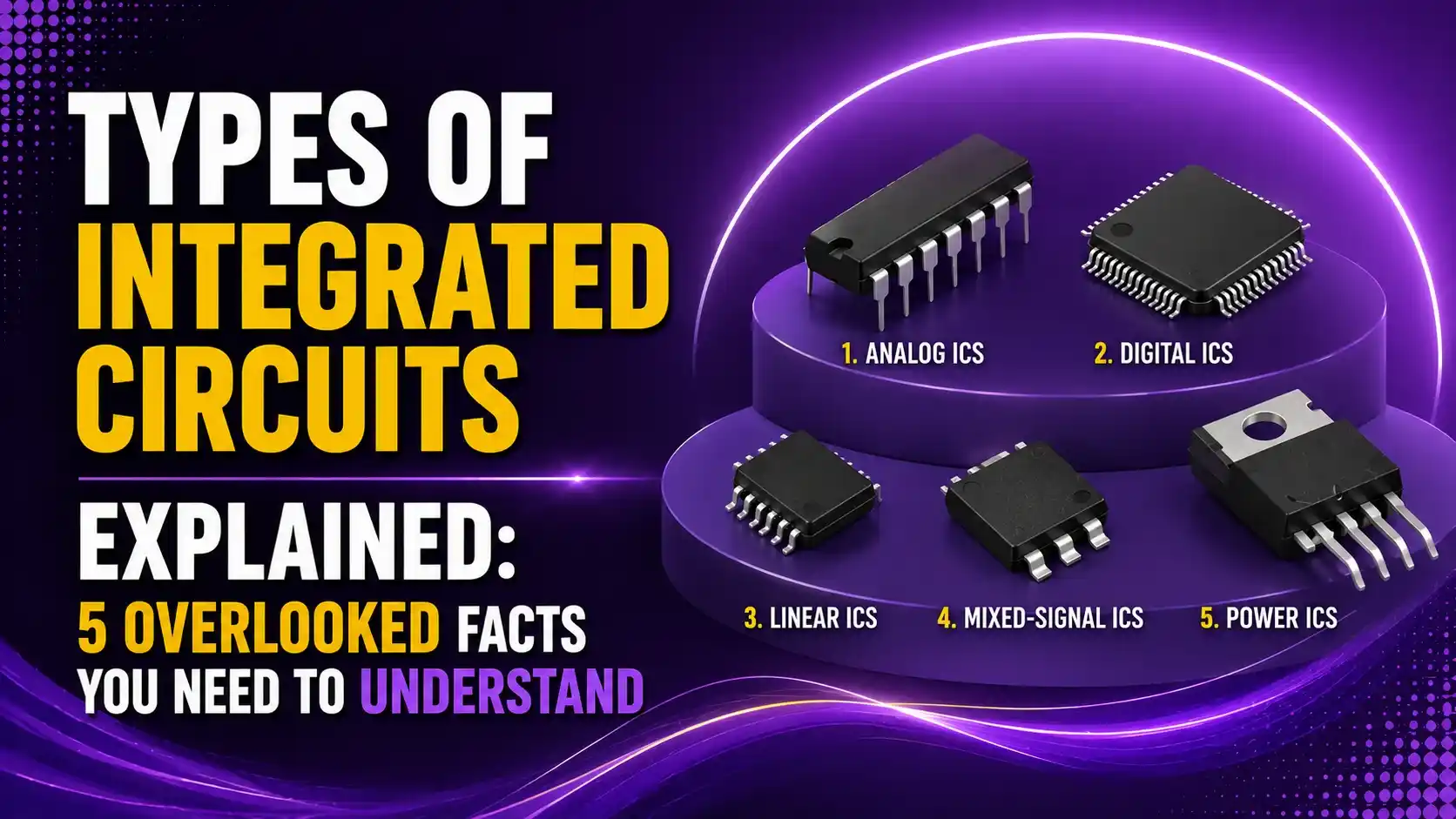
This guide covers the five overlooked facts behind IC classification, going deeper into what actually separates monolithic from hybrid construction and what the SSI-through-ULSI labels genuinely measure.
The Three Independent Ways an IC Gets Classified
The most common source of confusion is treating these three classification systems as one, when they actually describe three completely separate things about the same chip.
By Signal Type
Digital, analog, or mixed-signal, describing what kind of electrical signal the IC processes.
By Fabrication Method
Monolithic or hybrid, describing how the physical chip itself was manufactured.
By Integration Level
SSI through ULSI, describing roughly how many transistors are packed onto that one chip.
5 Overlooked Facts About IC Classification
These five facts clear up the details that most quick summaries of IC types tend to gloss over.
Signal Type Is the Primary Split, Not Integration Level
When someone says "types of ICs," they usually mean digital versus analog versus mixed-signal first. Integration level is a completely separate, secondary classification that applies within any of those three signal categories.
Monolithic vs Hybrid Describes Fabrication, Not Function
A monolithic IC has every component built into one continuous piece of silicon. A hybrid IC instead combines several separate chips and discrete parts on a shared ceramic substrate. Both can be digital, analog, or mixed-signal.
Integration Level Measures Transistor Count, Not Physical Size
SSI, MSI, LSI, VLSI, and ULSI are frequently misread as describing a chip's physical dimensions. They actually classify chips by roughly how many active devices are packed onto that die, regardless of how large or small the package looks.
Bipolar and MOS Logic Families Trade Speed for Power
TTL and ECL, built from bipolar transistors, generally switch faster but draw more power. CMOS and other MOS-based families trade some of that raw speed for dramatically lower power consumption, which is exactly why CMOS dominates in battery-powered and densely packed modern chips.
A Single Failed Component Takes Down the Whole IC
Unlike a discrete circuit where a single bad resistor or transistor can simply be swapped, a monolithic IC's components are permanently fused into one silicon die. One internal failure means replacing the entire chip, there is no repairing just the failed piece.
Digital, Analog, and Mixed-Signal ICs Explained
This is the classification most engineers mean by default when they talk about "types" of integrated circuits.
Digital IC
Processes only two discrete states, effectively 0 and 1, using logic gates as its fundamental building block.
Example: 7400 series NAND gates
Analog IC
Processes a continuous range of voltage levels, with output varying smoothly in proportion to input.
Example: LM741 operational amplifier
Mixed-Signal IC
Combines digital and analog circuitry on the same die, bridging the two domains in a single chip.
Example: analog-to-digital converter
What is happening: A digital IC only ever needs to distinguish between two voltage ranges, roughly "high" and "low," which makes its internal logic dramatically simpler than an analog IC's continuous signal path.
A real example: An analog-to-digital converter is a mixed-signal IC almost by definition, since its entire job is translating a continuously varying analog voltage into a discrete digital number the rest of a system can process.
Why it works: Nearly every modern smartphone or embedded system needs all three categories cooperating together, a mixed-signal chip alone rarely does useful work without digital logic to interpret its output and analog circuitry to condition its input.
Monolithic vs Hybrid Construction, in More Depth
This second classification axis is about how the physical chip gets built, and it genuinely trades manufacturing simplicity against performance headroom.
A monolithic IC starts as a single, uniform wafer of silicon. Every transistor, resistor, and capacitor the circuit needs gets formed directly into that same piece of material through a sequence of diffusion and deposition steps, then wired together with microscopic metal traces on the surface. Because the entire process happens on one continuous substrate, monolithic ICs are cheap to mass-produce and extremely reliable once the design is proven, which is exactly why the overwhelming majority of ICs made today, from simple op-amps to complex microprocessors, are monolithic.
A hybrid IC takes a different approach entirely. Rather than fabricating everything from scratch on one silicon die, a hybrid combines several separately manufactured monolithic chips, along with discrete passive components like resistors and capacitors, onto a shared ceramic or insulating substrate, then wires them together using thick-film or thin-film interconnect techniques. This lets a designer mix components that would be difficult or impossible to fabricate together on one die, at the cost of a larger physical size, higher manufacturing cost, and generally lower production volumes than a fully monolithic chip.
What is happening: Monolithic fabrication favors high-volume, standardized designs. Hybrid fabrication favors lower-volume, specialized designs that need components a single silicon process cannot economically combine.
A real example: A hybrid module might combine a monolithic power amplifier chip with separately mounted, high-precision thick-film resistors to reach a tolerance the monolithic process alone could not achieve reliably.
Why it works: Hybrid construction sacrifices the cost and size advantages of full monolithic integration specifically to gain design flexibility, better component tolerances, and the ability to handle higher power in a compact package.
Integration Level: What SSI Through ULSI Really Measures
The integration level labels sound like they describe physical size, but they are entirely about transistor density.
Digital Logic Families: TTL, ECL, and MOS Compared
Within digital ICs specifically, the choice of underlying transistor technology shapes speed, power, and noise immunity in ways that genuinely matter for a design.
TTL (Transistor-Transistor Logic) builds its logic gates directly from bipolar transistors, with the NAND gate as its most fundamental building block. Standard TTL offered a good balance of speed and reliability for decades, and later variants like Schottky TTL improved switching speed further by preventing the transistors from driving fully into saturation.
ECL (Emitter-Coupled Logic) keeps its bipolar transistors in the active region rather than switching them fully on or off, which is exactly what makes ECL the fastest classic bipolar logic family, at the cost of noticeably higher power consumption than TTL.
MOS and CMOS logic families use metal-oxide-semiconductor field-effect transistors instead of bipolar transistors. CMOS specifically pairs an n-channel and p-channel MOSFET together so that current flows only during switching transitions, not while holding a steady state, which is exactly why CMOS achieves such dramatically lower static power consumption than TTL or ECL, and why it now dominates nearly all modern digital IC design.
Try It: Integration Level Classifier
Enter an approximate transistor or device count to see which integration level category it falls into.
IC Signal Types Compared
| Feature | Digital IC | Analog IC | Mixed-Signal IC |
|---|---|---|---|
| Signal States | Two discrete states | Continuous range | Both, on one die |
| Core Building Block | Logic gate | Amplifier | Converter circuit |
| Typical Example | 7400 series logic | LM741 op-amp | ADC, DAC |
| Design Focus | Noise margin, switching speed | Linearity, gain accuracy | Isolation between domains |
Where Integrated Circuits Show Up
Computing and Memory
Microprocessors and RAM/ROM chips are VLSI or ULSI digital ICs at their core.
Signal Conditioning
Analog and mixed-signal ICs amplify, filter, and convert real-world sensor signals.
Power and Timing
Voltage regulator and timer ICs, often hybrid or monolithic, manage power delivery and clocking.
Advantages and Limitations of Integrated Circuits
Why ICs Replaced Discrete Circuits
Genuine Limitations to Keep in Mind
Download Integrated Circuit References
These two references go deeper into IC classification and integration level history.
VLSI Design Lecture Notes: IC Technologies
University lecture notes covering SSI through ULSI with real examples
Integrated Circuit Classification
Technical reference covering monolithic, thick-thin film, and hybrid ICs
Watch: Digital, Analog, and Mixed-Signal ICs Explained
This video walks through the practical differences between the three main IC signal categories.
FAQs on Types of Integrated Circuits
External References
- MRCET, VLSI Design Lecture Notes, IC Technologies
- IDC Online, Integrated Circuit Classification
- All About Circuits, Common Analog, Digital, and Mixed-Signal ICs
- YouTube, Common Analog, Digital, and Mixed-Signal Integrated Circuits
What we learn today
- Integrated circuits are classified along three independent axes: signal type, fabrication method, and integration level.
- Digital, analog, and mixed-signal describe what kind of electrical signal an IC processes, the classification most people mean by "IC types."
- Monolithic ICs fabricate everything on one silicon die, while hybrid ICs combine separate chips on a shared substrate.
- SSI through ULSI measure transistor count per chip, not physical package size, ranging from under 100 devices to over a million.
- A single internal failure requires replacing an entire IC, unlike a discrete circuit where only the failed part needs swapping.