
A small disc placed in the flow stream feels a push that grows with the square of velocity. Measure that push with strain gauges and you have a rugged meter for steam, dirty liquids and viscous oils.
Few meters are as mechanically simple as a disc on a sensing beam. That simplicity lets the drag principle survive fluids that would jam a turbine or plug an orifice tap.
What Is a Target Flow Meter?
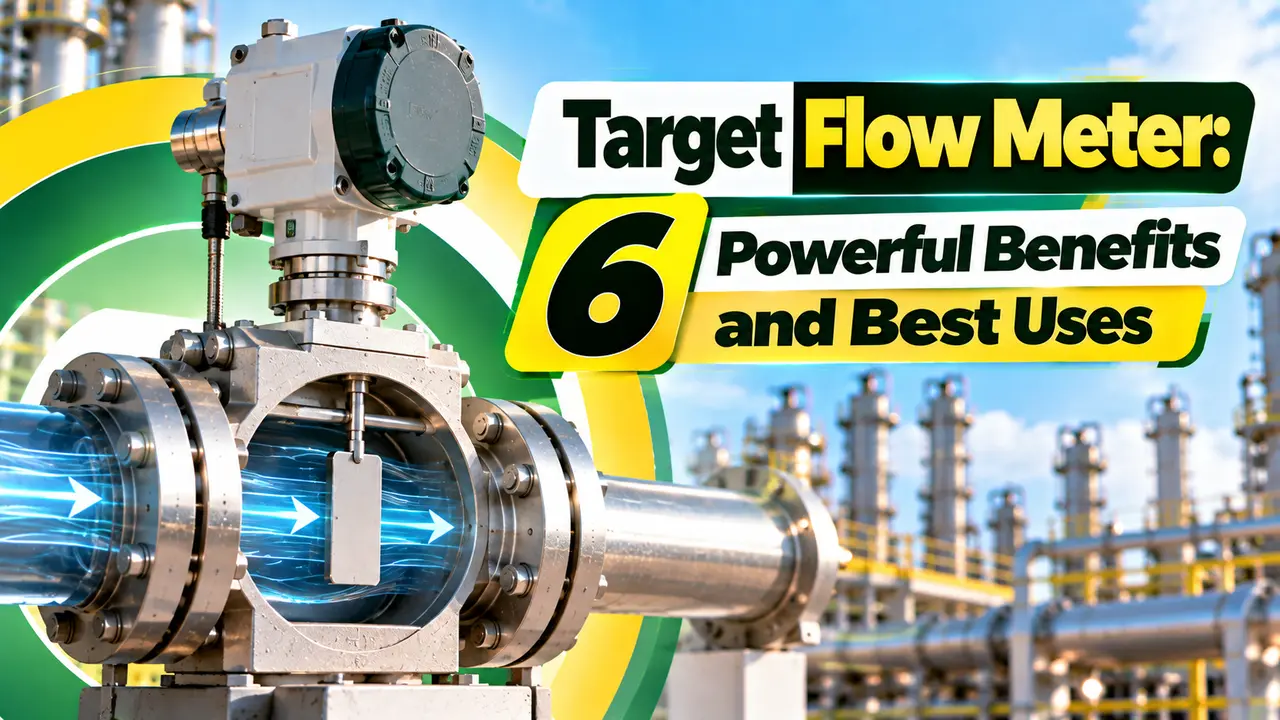
A target flow meter is a drag force instrument in which a flat disc, called the target, is held in the centre of the pipe on a rod or beam. Flowing fluid pushes on the disc, the beam bends slightly, and strain gauges convert that bending into an electrical signal.
It sits between differential pressure and velocity meters in our list of types of flow meters. The disc works like an orifice plate turned inside out, because flow passes around the edge instead of through a hole.
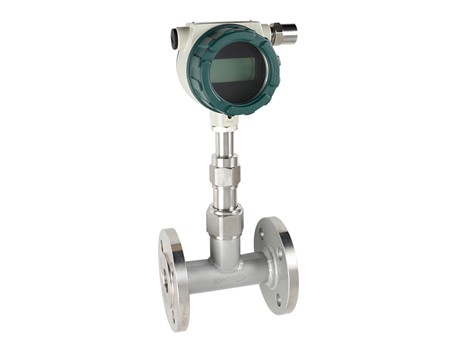
A target flow meter has no bearings, rotors or small ports, so solids and condensate simply pass around the disc. This makes the design popular in steam, crude oil and wastewater service.
Working Principle of the Drag Disc
The drag force follows the classic fluid dynamics relation F = Cd × A × ρ × v² ÷ 2. Here Cd is the drag coefficient, A is the target face area, ρ is density and v is the flow velocity.
Because force rises with v², flow is proportional to the square root of force. The electronics apply the same square root extraction used with DP meters.
The Niagara Meters ForceMeter manual describes four strain gauges on the sensing beam, two on the leading side and two on the trailing side. They form a four active arm bridge that doubles sensitivity and cancels temperature drift.
Drag Force Formula With a Worked Example
Example, water in a 100 mm line:
Force F = 20 N, target diameter 60 mm, Cd = 1.2, ρ = 1000 kg/m³
A = π × 0.03² = 0.002827 m²
v = √(40 ÷ 3.393) = √11.79 = 3.43 m/s
Pipe area = π × 0.05² = 0.007854 m²
Q = 3.43 × 0.007854 × 3600 = 97.1 m³/h
In practice Cd is found by calibration, because it depends on the ratio of target to pipe diameter and on Reynolds number. The formula shows the trend, while the maker calibration sets the exact figure.
Target Flow Meter Calculator
Halve the force to 10 N and the flow falls only to about 71 percent. That is the square law at work.
6 Powerful Benefits of the Drag Principle
SenTec notes that life tests on its sensing element reached 20,000,000 cycles, showing how durable the beam is. Holykell lists its HTF range from minus 196 °C to 450 °C and pressure ratings up to 42 MPa, useful when you select a flow meter for high temperature fluids.
For very large lines an insertion probe is cheaper than a full bore spool, a trade off discussed for Annubar flow meters as well.
Where Drag Disc Meters Work Best
Accuracy, Turndown and Limitations
SenTec explains that at 10 percent flow the disc sees only 1 percent of full scale force, and quotes a turndown near 15 to 1. Read turndown ratio in flow meters to see why square law devices struggle at low flow.
Niagara Meters specifies about 1 percent of rate over a 15 to 1 range, with 10 D of straight pipe upstream and 5 D downstream. For very small flows, compare options in flow meters for low flow.
- Rugged, with no bearings.
- Handles steam, slurry and oils.
- Fast response.
- Suits very high pressure.
- Square law limits turndown.
- Density changes shift the reading.
- Needs straight pipe.
- Target can erode in abrasive duty.
Density must be known or compensated, since force depends on ρ directly. The same issue affects flow nozzles, orifices and venturis, and other effects are in factors affecting flow meter readings.
Niagara ForceMeter Strain Gauge Manual PDF
Drag Disc Flowmeter Video
Target Flow Meter FAQ
It measures the drag force that flowing fluid applies to a disc held in the pipe. Strain gauges on the support beam turn that force into an electrical signal.
Because force rises with velocity squared, the transmitter takes the square root. The result is a clean flow signal that is linear with volumetric flow rate in the pipe.
The drag force equation contains velocity squared, just like the pressure drop across an orifice. So doubling the flow gives four times the force on the target.
The electronics extract the square root to linearise the signal. This also means the signal becomes very small at low flow, which limits the useful turndown of the instrument.
Yes, saturated and superheated steam are among its most common uses. Condensate droplets pass around the disc without jamming anything inside the meter.
Steam density changes with pressure and temperature, so these installations need compensation. Many users add pressure and temperature inputs to a flow computer, which then corrects the meter output in real time.
Typical figures are around 10 to 1 up to 15 to 1 for standard designs. Some makers quote wider ranges with special calibration and digital electronics.
At 10 percent flow the force is only 1 percent of full scale. Noise, vibration and zero drift therefore dominate the lower end of the range, so size the meter carefully.
Yes, a typical requirement is 10 D upstream and 5 D downstream of the meter. The disc samples the central core, so profile distortion affects it.
Avoid mounting the meter right after control valves, pumps or headers. Follow the specific manufacturer table for elbows, reducers, tees and partly open valves in your line.
Yes, this is one of its main strengths compared with turbine meters. There are no small holes to plug and no bearings to foul.
Very abrasive slurry can still erode the disc edge over time. Inspect the target during planned shutdowns and send the target flow meter for recalibration if its edge shape has changed.
Makers calibrate on a flow rig, since the drag coefficient depends on geometry and Reynolds number. Field checks usually cover zero and span of the bridge electronics.
Some designs allow a dry calibration by hanging known weights on the beam. This quick check confirms the force signal without removing the meter from the process line.
Related Articles
- Types of Flow Meters
- Strain Gauge Working Principle
- Square Root Extraction in DP Flow
- Turndown Ratio in Flow Meters
- Annubar Flow Meter Working
External References
- ForceMeter Strain Gage Manual, Niagara Meters
- What Is the Target Flow Meter, SenTec
- Flow Measurement, Wikipedia
What We Learn Today
- A target flow meter measures the drag force on a disc, and flow is proportional to the square root of that force.
- A four arm strain gauge bridge on the sensing beam gives a rugged signal with no bearings or moving parts to wear.
- It suits steam, dirty and viscous fluids, but the square law limits its turndown to roughly 15 to 1 in most designs.