
Both devices turn light into an electrical signal, but their speed, sensitivity, and linearity make them suited to very different sensing tasks.
A Photodiode converts light directly into a small, fast, linear current, while a phototransistor amplifies that same light triggered current internally, trading speed for a much larger output signal.
Both parts belong to the same family as the light dependent resistor, though all three sense light through completely different physical mechanisms.
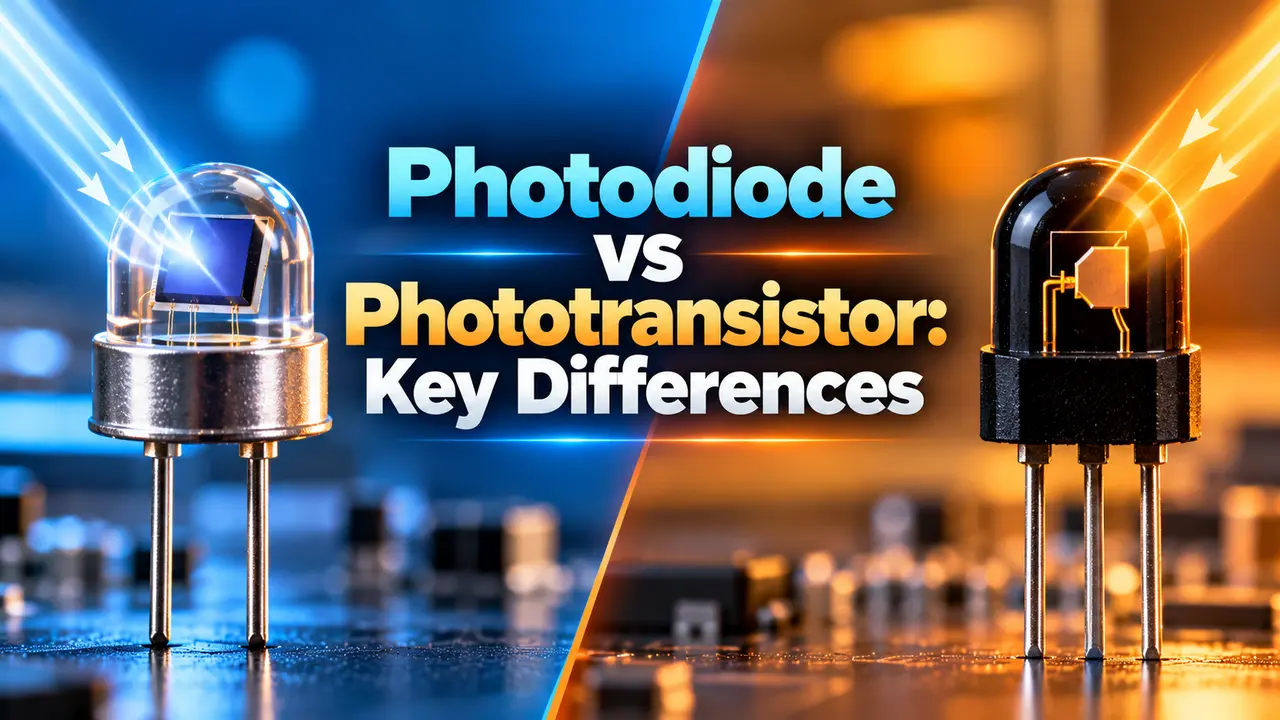
Photodiode vs Phototransistor: How Each One Works
A photodiode is a semiconductor junction that generates a current proportional to the light striking it, operating in either photovoltaic mode or reverse biased photoconductive mode.
A phototransistor uses the same light sensitive junction as its base region, but the transistor action amplifies that small photocurrent by the device's current gain before it ever reaches the output pins.
That internal gain is exactly why one part responds in nanoseconds while the other needs microseconds, and why the choice between them almost always comes down to speed against sensitivity.
Many of the photoelectric sensors used in industrial automation actually build on one of these two detector types internally.
4 Steps in Light to Signal Conversion
Common Package Types
Fast, linear response, favored for precision light measurement and fiber optic receivers.
Adds internal gain through avalanche multiplication for very low light detection.
Stacks two transistor stages for extremely high sensitivity at slower speed.
A balanced choice for general purpose presence and interrupt sensing tasks.
Signal Path Comparison
Responsivity Check
Example:
Incident light power = 10 microwatts
Output current = 5 microamps
Responsivity = 5 divided by 10 = 0.5 amps per watt
An optocoupler often combines one of these detectors with an internal LED, using the same light sensing principle to pass a signal across an isolation barrier.
Where Each Device Is Used
Photodiode vs Phototransistor: Choosing Between the Two
Response speed is often the deciding factor. A photodiode can switch in a few nanoseconds, while a typical phototransistor needs several microseconds to fully turn on or off.
Sensitivity works the other way around. A phototransistor's internal gain, often in the range of one hundred to one thousand, produces a far larger output for the same amount of incident light.
Linearity matters for measurement tasks. A photodiode's output current tracks light intensity closely across a wide range, while a phototransistor saturates earlier and reads intensity less predictably.
Temperature stability also differs noticeably. A photodiode's dark current and responsivity drift only modestly with temperature, while a phototransistor's gain can shift more significantly as the die warms during operation.
Circuit complexity is a practical concern too. A phototransistor can drive a load almost directly, while a photodiode's tiny current usually needs an external transimpedance amplifier stage to become useful.
Cost differences are generally small for standard parts, so the decision usually comes down to whether the application needs raw speed and accuracy or simple, low cost detection.
Packaging options add another wrinkle to the Photodiode vs Phototransistor decision. Both devices come in surface mount, through hole, and lensed packages, and the lens shape strongly affects the angle from which each part can detect light.
Noise performance is worth checking for low light applications. A photodiode paired with a good transimpedance amplifier generally achieves a better signal to noise ratio than a phototransistor at very low illumination levels, since the amplifier's noise can be engineered independently of the sensor.
Spectral response also varies between individual parts regardless of category, so checking the datasheet's wavelength sensitivity curve against the actual light source is essential before finalizing either choice.
This is the same wavelength matching concern that applies when selecting an IR sensor for proximity or object detection tasks, whether the source is visible, infrared, or ultraviolet light.
Long term stability under continuous illumination differs as well. A photodiode's output tends to remain consistent over years of operation, while a phototransistor's gain can degrade gradually as the die accumulates thermal cycling stress.
For engineers building a new sensing circuit, benchmarking a sample of each device under the actual target lighting conditions remains the most reliable way to settle a Photodiode vs Phototransistor comparison for that specific application.
Responsivity Calculator
Reference Document
Watch: Photodiode vs Phototransistor vs Photoresistor
Frequently Asked Questions
Related Articles
- LDR Working Principle
- Optocoupler Working Principle
- IR Sensor Working Principle
- Types of Photoelectric Sensors
- MOSFET Working Principle
External References
What We Learn Today
- A photodiode trades signal strength for speed and linearity, ideal for precise or fast light measurement.
- A phototransistor trades speed for internal gain, producing a strong, simple signal for presence detection.
- Application requirements around speed, accuracy, and circuit simplicity decide which device fits best.