How an Ultrasonic Flow Meter Works
Watch pulses travel between two transducers, with and against the flow. Change velocity, pipe size and sound speed to see the real transit times.
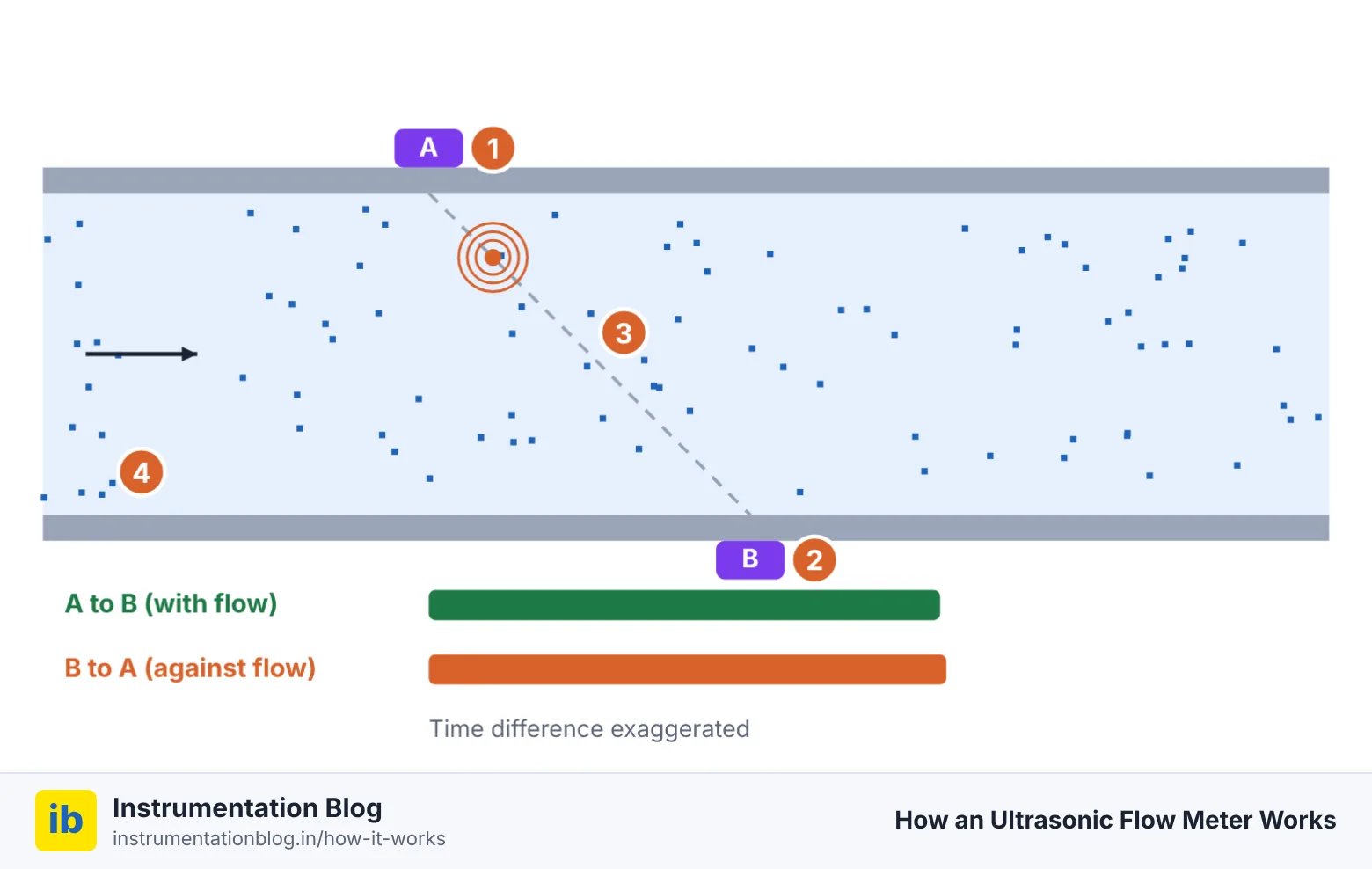
Quick answer: A transit time ultrasonic flow meter sends sound pulses diagonally across the pipe in both directions. The pulse going with the flow arrives slightly earlier than the one going against it, and that time difference is proportional to flow velocity.
What Is an Ultrasonic Flow Meter?
Transit time ultrasonic flow meters measure flow by timing sound pulses, so they have nothing in the flow path. Inline versions are used for custody transfer of gas and liquids; clamp on versions are popular for checks and retrofits.
The time difference they measure is tiny, often a few hundred nanoseconds, so the electronics are very precise. Multi path meters average several sound paths to handle uneven flow profiles.
For clean liquids and gases they work very well; heavy bubbles or solids scatter the sound and can stop the measurement.
How an Ultrasonic Flow Meter Works: Interactive Animation
- 1Transducer A (upstream)
- 2Transducer B (downstream)
- 3Diagonal sound path at 45°
- 4Flow direction
Ultrasonic Flow Meter Working Principle Step by Step
- Two transducers face each other across the pipe at an angle.
- Transducer A sends a pulse to B, moving with the flow, so it arrives a little early.
- Transducer B sends a pulse back to A, against the flow, so it arrives a little late.
- The difference is only nanoseconds, so the electronics time both pulses very precisely.
- Velocity is calculated from the two times, then multiplied by pipe area for volume flow.
Ultrasonic Flow Meter Labelled Diagram
Ultrasonic Flow Meter Formula
t(B to A) = L ÷ (c − v cos θ)
v = L ÷ (2 cos θ) × (1 ÷ t(AB) − 1 ÷ t(BA))
Δt ≈ 2 L v cos θ ÷ c²
Main Parts of an Ultrasonic Flow Meter
| Part | What it does |
|---|---|
| Transducers | Piezoelectric crystals that send and receive ultrasonic pulses |
| Spool or clamp on | Inline body or clamp on mounts outside an existing pipe |
| Sound path | One or more chords across the pipe; more paths give better accuracy |
| Transmitter | Times the pulses and calculates flow |
Where an Ultrasonic Flow Meter Is Used
Advantages
- No pressure loss and no moving parts
- Clamp on versions install without cutting the pipe
- Works on large pipes economically
Limitations
- Bubbles and solids can block the sound
- Accuracy depends on flow profile and straight runs
- Clamp on accuracy depends on pipe data and coupling
Ultrasonic Flow Meter Field Tips and Common Problems
- For clamp on meters, enter the exact pipe OD, wall thickness and material.
- Mount transducers on the side of horizontal pipes, not the top or bottom.
- Use fresh coupling gel or pads; poor coupling is a common cause of signal loss.
- Check the signal strength and sound speed readings as quick health diagnostics.
Related Calculators and Tools
Frequently Asked Questions
Why is the time difference so small?
Sound in water travels at about 1480 m/s, much faster than the flow. The flow only changes the pulse time by a tiny fraction, often a few hundred nanoseconds.
Does the speed of sound matter?
The transit time method largely cancels it in the velocity equation, but the meter still uses it for diagnostics.
What is the difference from Doppler?
Doppler meters need particles or bubbles to reflect sound. Transit time meters need relatively clean liquid.
Why use more than one sound path?
Each path samples one line across the pipe. Several paths average the flow profile and improve accuracy.
Learn more on the blog
How an ultrasonic flow meter works
A practical guide on instrumentationblog.in that goes deeper into this topic with field examples.
Read Full ArticleMore How It Works
All How It Works animations · Instrumentation glossary · Comparisons