How a Turbine Flow Meter Works
Change the flow and the K factor and watch the rotor spin, the pickup produce pulses and the totaliser count up.
Quick answer: A turbine flow meter has a free spinning bladed rotor in the flow. Rotor speed is proportional to velocity, and a magnetic pickup produces a pulse each time a blade passes, so the pulse frequency divided by the K factor gives flow.
What Is a Turbine Flow Meter?
A turbine flow meter is a small propeller in the pipe that spins faster as flow increases. On clean, low viscosity liquids it gives excellent repeatability, which is why it is widely used for fuel and chemical batching.
The meter produces pulses, and each pulse represents a fixed volume set by the K factor. This makes totalising and batching very simple.
Because it has bearings and a moving rotor, a turbine meter needs clean fluid and occasional checks for wear.
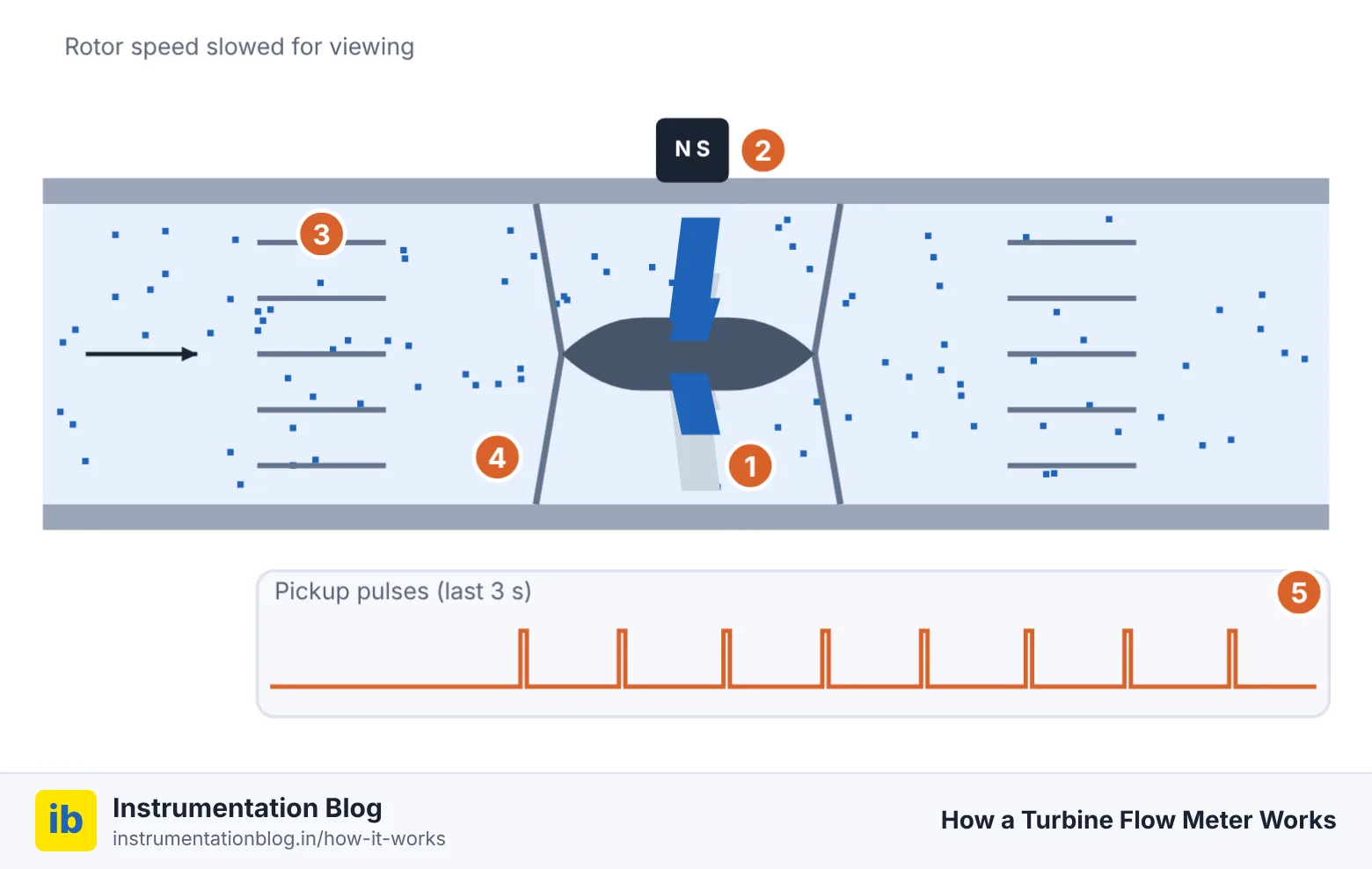
How a Turbine Flow Meter Works: Interactive Animation
- 1Bladed rotor on low friction bearings
- 2Magnetic pickup
- 3Flow straightener vanes
- 4Rotor supports
- 5Pulse output
Turbine Flow Meter Working Principle Step by Step
- Straightener vanes remove swirl so the rotor sees an even flow.
- The angled blades turn the fluid's motion into rotation.
- Rotor speed rises in proportion to flow velocity over the meter's linear range.
- Each blade passing the magnetic pickup creates one pulse.
- The meter counts pulses: frequency ÷ K factor gives flow rate, and total pulses ÷ K gives volume.
Turbine Flow Meter Labelled Diagram
Turbine Flow Meter Formula
f: pulse frequency (Hz) K: pulses per litre
Q: flow in litres per second
Example: 20 pulses/L × 40 m³/h ÷ 3.6 = 222 Hz
Main Parts of a Turbine Flow Meter
| Part | What it does |
|---|---|
| Rotor | Light bladed wheel, often stainless steel, on ball or sleeve bearings |
| Pickup | Magnetic or inductive sensor outside the flow |
| Straighteners | Vanes before and after the rotor that remove swirl |
| Meter body | Flanged or threaded housing |
| Electronics | Count pulses, apply K factor, totalise |
Where a Turbine Flow Meter Is Used
Advantages
- High accuracy and repeatability on clean fluids
- Fast response, good for batching and custody transfer
- Pulse output is easy to totalise
Limitations
- Moving parts and bearings wear
- Sensitive to viscosity changes and swirl
- Not for dirty fluids or slurries
Turbine Flow Meter Field Tips and Common Problems
- Fit a strainer upstream to protect the rotor and bearings.
- Keep the meter full; air or vapour makes the rotor overspeed and damages bearings.
- Recheck the K factor if viscosity or temperature changes a lot.
- Do not exceed the maximum flow rating; overspeed shortens bearing life quickly.
Related Calculators and Tools
Frequently Asked Questions
What is the K factor?
It is the number of pulses the meter produces per unit volume, found by calibration. It is printed on the meter tag or calibration certificate.
Why does viscosity matter?
Higher viscosity increases drag on the rotor and changes the K factor, especially at low flow.
Can turbine meters measure gas?
Yes, gas turbine meters are common for natural gas, but they are a different design from liquid turbine meters.
Why are straighteners needed?
Swirl makes the rotor spin faster or slower than the true flow, which gives an error.
Learn more on the blog
Turbine flow meter working principle
A practical guide on instrumentationblog.in that goes deeper into this topic with field examples.
Read Full ArticleMore How It Works
All How It Works animations · Instrumentation glossary · Comparisons