How a Radar Level Transmitter Works
Change the level and the liquid's dielectric constant. Watch the microwave pulse travel down and back, and the echo peak move and change size.
Quick answer: A radar level transmitter sends microwave signals from an antenna at the top of the tank. They reflect from the liquid surface, and the time of flight gives the distance; level is tank height minus that distance.
What Is a Radar Level Transmitter?
Radar level transmitters measure the time a microwave signal takes to reach the liquid surface and return. Because nothing touches the liquid, they suit corrosive, hot, sticky and hazardous products.
Modern 80 GHz radars have a narrow beam that avoids most tank internals. The transmitter builds an echo curve and picks the true surface echo from it.
Low dielectric liquids reflect only a small part of the signal, and foam or condensation on the antenna can weaken the echo further.
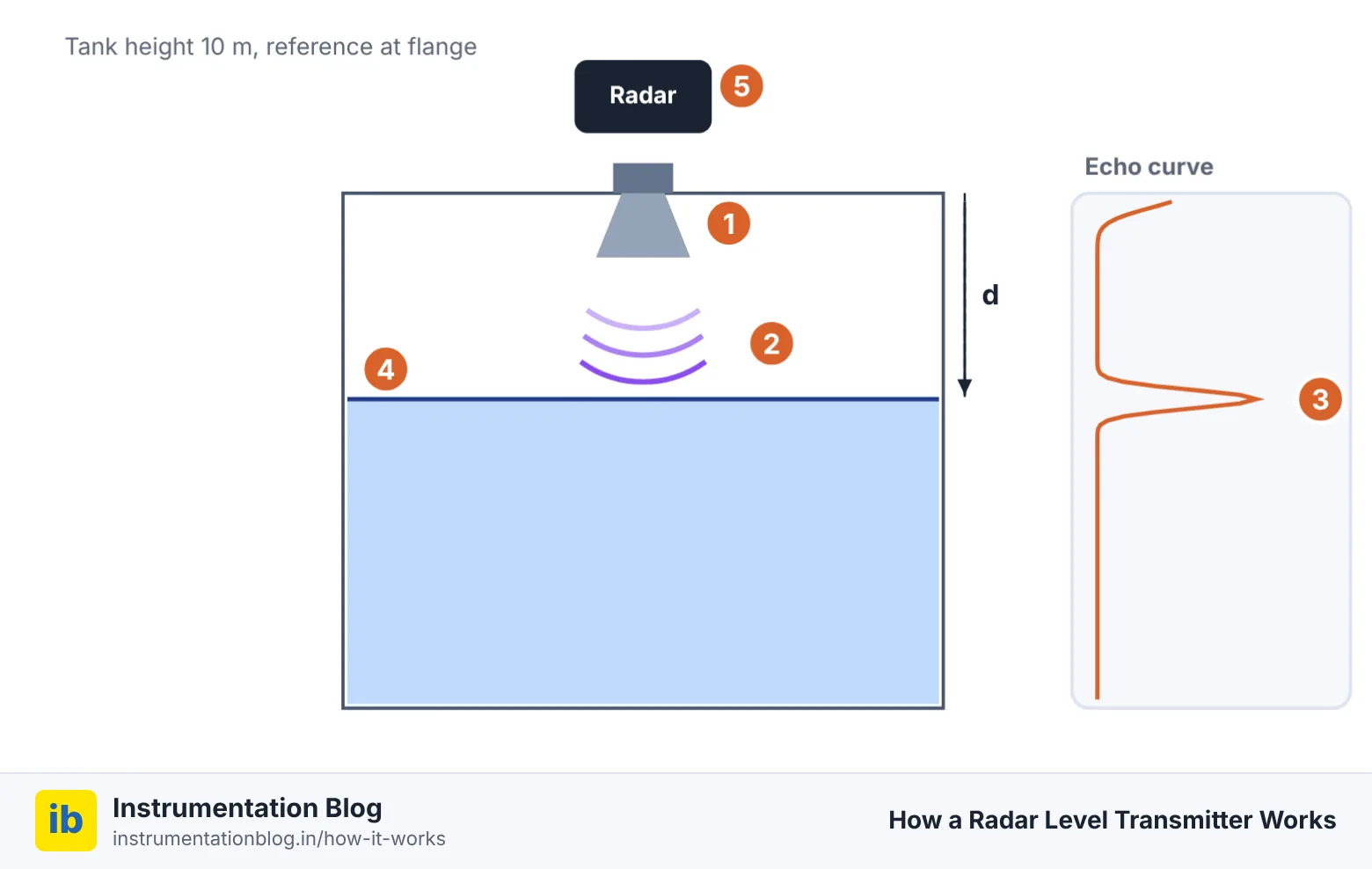
How a Radar Level Transmitter Works: Interactive Animation
- 1Horn antenna
- 2Microwave signal going down
- 3Echo returning
- 4Liquid surface
- 5Transmitter electronics
Radar Level Transmitter Working Principle Step by Step
- The antenna directs microwaves down towards the liquid surface.
- Part of the energy reflects at the surface, more for liquids with a high dielectric constant.
- The transmitter measures the round trip time (pulse) or frequency shift (FMCW).
- It builds an echo curve and picks the surface echo, ignoring known false echoes.
- Distance = c × t ÷ 2, and level = reference height minus distance.
Radar Level Transmitter Labelled Diagram
Radar Level Transmitter Formula
c ≈ 299,792,458 m/s in air or vapour
Level = H(ref) − d
Reflection ≈ ((√εr − 1) ÷ (√εr + 1))²
Example: 4 m distance gives t ≈ 26.7 ns
Main Parts of a Radar Level Transmitter
| Part | What it does |
|---|---|
| Antenna | Horn, lens or drop antenna that focuses the beam |
| Process seal | Separates electronics from the tank |
| Electronics | Generates the signal, builds the echo curve and outputs level |
| Mounting nozzle | Position and length affect false echoes |
Where a Radar Level Transmitter Is Used
Advantages
- Non contact: no parts in the liquid
- Not affected by density, temperature or pressure changes
- Works on most liquids and many solids
Limitations
- Low dielectric liquids give weak echoes
- Foam, internals and nozzles can cause false echoes
- Setup of the echo curve needs care
Radar Level Transmitter Field Tips and Common Problems
- Mount away from the tank wall, inlet streams and agitator blades.
- Use false echo mapping with the tank as empty as possible.
- Keep the nozzle short or use an antenna that extends past the nozzle.
- For low dielectric products consider guided wave radar or a stilling well.
Related Calculators and Tools
Frequently Asked Questions
What is the dielectric constant and why does it matter?
It describes how a material reacts to an electric field. Water (about 80) reflects strongly; oils (about 2) reflect only a few percent, so the echo is weaker.
Does vapour affect radar?
In most cases very little, which is a big advantage over ultrasonic. Very high pressure vapours can slightly slow the signal.
What is a false echo?
A reflection from something other than the surface, such as an agitator, ladder or weld. False echo mapping teaches the transmitter to ignore it.
Pulse or FMCW?
Pulse radar measures time directly; FMCW sweeps frequency and measures the difference frequency. Both give the same distance.
Learn more on the blog
Radar type level transmitter
A practical guide on instrumentationblog.in that goes deeper into this topic with field examples.
Read Full ArticleMore How It Works
All How It Works animations · Instrumentation glossary · Comparisons