How a Vortex Flow Meter Works
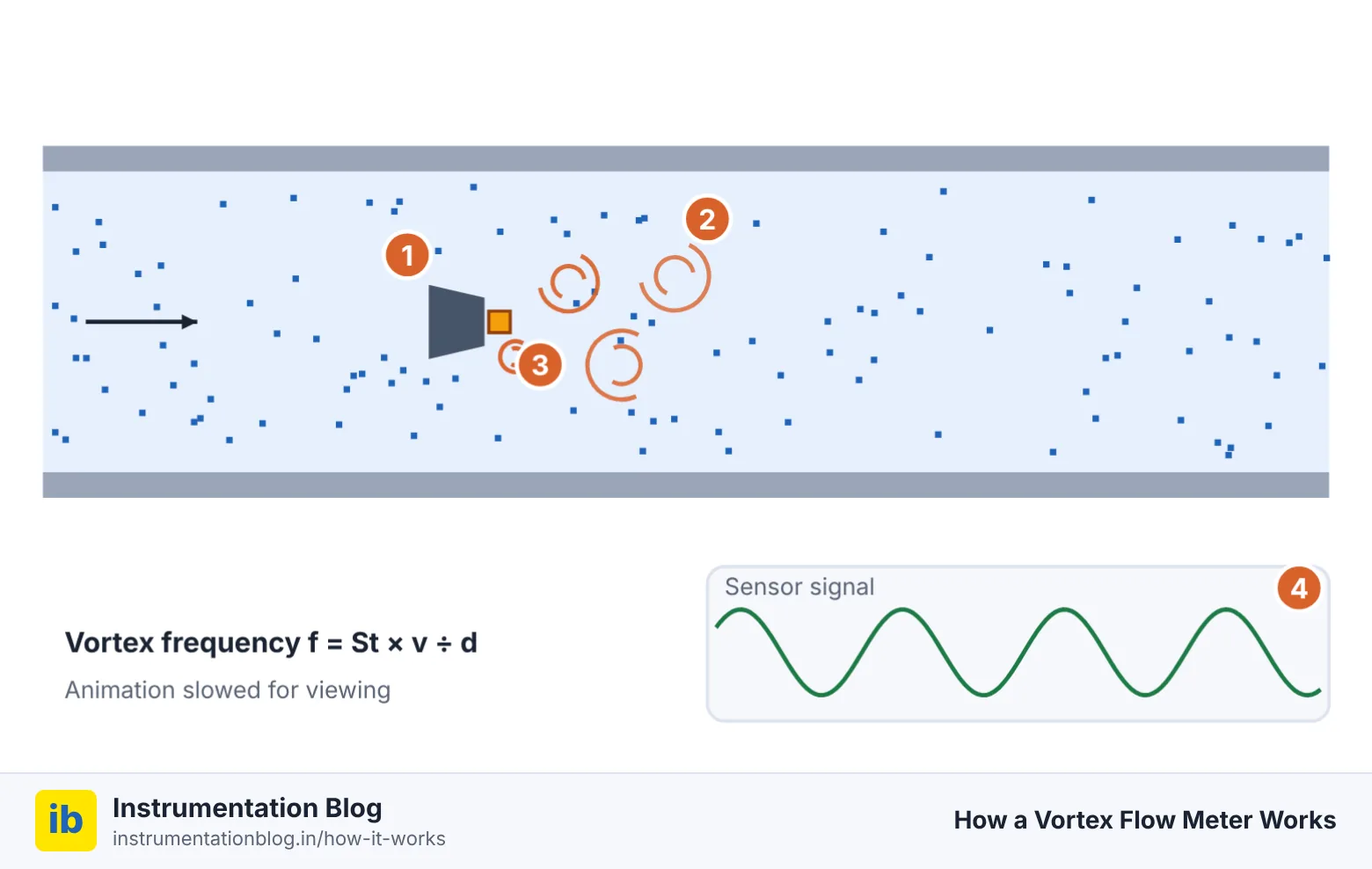
Increase the velocity and watch the bluff body shed vortices faster, one side then the other. The sensor counts them to measure flow.
Quick answer: A vortex flow meter places a bluff body (shedder bar) across the flow. Vortices break away alternately from each side, and their frequency is proportional to velocity, so counting them gives the flow rate.
What Is a Vortex Flow Meter?
Vortex flow meters count the vortices that form behind a bluff body, much like a flag flapping behind a pole. Because they have no moving parts, they are popular for steam, gases and clean liquids.
The output is a frequency that is proportional to velocity over a wide range, often 10:1 or more. Many vortex meters add temperature and pressure sensors to give mass flow of steam or gas directly.
The weak points are low flow, where vortices stop forming cleanly, and pipe vibration, which can look like flow to the sensor.
How a Vortex Flow Meter Works: Interactive Animation
- 1Bluff body (shedder bar)
- 2Vortices shed alternately on each side
- 3Sensor that feels the pressure swings
- 4Pulse signal to the transmitter
Vortex Flow Meter Working Principle Step by Step
- The bluff body splits the flow, and the boundary layer separates at its sharp edges.
- A vortex forms and breaks away on one side, then on the other, creating a von Kármán vortex street.
- Each vortex causes a small pressure swing on the body or on a sensor wing behind it.
- A piezoelectric or capacitive sensor converts these swings into a pulse train.
- The frequency is proportional to velocity over a wide range, so the meter has a fixed K factor.
Vortex Flow Meter Labelled Diagram
Vortex Flow Meter Formula
f: shedding frequency (Hz) St: Strouhal number (about 0.2)
v: velocity (m/s) d: bluff body width (m)
Example: 0.2 × 3 m/s ÷ 0.025 m = 24 Hz
Main Parts of a Vortex Flow Meter
| Part | What it does |
|---|---|
| Bluff body | Shedder bar shaped to give a clean, stable vortex street |
| Sensor | Piezo or capacitive element that detects the alternating force |
| Meter body | Flanged or wafer body with the bluff body inside |
| Transmitter | Filters the signal, counts frequency and outputs flow |
Where a Vortex Flow Meter Is Used
Advantages
- Works on liquids, gases and steam
- No moving parts and low maintenance
- Linear output over a good range
Limitations
- Needs a minimum Reynolds number, so no signal at low flow
- Pipe vibration can create false pulses
- Needs straight runs and a full pipe
Vortex Flow Meter Field Tips and Common Problems
- Size the meter for velocity, not pipe size; a smaller meter often gives better low flow performance.
- Avoid mounting near pumps, control valves or other vibration sources.
- Keep gaskets centred; a gasket protruding into the bore disturbs the vortex street.
- Set the low flow cutoff above the point where the signal becomes unstable.
Related Calculators and Tools
Frequently Asked Questions
What is the Strouhal number?
It is the dimensionless ratio that links shedding frequency, velocity and body width. For a well designed shedder it stays nearly constant over a wide range of Reynolds numbers.
Why does a vortex meter stop reading at low flow?
Below a minimum Reynolds number the vortices are weak or irregular, so the meter applies a low flow cutoff.
Can it measure steam?
Yes. Vortex meters are widely used on saturated and superheated steam, often with temperature and pressure compensation for mass flow.
Does vibration affect it?
Yes. Strong pipe vibration near the shedding frequency can be counted as flow, so supports and filtering matter.
Learn more on the blog
Vortex flow meter working principle
A practical guide on instrumentationblog.in that goes deeper into this topic with field examples.
Read Full ArticleMore How It Works
All How It Works animations · Instrumentation glossary · Comparisons