How an Orifice Plate Works
Move the sliders to change flow and beta ratio. Watch the liquid speed up through the bore, the pressure dip at the vena contracta and the DP transmitter respond.
Quick answer: An orifice plate is a thin plate with a hole that squeezes the flow. The liquid speeds up through the bore, its pressure falls, and the differential pressure (DP) across the plate rises with the square of the flow rate.
What Is an Orifice Plate?
The orifice plate is the oldest and still one of the most common flow elements in process plants. It is used on water, steam, natural gas and hydrocarbons because it is cheap, simple and calculated from a published standard.
The plate itself does not measure anything. It creates a pressure difference, and a DP transmitter across two taps converts that difference into a flow signal.
Because flow follows the square root of DP, the signal is strong at high flow and weak at low flow. That is why orifice loops are usually designed for normal flow between about 30 % and 90 % of the maximum.
How an Orifice Plate Works: Interactive Animation
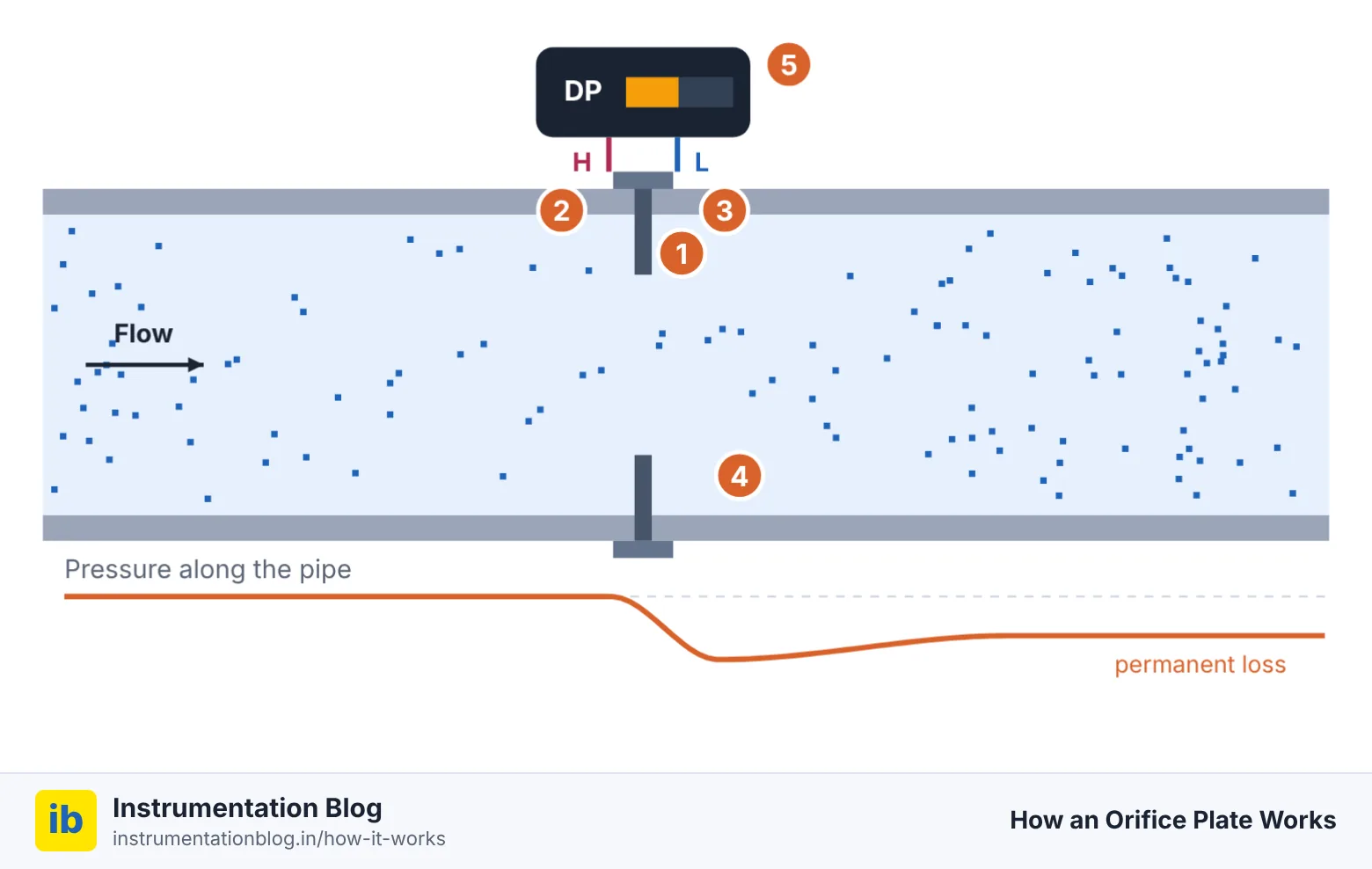
- 1Orifice plate with a sharp edged bore
- 2High pressure (H) flange tap
- 3Low pressure (L) flange tap
- 4Vena contracta: narrowest jet, lowest pressure
- 5DP transmitter
Orifice Plate Working Principle Step by Step
- The plate is clamped between two flanges and the bore is smaller than the pipe.
- Liquid accelerates to pass through the bore, so velocity rises and static pressure falls (Bernoulli).
- Just after the plate the jet is narrowest (vena contracta) and pressure is lowest.
- Two taps feed the DP transmitter: DP grows with the square of flow, so 50 % flow gives only 25 % DP.
- The transmitter or the control system takes the square root of DP to get a linear flow signal.
Orifice Plate Labelled Diagram
Orifice Plate Formula
E = 1 ÷ √(1 − β⁴) and β = d ÷ D
So Q ∝ √ΔP and ΔP ∝ Q²
Example: 70 % flow gives 0.7² = 49 % of full scale DP
Main Parts of an Orifice Plate
| Part | What it does |
|---|---|
| Orifice plate | Thin plate with a precise sharp edged bore, usually stainless steel |
| Flanges and taps | Hold the plate and provide the H and L pressure connections |
| Impulse lines | Small tubes that carry the two pressures to the transmitter |
| DP transmitter | Measures ΔP and sends a 4 to 20 mA flow signal |
| Straight pipe run | Upstream and downstream lengths that give a settled flow profile |
Where an Orifice Plate Is Used
Advantages
- Simple, cheap and works on liquids, gases and steam
- Standardised in ISO 5167, so it can be calculated without flow calibration
- No moving parts in the line
Limitations
- Permanent pressure loss costs pumping energy
- Square root relation limits rangeability to about 3:1 or 4:1
- Needs long straight runs and a sharp, clean edge
Orifice Plate Field Tips and Common Problems
- Install the plate with the sharp square edge facing upstream; a reversed plate reads low.
- Check that both impulse lines are full of liquid (or drained for gas) and at the same temperature.
- A worn or dented edge makes the meter read low; inspect plates during shutdowns.
- Keep the recommended straight run, or fit a flow conditioner, to avoid profile errors.
Related Calculators and Tools
Frequently Asked Questions
Why does DP rise with the square of flow?
Pressure drop comes from the kinetic energy of the fluid, which depends on velocity squared. Double the flow and the DP rises four times.
What is the beta ratio?
It is the bore diameter divided by the pipe inside diameter. Most plates use a beta ratio between about 0.2 and 0.75.
What is the vena contracta?
It is the narrowest point of the jet just downstream of the plate, where velocity is highest and pressure is lowest.
Is all the pressure drop lost?
No. Part of it recovers downstream. A rough estimate of the permanent loss is (1 − β^1.9) times the measured DP.
Learn more on the blog
Orifice plate flow measurement
A practical guide on instrumentationblog.in that goes deeper into this topic with field examples.
Read Full ArticleMore How It Works
All How It Works animations · Instrumentation glossary · Comparisons