
Powders and granules do not form a flat surface, they pile into cones, cling to walls and fill the air with dust. Choosing the right silo sensor means understanding those habits as well as the physics of each technology.
Measuring cement, grain or plastic pellets is very different from measuring water in a tank. Dust, sloping surfaces and heavy pull forces on probes all shape the choice of instrument.
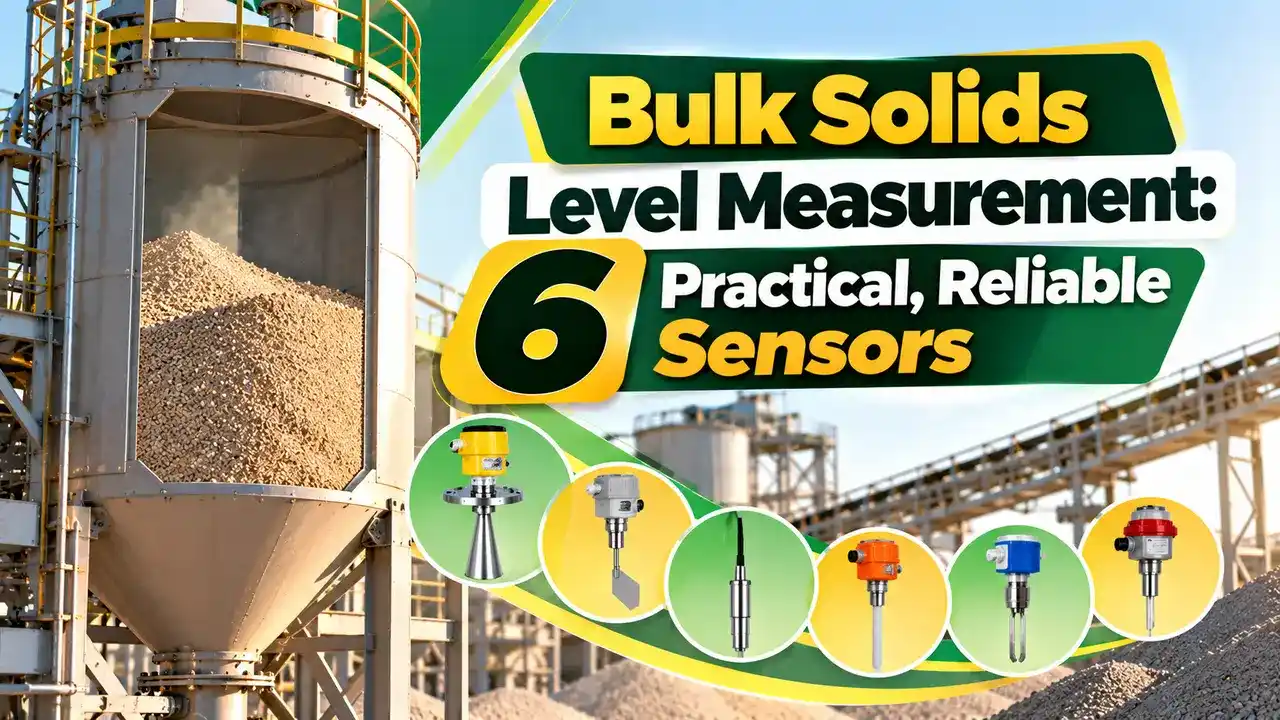
What Is Bulk Solids Level Measurement?
Bulk solids level measurement is the continuous or point detection of the height of powders, granules or lumps stored in silos, bins and hoppers, used for inventory, reorder planning and overfill protection. It follows the same basics of level measurement as liquids, but the material behaves very differently.
Solids pile at their angle of repose during filling and form a funnel when emptying from a centre outlet. So a single point reading is only an estimate of the true average height.
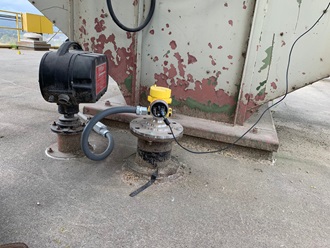
VEGA describes a grain terminal that replaced plumb bob sensors, which had cost about 50,000 US dollars a year in maintenance, with nearly 100 radar units. The VEGAPULS 69 used there reaches up to 120 m.
Challenges Inside a Silo
These effects decide bulk solids level sensor choice more than accuracy figures do. The general selection logic is in how to select the right level sensor.
6 Practical Sensors for Silos
Non contact FMCW radar with a very narrow beam.
Pulse travels down a weighted cable.
A yo yo weight lowered until it touches the surface.
Weigh the whole silo on its legs.
Vibration damps when covered by material.
A motor driven paddle stalls in material.
Endress and Hauser explains that silo radars use 6 GHz, 26 GHz or 80 GHz, with beam angles from about 23 degrees at the lowest frequency down to 3 degrees at the highest. The narrow beam avoids ladders, braces and wall build up, as discussed in non contact vs guided wave radar.
According to the same white paper, 26 GHz pulse radar reaches up to about 230 feet while 80 GHz FMCW units extend to about 410 feet. Remaining false echoes from internals are handled as shown in radar false echo handling.
Contact Methods and Point Switches
A guided wave radar cable must be rated for the pull force of moving solids, which can reach several tonnes in tall silos. Anchor the cable end only if the maker allows it, since fixing it adds more load to the silo roof.
The weight and cable, or yo yo, sensor lowers a weight on demand and counts cable length until the weight rests on the surface. It sees through dust but has moving parts and can be buried if it runs during filling.
For alarms, a vibrating rod or fork switch or a rotary paddle switch is simple and reliable. A capacitance switch is another option for fine powders.
Why Volume Is Not Mass
A level sensor gives height, and height gives volume only if the silo shape is known. Mass then needs bulk density, which changes with compaction, moisture and particle size.
Bulk density can vary 10 percent or more for the same product, so level based mass is an estimate. When the balance sheet needs true tonnes, weigh the silo with load cells, or use a weigh feeder on the outlet.
Silo Volume and Mass Formula
V cylinder = π × R² × (L minus Hc)
Mass = (V cone + V cylinder) × Bulk density
Example:
Diameter 4 m, R = 2 m, cone height 3 m, level 10 m from outlet
V cone = π × 4 × 3 ÷ 3 = 12.57 m³
V cylinder = π × 4 × 7 = 87.96 m³
Bulk density 750 kg/m³
V = 100.5 m³, mass = 75.4 tonnes
The formula assumes a flat surface, so a cone at the angle of repose adds some error at the top. Radar mapping systems reduce this by scanning several points.
Bulk Solids Level to Mass Calculator
Measure the real outlet to sensor distance, since drawings often differ from the built silo.
- Sees through most dust.
- No moving parts.
- Long range in tall silos.
- Low maintenance.
- Angle of repose error.
- Low dielectric powders give weak echoes.
- Internals cause false echoes.
- Level gives volume, not mass.
For radioactive or extreme duties, compare with nuclear level measurement, which works from outside the silo wall.
Endress and Hauser Silo White Paper PDF
Inventory Monitoring in Food Silos Video
Bulk Solids Level FAQ
For most tall and dusty silos, 80 GHz non contact radar is the first choice today. Its narrow beam avoids walls and internals.
Short silos with low dielectric materials may suit guided wave radar better. Where true mass matters most, load cells under the silo legs remain the reference method for inventory.
A higher frequency gives a much narrower beam from the same antenna size. Endress and Hauser quotes beam angles down to about 3 degrees.
The narrow beam reaches the surface without hitting ladders and wall build up. VEGA also reports that its 80 GHz radar sees through the dust created during filling and emptying.
It is the steepest slope at which a heap of loose material stays stable. Grain, cement and plastic pellets each have their own typical angle.
Material piles into a cone during filling and forms a crater when emptying. A single point bulk solids level sensor therefore reads higher or lower than the true average height.
Yes, but the cable must be rated for the pull force of moving material. Tall silos with heavy products can load the roof by several tonnes.
Check the roof strength and the maker load chart before choosing this method. Keep the cable well away from the inlet stream to avoid abrasion and wear over time.
First calculate volume from level using the cone and cylinder geometry. Then multiply that volume by the measured bulk density of the stored product.
Bulk density changes with moisture and compaction, so the result is an estimate. Load cells give true mass directly without relying on any assumed density value.
They give high and low alarms to prevent overfilling and to warn before a silo runs empty. Vibrating rods and rotary paddles are the most common types in cement and food plants.
High switches often trip the pneumatic filling line or the conveying blower. Low switches protect feeders and screw conveyors from running without material.
Yes, the yo yo sensor remains common in very dusty silos and in low budget installations. It reads well because it physically touches the surface.
Its moving parts need maintenance, and the weight can be buried if it runs during filling. Many plants now replace it with bulk solids level radar to cut maintenance and service costs.
Related Articles
- Radar Level Selection, Non Contact vs Guided Wave
- Guided Wave Radar Level Transmitter
- Vibrating Fork Level Switch Working
- Paddle Type Level Switch
- Load Cell Working Principle
External References
- Measuring the Level of Bulk Solids Stored in Silos, Endress and Hauser
- More Reliable Grain Level Measurements With 80 GHz Radar, VEGA
- Angle of Repose, Wikipedia
What We Learn Today
- Bulk solids level readings are affected by dust, cones at the angle of repose, funnel flow and heavy pull forces on probes.
- Narrow beam 80 GHz radar is the usual first choice for tall silos, with guided wave radar, yo yo sensors and point switches filling other roles.
- Level gives volume from silo geometry, but mass needs a known bulk density or load cells for a true inventory figure.