The pressure at the bottom of any liquid column depends only on density, gravity and height. Learn how to use that rule for tank levels, transmitter ranges and mounting offsets with solved examples and a free calculator.
The hydrostatic pressure formula tells you how much pressure a liquid column creates at any depth. We use it for tank bottom pressure, specific gravity, unit conversion and transmitter mounting corrections.
What Is the Hydrostatic Pressure Formula?
The hydrostatic pressure formula is P = ρ × g × h, where ρ is the liquid density, g is the acceleration due to gravity and h is the vertical height of liquid above the point. It gives the gauge pressure created by a still liquid column, and adding atmospheric pressure turns it into absolute pressure.
- P = ρ × g × h gives pressure in pascal when ρ is in kg/m³, g in m/s² and h in m
- Standard gravity is 9.80665 m/s², so 1 m of water at SG 1.0 gives 9.807 kPa or 98.07 mbar
- In plant units, P (mbar) = 98.0665 × SG × h (m)
- Absolute pressure = gauge pressure + atmospheric pressure, about 1013.25 mbar at sea level
- Pressure depends on vertical height only, not on the tank shape or volume
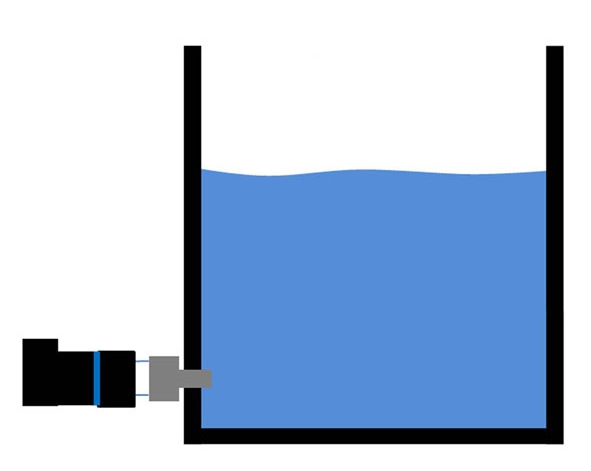
This is the principle behind hydrostatic level measurement, where a pressure sensor at the bottom of a tank reads the liquid column above it. WIKA describes the same idea in its white paper on submersible sensors, where level is found from h = p ÷ (ρ × g).
Hydrostatic Pressure Formula P = ρgh in Detail
Think of a column of liquid with a base area A and height h. Its weight is ρ × A × h × g, and dividing that weight by the area A leaves P = ρ × g × h, so the area cancels out completely.
ρ = density, kg/m³
g = 9.80665 m/s²
h = height of liquid above the point, m
P in Pa (N/m²)
In the hydrostatic pressure formula the height h is always the vertical distance from the free surface down to the point of measurement. A long sloping pipe or a wide tank does not change the answer, which is why the basics of pressure measurement always speak of head rather than volume.
A tall thin pipe and a huge storage tank filled to the same height give exactly the same bottom pressure. This is called the hydrostatic paradox, and it was demonstrated by Blaise Pascal with a long tube fitted to a barrel.
Does Hydrostatic Pressure Depend on the Shape of the Container?
No, the pressure at a given depth depends only on the vertical height, the density and gravity. Two connected vessels of different shapes settle at the same level for this very reason, which is the basis of sight glasses and bypass chambers.
Shape does matter for volume and weight, so a cone bottom tank and a flat bottom tank at the same level hold different amounts of liquid. Converting a level to volume needs the tank geometry, as covered in our tank volume from level calculator.
Gauge vs Absolute Hydrostatic Pressure
A gauge sensor vented to air reads only the liquid column, because atmosphere presses equally on the liquid surface and on the back of the sensor. An absolute sensor also reads the atmosphere, so its value is higher by roughly 1013 mbar at sea level.
P absolute = P atm + ρ × g × h
P atm ≈ 1013.25 mbar at sea level
WIKA notes that its submersible probes use a vent tube in the cable to carry atmospheric pressure to the sensor, so weather changes are fully compensated. The difference between both bases is explained further in absolute vs gauge pressure.
On a closed pressurised tank, a single gauge sensor at the bottom also reads the gas pressure above the liquid. Use a DP transmitter with the low side connected to the vapour space so that only the liquid column is measured.
Specific Gravity Form of the Hydrostatic Pressure Formula
In plants we rarely use kg/m³ directly. Specific gravity SG is the liquid density divided by the density of water, so the hydrostatic pressure formula becomes a quick one line calculation in mmWC or mbar.
P (mbar) = 98.0665 × SG × h (m)
P (kPa) = 9.80665 × SG × h (m)
Because water at SG 1.0 gives 1 mmWC per mm of height, transmitters for water service are often ranged directly in mmWC or mH₂O. For other liquids you multiply the height by the SG, and for liquids whose density changes, see DP level with varying density.
| Liquid (SG) | 1 m | 2 m | 5 m | 10 m |
|---|---|---|---|---|
| Water (1.00) | 98.1 mbar | 196.1 mbar | 490.3 mbar | 980.7 mbar |
| Diesel (0.84) | 82.4 mbar | 164.8 mbar | 411.9 mbar | 823.8 mbar |
| Seawater (1.025) | 100.5 mbar | 201.0 mbar | 502.6 mbar | 1005.2 mbar |
| Sulphuric acid 98 % (1.84) | 180.4 mbar | 360.9 mbar | 902.2 mbar | 1804.4 mbar |
The table applies the hydrostatic pressure formula with standard gravity and the SG values shown. Use the actual SG at operating temperature from the process data sheet, because the density of most liquids falls as they warm up.
mmWC, mbar and Other Head Units
Hydrostatic heads appear in many units on transmitter tags, calibrator screens and vendor sheets. This conversion table covers the ones you will meet most often in Indian plants.
| Unit | Pascal | mbar |
|---|---|---|
| 1 mmH₂O (mmWC) | 9.807 Pa | 0.0981 mbar |
| 1 mH₂O | 9806.65 Pa | 98.07 mbar |
| 1 inH₂O | about 249 Pa | about 2.49 mbar |
| 1 mmHg | 133.3 Pa | 1.333 mbar |
| 1 psi | 6894.8 Pa | 68.95 mbar |
| 10 mH₂O | 98066.5 Pa | 980.7 mbar |
A handy rule from WIKA is that 1 bar corresponds to a water column of about 10 m. For conversions to psi and kPa you can also use our psi to bar converter.
Solved Example: Tank Bottom Pressure
An open water tank holds water to a height of 6 m above the bottom nozzle, and we apply the hydrostatic pressure formula directly. We want the gauge and absolute pressure at the nozzle in mbar and kPa.
P = 588.4 mbar g = 58.84 kPa g
P abs = 588.4 + 1013.25
P abs = 1601.65 mbar
The bottom nozzle therefore sees about 0.59 bar g. A transmitter ranged 0 to 600 mbar would suit this tank with a little margin at the top.
Transmitter Mounted Below the Tap: Correction Example
Level transmitters are often fitted below the bottom nozzle for easy access, and the impulse line between the tap and the transmitter then fills with liquid. That extra column adds a constant pressure, which must be removed with a zero suppression, a step explained in our guide to DP level transmitter range calculation.
A brine tank has SG 1.2, a level of 4 m above the tap and a transmitter mounted 0.5 m below the tap. The same numbers are used as calculator defaults below.
P = 98.0665 × 1.2 × 4.5
P = 529.56 mbar g
Offset alone = 98.0665 × 1.2 × 0.5 = 58.84 mbar
Range: LRV 58.84 mbar, URV 529.56 mbar
So at zero level the transmitter already reads 58.84 mbar, and the range is suppressed by that amount. If you forget it, the DCS shows a level of about 0.5 m on an empty tank.
With remote seals the column is filled with fill fluid instead of process liquid. Emerson shows this case in its Transmitters with Seals data sheet, where a seal fill of SG 0.934 mounted 20 inches below the tap moves the 4 mA point to 18.7 inH₂O and the 20 mA point to 72.7 inH₂O, as discussed in fill fluid selection for diaphragm seals.
Hydrostatic Pressure Formula Calculator
Enter the liquid level above the tap, the specific gravity and the vertical offset of the transmitter below the tap. The calculator returns gauge pressure in mbar, kPa and psi, plus absolute pressure at sea level.
Set the offset to zero for a sensor at tap height. For a submersible probe, enter the depth of the probe below the surface as the level, and size the range with our pressure transmitter sizing calculator.
Effect of Temperature and Gravity
WIKA gives a clear example of the temperature effect in its white paper. Water has a density of 998.20 kg/m³ at 20 °C but only 971.79 kg/m³ at 80 °C, so using the 20 °C density for hot water gives a level error of about 2.7 %.
Gravity also varies slightly with latitude and altitude, and WIKA advises using the local value of g in the hydrostatic pressure formula for precise work. Most plant calculations use standard gravity of 9.80665 m/s², and calibrators state pressure in units based on that value.
Seawater is denser than fresh water, at an SG of about 1.025. A depth gauge set for fresh water therefore reads about 2.5 % deep when it is used in the sea.
- Simple, low cost sensors with no moving parts
- Unaffected by foam, vapour or tank internals
- Works in open tanks, wells and sumps
- Easy to verify with a known water column
- Needs a known and steady density
- Closed tanks need a DP transmitter or two sensors
- Solids can block taps and impulse lines
- Hot or cold impulse lines change the liquid column
Common Mistakes and Field Tips
Most problems with hydrostatic level loops come from the installation, not from the hydrostatic pressure formula itself. This table lists faults we often see during commissioning.
| Symptom | Likely cause | Fix |
|---|---|---|
| Level shows about 0.5 m on empty tank | Transmitter below tap, no suppression | Set LRV for the offset column |
| Level reads high on hot liquid | Density used at a lower temperature | Use SG at operating temperature |
| Reading follows the weather | Absolute sensor or blocked vent tube | Use a vented gauge sensor, clear the vent |
| Level reads high on closed tank | Gas pressure added to liquid head | Use DP with low side to vapour space |
| Slow or stuck reading | Blocked impulse line or tap | Flush the line, consider a flush diaphragm |
- Vertical height used, not pipe length
- SG taken at operating temperature
- Atmosphere added only for absolute readings
- Transmitter offset below tap measured and entered
- Closed tanks measured with DP, not a single gauge sensor
Before calibrating a level loop, fill the impulse line fully and vent all air. A small air pocket in a wet leg can shift the zero by several mbar.
For level measurement with wet and dry legs on closed tanks, read our article on wet leg and dry leg level measurement. Submersible probes are covered in submersible level transmitter working.
The video derives the hydrostatic pressure formula from a force balance on a fluid element. It is a good refresher before you solve level range problems on your own.
Hydrostatic Pressure Formula FAQ
The hydrostatic pressure formula is P = ρ × g × h, where ρ is density, g is gravity and h is the liquid height. With SI units the answer comes out in pascal.
In plant units you can write P in mbar as 98.0665 times the specific gravity times the height in metres. This shortcut is handy for quick level range checks.
One metre of water at specific gravity 1.0 creates about 9.807 kPa, which equals 98.07 mbar. That is close to 0.1 bar, so 10 metres of water is close to 1 bar.
This value uses standard gravity of 9.80665 metres per second squared. Warm water is slightly lighter, so its pressure per metre is a little lower.
No, hydrostatic pressure at a point depends only on the vertical height of liquid above it, its density and gravity. A narrow pipe and a wide tank at the same level give the same bottom pressure.
Shape does change the volume and total weight of liquid in the vessel. That is why converting level to volume needs the tank dimensions as well.
The basic hydrostatic pressure formula gives gauge pressure, meaning the pressure above the surrounding atmosphere. To get absolute pressure you add the local atmospheric pressure, about 1013 mbar at sea level.
Vented gauge sensors cancel the atmosphere automatically and read only the liquid column. Absolute sensors include it, so their readings move up and down with the weather.
Pressure rises in direct proportion to specific gravity at the same height. A liquid with specific gravity 1.2 gives twenty percent more pressure than water at the same level.
So a transmitter ranged for water must be rescaled for any other liquid. Always use the specific gravity at the real operating temperature and not at room temperature.
Measure the vertical height from the liquid surface down to the bottom nozzle and note the specific gravity. Multiply 98.0665 by the specific gravity and the height in metres to get mbar.
For a closed tank you must also add the gas pressure above the liquid. For absolute pressure you then add the atmospheric pressure as well.
Related Articles
- Hydrostatic Level Measurement
- Absolute vs Gauge Pressure
- DP Level Transmitter Range Calculation
- Wet Leg and Dry Leg Level Measurement
- PSI to Bar Conversion
External References
- WIKA: Hydrostatic Level Measurement With Submersible Pressure Sensors (PDF)
- WIKA Blog: Hydrostatic Level Measurement
- Wikipedia: Hydrostatics
What We Learn Today
- The hydrostatic pressure formula P = ρgh gives gauge pressure from density, gravity and vertical height, independent of the shape of the tank.
- In plant units, pressure in mbar equals 98.0665 times specific gravity times height in metres, so one metre of water gives 98.07 mbar.
- A transmitter mounted below the tap sees an extra liquid column, so its lower range value must be suppressed by that offset pressure.