
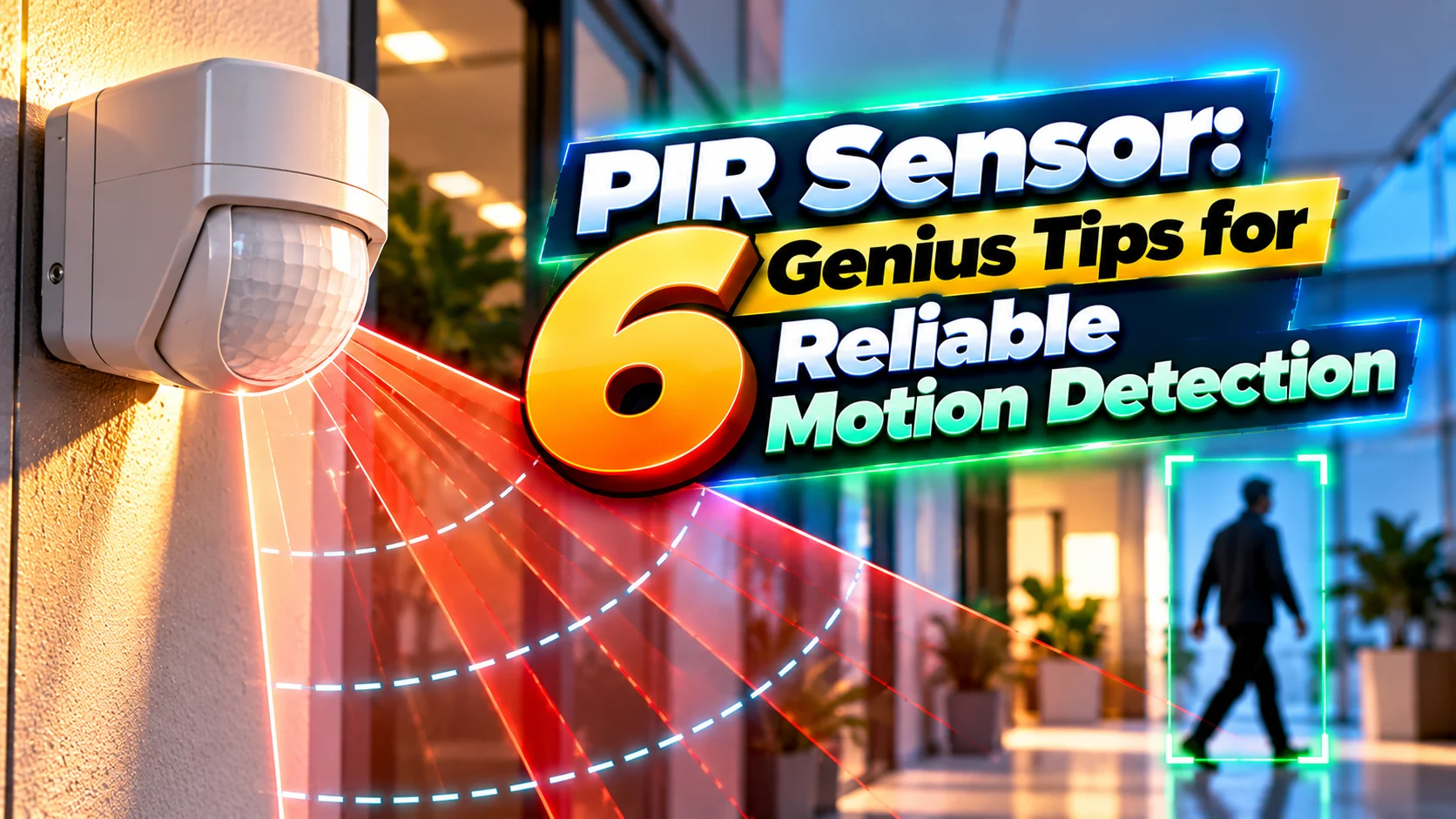
A tiny pyroelectric element and a plastic lens detect the body heat of a moving person without emitting anything.
A PIR sensor detects motion by sensing changes in infrared heat radiated by people and animals. It is passive, meaning it emits no energy of its own, which keeps power use extremely low.
What Is a PIR Sensor?
A PIR sensor, or passive infrared sensor, is a motion detector that responds to changes in infrared radiation within its field of view. Unlike an active IR sensor, it has no emitter and only listens for heat.
Every warm object radiates infrared energy, and the human body radiates strongly around a wavelength of about 10 micrometres. A moving person creates a changing heat pattern that the sensor can see.

The SR501 module is the most popular hobby and training version. It combines a pyroelectric element, a Fresnel lens and a BISS0001 signal processing chip.
Because it detects change, a person standing perfectly still may not be detected. This is the key difference from presence sensors based on microwave radar.
How a PIR Sensor Detects Motion
The pyroelectric element has two sensing slots wired in opposition. When the room is still, both see the same heat and the signals cancel.
When a person walks across, one slot sees them first and then the other. This produces a positive pulse followed by a negative pulse, which the chip recognizes as motion.
The Fresnel lens splits the view into many zones. Each crossing between zones creates another pulse, which increases sensitivity to movement across the field.
SR501 Settings and Specifications
| Parameter | Typical Value |
|---|---|
| Supply voltage | 4.5 to 12 V, usually 5 V |
| Output | 3.3 V digital high on motion |
| Detection range | About 3 to 7 m, adjustable |
| Detection angle | About 120 degrees |
| Time delay | About 1 second to 3 minutes |
| Warm up time | 30 to 60 seconds |
Two small potentiometers set sensitivity and time delay. A jumper selects single trigger mode, marked L, or repeat trigger mode, marked H.
In repeat mode, the output stays high as long as motion continues. The output can drive a microcontroller input directly or switch a relay through a transistor.
6 Genius Tips for Reliable Detection
Tip 1 is the most important. A PIR sensor is much more sensitive to sideways motion than to someone walking directly toward it.
Tip 2 matters because moving warm air looks like a person. Similar false trigger issues appear in fire alarm detectors placed near vents.
PIR Sensor Coverage Width Formula
d = distance from the sensor
θ = detection angle
Worked example:
d = 5 m, θ = 120 degrees
tan(60 degrees) = 1.732
W = 2 × 5 × 1.732
Coverage width = 17.3 m at 5 m distance
The calculated width is the edge of the cone, not guaranteed detection everywhere inside it. Sensitivity falls near the edges and at the far end of the range.
Use the result to check whether one sensor can cover a room or whether two are needed. Overlapping two sensors removes blind spots in large areas.
PIR Sensor vs Microwave vs Ultrasonic Motion Sensors
| Feature | PIR | Microwave | Ultrasonic |
|---|---|---|---|
| Principle | Passive heat change | Doppler radar | Sound echo |
| Power use | Very low | Higher | Medium |
| Sees through thin walls | No | Yes | No |
| Detects still people | No | Sometimes | Sometimes |
| False triggers | Heat sources | Movement outside area | Air currents |
Dual technology detectors combine PIR and microwave, and trigger only when both agree. This greatly reduces false alarms in security systems.
For object detection on machines, other photoelectric sensors or proximity sensors are usually a better fit than PIR.
Where a PIR Sensor Is Used
Occupancy sensing is a major energy saver in buildings, often linked with the HVAC system. Lights and cooling run only when rooms are in use.
For sensor selection in general, see our sensor selection criteria guide, which compares range, response and environment.
PIR Coverage Calculator
Real coverage depends on the lens pattern and mounting height. Check the manufacturer coverage diagram for final placement.
- Very low power consumption.
- Low cost and simple to use.
- Emits nothing, so it is safe and silent.
- Good at detecting people crossing the view.
- Cannot detect a still person.
- Affected by heat sources and sunlight.
- Cannot see through glass or walls.
- Needs warm up after power on.
SR501 Datasheet PDF
SR501 Working and Wiring Video
PIR Sensor Questions and Answers
Related Articles
- IR Sensor Working Principle
- Industrial Automation Sensors
- LDR Working Principle
- Sensor Selection Criteria
- Types of Photoelectric Sensors
External References
- SR501 PIR Sensor Tutorial, Last Minute Engineers
- SR501 Pinout and Datasheet, Components101
- SR501 Datasheet, MPJA
- Passive Infrared Sensor, Wikipedia
What We Learn Today
- This sensor detects changes in infrared heat using a dual pyroelectric element.
- The Fresnel lens creates zones so sideways motion is detected best.
- Careful placement away from heat sources prevents most false triggers.