
Pull cord, belt sway and zero speed switches stop a running belt before a small fault turns into an injury or a fire.
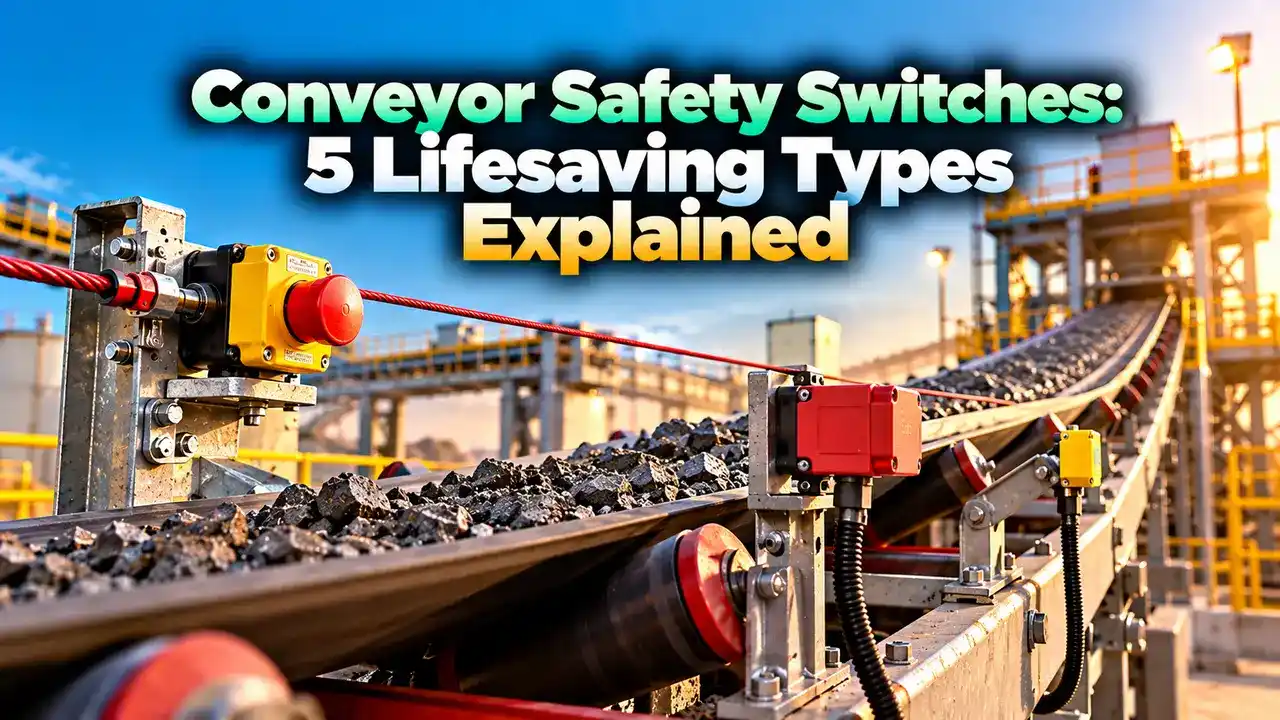
Conveyor safety switches are field devices that detect dangerous conditions on a belt conveyor and trip the drive through the interlock circuit. The three most common are the pull cord switch, the belt sway switch and the zero speed switch.
What Are Conveyor Safety Switches?
Conveyor safety switches are rugged electromechanical or electronic devices mounted along a belt conveyor to detect unsafe conditions. When they operate, their contacts open the safety circuit and stop the drive motor, much like an emergency stop push button on a machine.
Long conveyors in cement, steel, power, mining and port plants can run for hundreds of metres through unmanned galleries. A person, a misaligned belt or a slipping pulley can cause serious harm long before anyone in the control room notices.
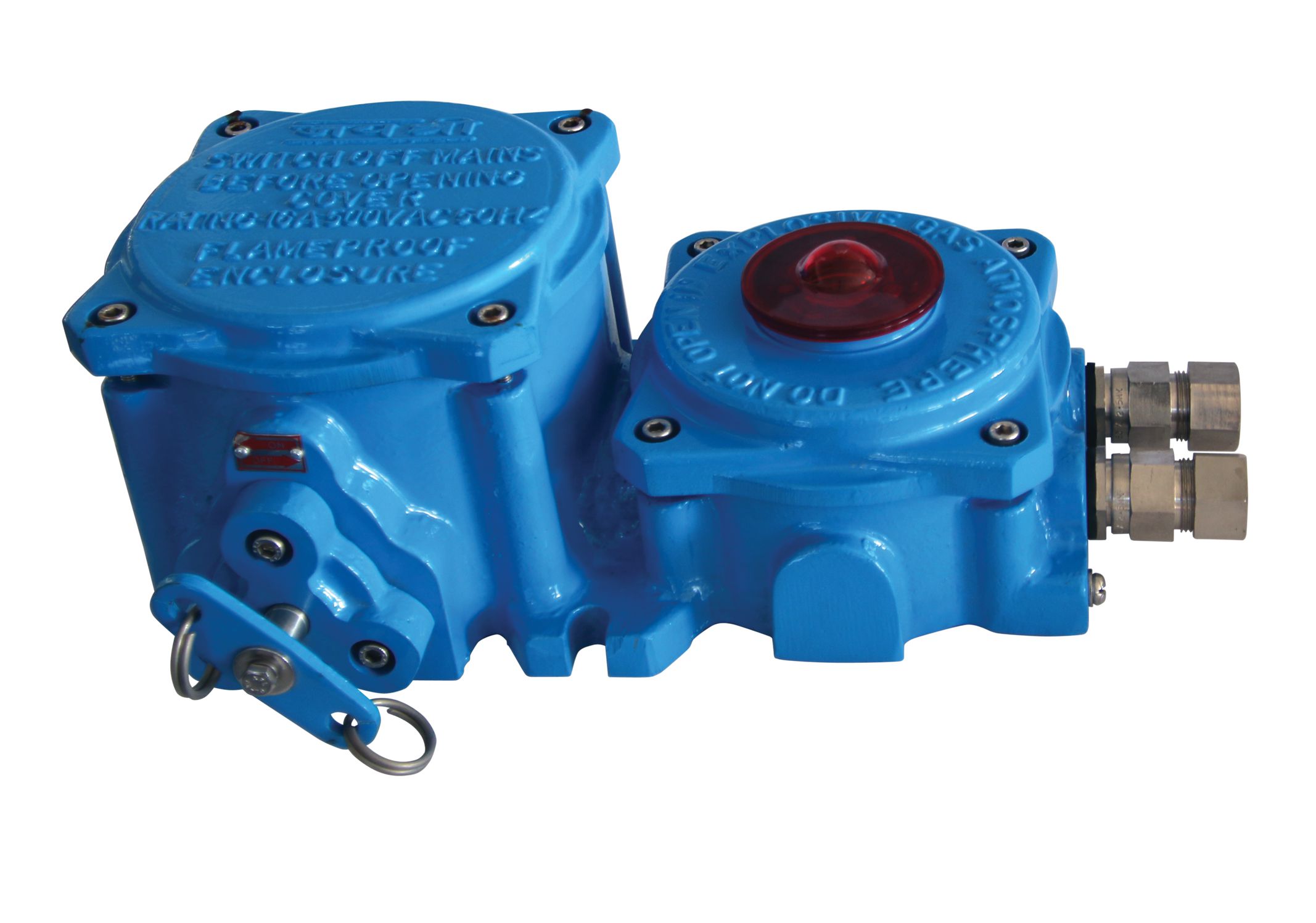
These devices give every person along the belt a way to stop it and give the control system early warning of mechanical faults. Most are rated IP65 or IP66 because they live in dust, water spray and outdoor weather.
The contacts are usually wired to a safety relay or a safety PLC input. This makes sure a single wiring fault does not hide a real trip.
5 Types of Conveyor Protection Switches
A steel wire rope runs along the belt, and pulling it anywhere trips and latches the switch.
A roller lever touches the belt edge and trips when the belt drifts too far sideways.
A sensor watches pulley rotation and trips if speed drops below a set value.
A tilt or probe switch detects material piling up in a transfer chute.
Detects longitudinal tears by sensing material falling through the belt.
The first three are found on almost every belt and are the focus of this article. Chute jam and rip detectors are added where the risk or belt value justifies the cost.
Mechanically, many of these devices are close cousins of the limit switch. The difference is the heavy duty actuator designed for belt duty.
Pull Cord Switch Working
Switches are fitted on both sides of the conveyor, with rope running between them at hand height. Eaton specifies that the distance between two trip switches must not exceed 100 metres.
The switch latches after it trips, so the belt cannot restart until someone walks to it and resets it by hand. This forces the operator to check the reason for the stop.
This latching behaviour matches the emergency stop principle in ISO 13850. Our article on emergency stop and emergency power off explains the difference between the two stop categories.
Belt Sway and Zero Speed Switches
A belt sway switch has a vertical roller lever mounted close to the belt edge on both sides. If the belt tracks off centre, it pushes the lever and the cam operates the contacts.
Two stage versions give an alarm at a small deflection and a trip at a larger one. One manufacturer lists a trip point of 17 degrees for a single stage unit, so always set angles from the datasheet.
A zero speed switch watches the tail or bend pulley, which is driven by the belt rather than the motor. Most use an inductive proximity sensor or a magnetic pickup that counts pulses from a target on the shaft.
If the belt slips on the drive pulley or breaks, the tail pulley slows down while the motor keeps running. The switch compares the pulse rate with a set point and trips after a start up delay.
Zero Speed Switch Set Point Formula
Trip speed = N × underspeed percent
N = pulley speed in rpm
v = belt speed in m/s
D = pulley diameter in m
Worked example:
v = 2.5 m/s, D = 0.5 m
N = (2.5 × 60) ÷ (3.1416 × 0.5) = 150 ÷ 1.571 = 95.5 rpm
Underspeed trip at 80 percent
Trip speed = 95.5 × 0.8 = 76.4 rpm
Set the underspeed point low enough to ignore normal load swings but high enough to catch real slip. Values between 70 and 90 percent of normal speed are common.
On conveyors with a VFD, the normal speed changes with the drive set point. In that case the PLC should scale the trip limit to the commanded speed.
4 Steps After a Pull Cord Trip
For maintenance work, a pull cord stop is never a substitute for isolation. Always follow lockout tagout before anyone enters the belt area.
Many plants fit a trip indication system that shows which switch operated. This saves long walks along galleries that can exceed a kilometre.
Conveyor Safety Switches Comparison Table
| Switch | Detects | Sensing Method | Reset |
|---|---|---|---|
| Pull cord | Person in danger | Wire rope and cam | Manual latch |
| Belt sway | Belt misalignment | Roller lever | Automatic |
| Zero speed | Slip or belt break | Proximity pulses | Automatic |
| Chute jam | Blocked chute | Tilt or probe | Automatic |
| Belt rip | Longitudinal tear | Trough or sensor loop | Manual |
Only the pull cord is a true emergency stop device operated by people. The others are process protection switches that act automatically.
In dusty coal handling areas, check whether the switches need flameproof certification. Our guide on explosion proof vs intrinsically safe instruments helps with that choice.
Where Belt Conveyor Switches Are Used
Many of these belts also carry a weigh feeder or belt scale. The safety switches protect that expensive equipment as well as the people nearby.
Larger plants route all switch signals to the PLC for sequence interlocks. A trip on any downstream belt stops every upstream belt to avoid spillage.
Belt Speed and Trip Point Calculator
Use the actual pulley diameter including lagging, because lagging adds several millimetres. A small diameter error changes the normal speed noticeably on small pulleys.
- Anyone along the belt can stop it quickly.
- Early detection of misalignment and slip.
- Protects belts, pulleys and structures.
- Supports plant sequence interlocks.
- Pull ropes need regular tension checks.
- Sway rollers wear and need replacement.
- Dust can foul proximity targets.
- Bypassed switches remove all protection.
Eaton Conveyor Switch Catalogue PDF
Pull Cord, Belt Sway and Zero Speed Video
Conveyor Safety Switches FAQ
Related Articles
- What Is a Limit Switch
- Emergency Stop Push Buttons
- What Is a Safety Relay
- Lockout Tagout Explained
- NPN and PNP Proximity Sensors
External References
- Conveyor Safety Switches Catalogue, Eaton
- Conveyor Safety Switch Range, Jayashree Electrodevices
- Pull Cord Switch Construction and Working, ElProCus
- Conveyor Belt, Wikipedia
- Kill Switch, Wikipedia
What We Learn Today
- Conveyor safety switches such as pull cord, belt sway and zero speed units cover people, alignment and slip.
- Pull cord switches latch and must be reset by hand at the switch.
- Zero speed set points come from belt speed, pulley diameter and an underspeed limit.