
When a plant trips, hundreds of alarms can fire within milliseconds, and Sequence of Events recording is the tool that tells engineers which one happened first.
Sequence of Events recording captures digital status changes with millisecond or better timestamp accuracy, letting engineers reconstruct the exact order a trip cascade unfolded rather than guessing from a jumbled alarm list.
This builds on our earlier looks at the types of alarms in a DCS and how a DCS historian stores process data over time.
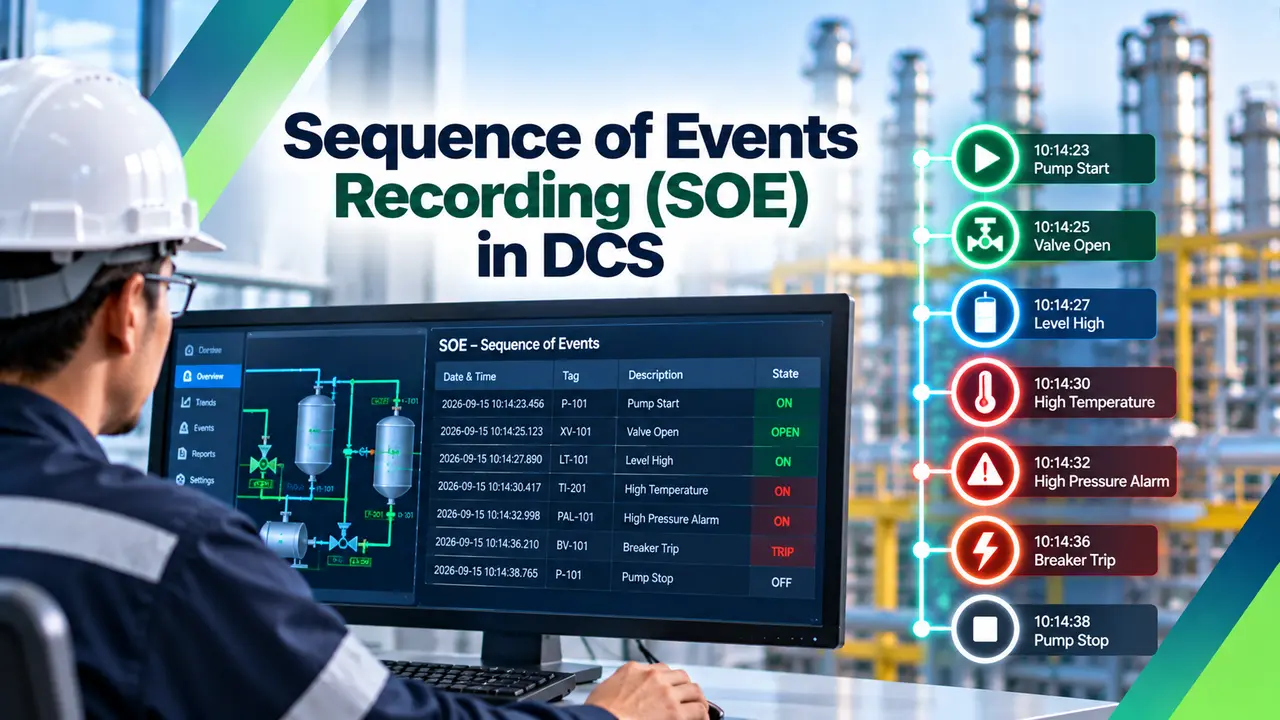
What Sequence of Events Recording Actually Does
Sequence of Events recording is a dedicated function within a DCS or SCADA system that timestamps digital status changes, trips, breaker positions, and contact changes, with enough precision to reconstruct exactly which change happened first.
The core purpose is root cause analysis after an upset. When a major trip occurs, a cascade of protective actions and consequential alarms can fire within a few hundred milliseconds. Sorting out the initiating event from the aftermath is nearly impossible without fine grained timestamps.
Why Ordinary Alarm Logging Falls Short
A standard DCS alarm and event log timestamps entries at the controller's scan rate, commonly somewhere between 100 milliseconds and a full second, using software timestamping applied when the controller happens to process that scan.
That resolution is entirely adequate for day to day operator awareness, but it cannot reliably order two events that both occurred inside the same scan cycle, which is exactly the situation during a fast moving trip.
Time Resolution and Why It Matters
Dedicated SOE systems typically achieve one millisecond resolution or better, with some vendors claiming sub millisecond accuracy, because the timestamp is applied by the input card hardware at the instant the contact actually changes state.
That hardware level timestamping removes the scan cycle jitter that limits ordinary logging, giving a deterministic and repeatable record of exactly when each contact changed, independent of how busy the controller happens to be at that moment.
Keeping Every Cabinet on the Same Clock
A Sequence of Events system spans multiple cabinets, often scattered across a large plant, and every one of them has to agree on the same time reference or the recorded order of events becomes meaningless.
A GPS disciplined master clock is the usual time source, distributing a common reference to field cabinets using IRIG B timecode or, increasingly on modern Ethernet based systems, IEEE 1588 Precision Time Protocol for sub microsecond synchronization.
NTP Versus a Dedicated Time Distribution Scheme
Ordinary network time protocol can synchronize clocks to within a few milliseconds over a typical plant network, which sounds close but still is not tight enough for the sub millisecond precision a dedicated SOE system needs.
That gap is why serious SOE installations use IRIG B or PTP hardware distribution rather than relying on NTP alone, particularly for cabinets that sit far apart electrically or physically across the site.
Where SOE Recording Gets Used
| Application | What SOE Reveals |
|---|---|
| Steam or gas turbine trip | Which protective trip signal actually initiated the shutdown sequence |
| Compressor trip | Order of surge, vibration, and interlock signals leading to shutdown |
| Boiler master fuel trip | The exact contact that started the fuel trip cascade across the unit |
| Electrical substation event | Breaker and relay operation sequence during a fault |
| Batch process troubleshooting | Whether interlocks and permissives sequenced in the intended order |
A Simple Example
Imagine a compressor trips and, within 40 milliseconds, three alarms appear, a high vibration alarm, a low lube oil pressure alarm, and the trip relay itself, all inside a single scan cycle on an ordinary log.
An SOE record resolves that same sequence to the millisecond, showing the low lube oil pressure alarm arrived first, the trip relay operated four milliseconds later, and the vibration alarm followed as a consequence rather than a cause.
Designing a Reliable SOE System
Redundancy for Critical Units
A single SOE processor or a single time source is a weak point on a unit where trip analysis genuinely matters, since losing the record during the very event you need it most for defeats the purpose entirely.
Redundant SOE cards paired with a backup time source keep the record intact even if one processor or one clock reference fails partway through an upset.
Dedicated SOE Cards vs Standard I/O Timestamping
Dedicated SOE Cards
Millisecond or better hardware timestamping, higher cost, used on critical trip circuits.
Standard I/O Timestamping
Adequate for routine alarms, but too coarse to order a fast trip cascade.
Most plants mix the two approaches deliberately, reserving dedicated SOE channels for the handful of trip and interlock signals that actually get analyzed after an incident, while leaving routine status points on standard I/O.
Reviewing an Event Record After a Trip
Once a trip has occurred, the review process usually starts with a sorted list of every timestamped change in the window surrounding the event, arranged from earliest to latest with the millisecond offset shown against each entry.
Engineers then work backward from the final trip relay operation, checking which upstream signal changed just before it, and continuing that chain until they reach the true initiating condition rather than a downstream symptom.
Feeding Findings Back Into the Historian
Once the initiating cause is identified, the finding is typically logged alongside the broader process data already retained in the plant historian, so future engineers reviewing that unit's history can see both the trend data and the confirmed root cause together.
This combined record also supports longer term reliability work, since a pattern of similar initiating causes across several trips points toward a design weakness rather than an isolated one time event.
Training Staff to Use SOE Data Effectively
An accurate record only helps if the people reviewing it understand how to read it, so operators and engineers both benefit from periodic training on interpreting a sorted event list and recognizing common cascade patterns.
Practice sessions using past trip records, worked through as case studies, build the pattern recognition that lets a reviewer spot the true initiating signal quickly instead of getting lost in a long list of consequential alarms.
Standards and Related References
IEC 60870 5 103 covers communication and event reporting for protection equipment, and IEC 61850 defines event and GOOSE messaging used heavily in substation automation, both relevant wherever an SOE system touches electrical protection gear.
EPRI has published guidance for power plant alarm and SOE system design and acceptance testing, and IRIG timecode standards remain the common reference for hardware time distribution across many SOE installations worldwide.
Common Mistakes to Avoid
Watch: Sequence of Events Recorder Overview
Sequence of Events Recording FAQs
Related Articles on This Site
- 7 Types of Alarms in DCS
- DCS Historian Explained, Data Storage
- SCADA Alarm Management
- Alarm Management, ISA 18.2
- DCS Controller Redundancy Types
External References
What We Learn Today
- Sequence of Events recording timestamps digital changes at millisecond or better resolution.
- Hardware level timestamping at the input card removes the jitter that limits ordinary alarm logs.
- GPS disciplined time distribution using IRIG B or PTP keeps every cabinet on the same clock.