
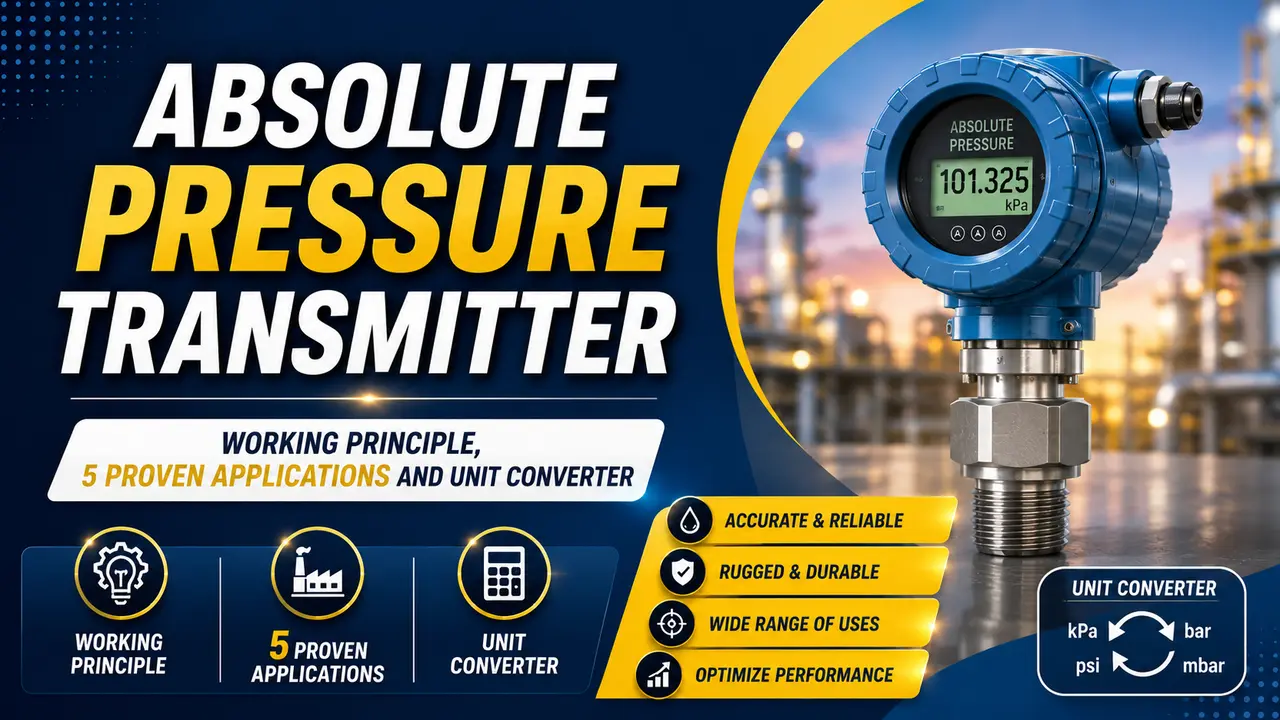
An absolute pressure transmitter measures pressure referenced to a perfect vacuum, not to the local atmosphere. This makes it the correct choice for any process where atmospheric pressure variation would introduce error -- vacuum systems, distillation columns, steam saturation calculations, and altitude sensitive measurements.
This guide explains how it works, when to choose absolute over gauge, and includes a live pressure unit converter and gauge to-absolute conversion calculator.
The difference between absolute and gauge pressure is a single fixed offset -- atmospheric pressure at sea level, 101.325 kPa. But choosing the wrong reference in an application produces errors that shift with weather and altitude, making the measurement useless for process control.
How an Absolute Pressure Transmitter Works
The sensing element contains a sealed reference cavity on one side of the measurement diaphragm, evacuated to a near perfect vacuum during manufacture. The process pressure acts on the opposite side.
Because the reference side is always at near zero pressure, the diaphragm deflection is directly proportional to absolute process pressure. Atmospheric pressure changes have no effect -- the transmitter sees only the process pressure measured from vacuum zero.
The sensor output is converted to a 4 to 20 mA or digital HART/Fieldbus signal. At 4 mA the output corresponds to the lower range value; at 20 mA it corresponds to the upper range.
Compare the three types in the pressure transmitter types guide.
Absolute vs Gauge vs Vacuum: Understanding the Three Pressure References
All three pressure types measure the same physical quantity -- force per unit area -- but with different reference points. Choosing the wrong reference is one of the most common specification errors in instrumentation.
| Pressure Type | Reference Point | Can Go Negative? | Use When |
|---|---|---|---|
| Absolute (kPa abs, psia) | Perfect vacuum (0 kPa abs) | No -- always ≥ 0 | Vacuum systems, steam saturation, distillation, barometric measurement, altitude compensation |
| Gauge (kPa g, psig) | Local atmosphere (varies with altitude and weather) | Yes -- negative gauge = vacuum below atmosphere | Tank pressure, pipe pressure, filter dP, most industrial process pressure monitoring |
| Vacuum (kPa vac, in Hg vac) | Atmosphere, expressed as how far below it | No -- always ≥ 0 | Vacuum vessels, condenser monitoring, freeze dryers, vacuum conveying systems |
| Differential (kPa d) | LP port of the transmitter | Yes -- if LP > HP | Flow across a restriction, level in a vessel, filter loading, density |
5 Proven Applications for Absolute Pressure Transmitters
Distillation Column Overhead
Vapour liquid equilibrium at the top tray depends on absolute pressure. The transmitter accuracy specification at this range is critical for product quality.
A 1 kPa error shifts the bubble point temperature by 0.3 to 0.5°C on light hydrocarbon services, directly affecting product purity.
Why absolute: atmospheric variation shifts equilibrium calculationSteam Saturation Temperature
The saturation temperature of steam is a fixed function of absolute pressure -- this relationship (from steam tables) requires absolute pressure as input. Gauge pressure gives a different saturation temperature at altitude or on a low pressure weather day, causing boiler control errors.
Why absolute: steam tables are referenced to absolute pressureVacuum Vessel and Condenser Monitoring
A surface condenser on a steam turbine operates at 5 to 15 kPa absolute. A gauge transmitter would read minus 86 to minus 96 kPa, which is hard to interpret.
An absolute transmitter reads 5 to 15 kPa directly, mapping cleanly to condenser performance tables.
Why absolute: gauge values are negative and confusing at deep vacuumBarometric and Altitude Compensation
DP flow meters and altitude sensitive process measurements require a local barometric reference. An absolute pressure transmitter on the instrument air header or open to atmosphere provides the barometric input for pressure compensation calculations in a flow computer or DCS.
Why absolute: gauge = 0 at any altitude; absolute reads actual bar pressureVacuum Dryer and Freeze Dryer Control
Pharmaceutical and food drying processes use vacuum to reduce the boiling point of water, allowing drying at low temperature. The drying rate and final moisture content both depend on absolute chamber pressure. Typical operating pressures are 0.1 to 10 kPa absolute.
Why absolute: process controlled to vapour pressure of water at target tempCompressor Suction Pressure
Compression ratio equals outlet absolute pressure divided by inlet absolute pressure. Using gauge pressures at altitude gives an incorrect ratio because the atmospheric offset does not cancel in the division.
Absolute transmitters on suction and discharge give accurate compression ratio for performance monitoring.
Why absolute: compression ratio = P_out(abs) / P_in(abs)Absolute Pressure Converter and Gauge Converter
When to Choose Absolute vs Gauge vs Differential
Choose Absolute When
- The process operates at or near atmospheric pressure and small pressure variations matter (distillation column pressure control)
- The process operates in vacuum -- gauge would give negative readings and confusing display
- The measurement is used in a calculation that references absolute pressure (steam tables, compression ratio, vapour pressure)
- The plant is at altitude and atmospheric variation would introduce an unacceptable error in a gauge measurement
- Barometric compensation is needed for a flow or density calculation in a DCS or flow computer
Choose Gauge When
- The process is well above atmospheric pressure and atmospheric variation is negligible relative to the measurement range (a 100 bar vessel where a 0.002 bar weather variation is irrelevant)
- Tank or pipe pressure monitoring where the operator needs to know how far above atmosphere the system is running
- Safety relief valve setpoints -- these are always specified in gauge pressure
- Filter pressure drop monitoring using a single port gauge transmitter at each end (though a DP transmitter is more accurate)
- Any application where the pressure switch or alarm setpoint is stated in gauge pressure in the process safety documents
Advantages and Limitations
| Aspect | Absolute Transmitter | Gauge Transmitter |
|---|---|---|
| Reference stability | Reference is a sealed vacuum cavity -- does not shift with weather or altitude | Reference is open to atmosphere -- reading shifts by up to 2 kPa with weather and several kPa with altitude |
| Vacuum measurement | Reads directly in positive kPa abs values -- intuitive and unambiguous | Reads negative values below atmosphere -- confusing to operators, easy to misread |
| High pressure applications | Reads atmospheric offset (101.325 kPa) even at zero gauge -- wastes range on low range transmitters | Starts at zero, uses full range for the process measurement |
| Steam table / vapour pressure calculations | Direct input -- no atmospheric correction needed | Must add local atmospheric pressure before using steam tables |
| Calibration reference | Requires a vacuum reference pump for field calibration at low ranges, or a precision absolute pressure standard | Can be zero checked at atmospheric pressure (open to air = 0 kPag) |
| Cost and availability | Slightly more expensive, less common than gauge type in general industrial use | More common, wider range of off the shelf options, simpler calibration setup |
Watch: Absolute Pressure Transmitter Working Principle and Applications
Absolute Pressure Transmitter Questions
External References
- Rosemount 3051 Absolute Pressure Transmitter Data Sheet -- Emerson
- EJA530E Absolute Pressure Transmitter -- Yokogawa
What We Learn Today
- Absolute pressure is referenced to perfect vacuum -- it never shifts with weather or altitude
- P_abs = P_gauge + P_atm (101.325 kPa at sea level)
- Use absolute for vacuum monitoring, steam calculations, distillation control, and compression ratio
- An absolute transmitter reads 101.325 kPa at atmospheric pressure, not zero
- Steam tables require absolute pressure input -- gauge pressure gives wrong saturation temperature at altitude
- Installing the wrong type (absolute vs gauge) gives a permanent 101.325 kPa offset error