NFPA 70E Explained: 6 Essential Rules Every Electrical Worker Must Know

Share:
Electrical Safety & Standards
NFPA 70E Explained: 6 Essential Rules Every Electrical Worker Must Know

NFPA 70E is the US standard for electrical safety in the workplace. It is updated every three years and sets the requirements for arc flash hazard assessment, PPE selection, and safe work procedures.

This guide breaks the standard into its six most important requirements so any engineer or technician can understand what compliance actually means on the job.

2024 Edition Arc Flash Study Safe Work Condition Energized Work Permit

NFPA 70E does not replace OSHA. It is a consensus standard that OSHA references as the accepted safe practice for electrical work. Where OSHA sets the legal minimum, NFPA 70E defines how to meet it.

What Is NFPA 70E?

NFPA 70E is published by the National Fire Protection Association. The current edition is 2024.

It covers electrical safety procedures for workers in commercial and industrial buildings. It does not cover the electrical installation itself -- that is NFPA 70 (the National Electrical Code).
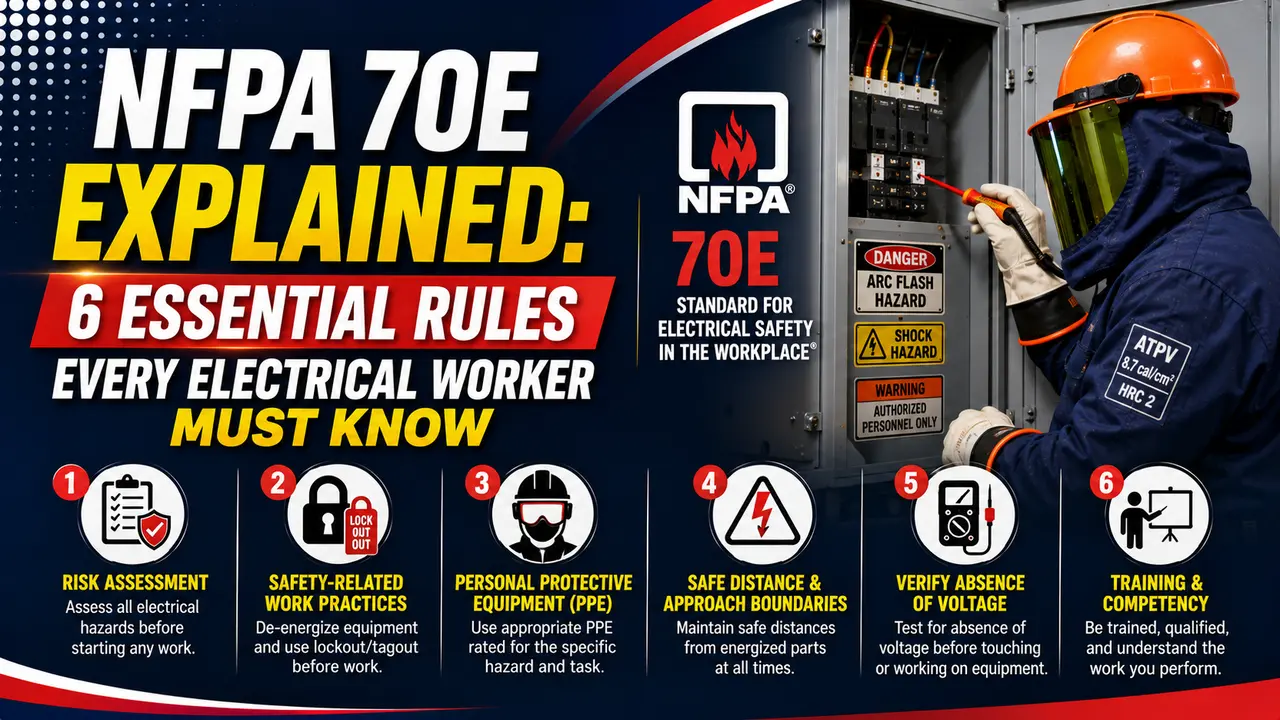
NFPA 70E

The standard applies to anyone who works on or near energized electrical equipment above 50V AC.

50V
Minimum voltage where NFPA 70E applies
3 years
Update cycle -- current edition is 2024
40 cal/cm²
Incident energy above which live work must not proceed
6 steps
Required to establish an Electrically Safe Work Condition
Advertisement
Advertisement

Key Articles Inside NFPA 70E

The standard is organised into numbered articles. These five are the ones that directly affect field workers and engineers.

Article 110
General Requirements
Defines who is a qualified person. Sets the hierarchy of risk controls. Requires an electrical hazard assessment before work begins.
Article 120
Safe Work Condition
The 6 steps to establish an Electrically Safe Work Condition (ESWC). All 6 must be completed before any conductor is touched. This is the LOTO section.
Article 130
Work Near Live Parts
Covers the shock protection boundaries, the arc flash boundary, energized work permits, and PPE selection for any live electrical work.
Article 230
Safety Related Maintenance
Sets requirements for maintaining electrical equipment in a safe condition. Covers inspection intervals and the safety implications of deferred maintenance.
Article 360
Special Equipment
Additional requirements for high voltage equipment, capacitors, and other special systems that carry higher or different hazards than standard low voltage equipment.
Informative Annex D
PPE Tables
Reference tables that list the required PPE category for common tasks by equipment type and voltage level. Used when an arc flash study is not available for the specific equipment.

Hierarchy of Risk Controls: The Most Important Concept in NFPA 70E

Before selecting PPE, NFPA 70E Article 110 requires that all higher level controls be considered first.

PPE is at the bottom -- not because it is unimportant, but because it is the last resort after every other control has been evaluated and either applied or ruled out.

1
Elimination
Remove the hazard entirely. De energise the equipment. The safest electrical work is always work on a dead system.
2
Substitution
Replace the hazardous condition with a safer one. Use lower voltage equipment, install remote racking, or add remote operation capability.
3
Engineering Controls
Physical barriers, arc flash current limiters, zone selective interlocking, insulating covers on bus work. These reduce the hazard before the worker arrives.
4
Awareness
Arc flash labels on every panel. Danger signs on energised switchgear. Barricades around live work zones. Orange cones and tape are awareness controls.
5
Administrative Controls
Energised work permits, written procedures, safety briefings, supervisor sign off, work order systems. Rules and paperwork that govern how work is done.
6
PPE -- Last Resort
Arc rated clothing, insulating gloves, face shields. Applied after all other controls are in place. PPE does not eliminate the hazard -- it protects the worker if other controls fail.

The 6 Step Electrically Safe Work Condition

Article 120 requires that all six steps are completed in order before any conductor can be touched.

Skipping or combining steps is a violation of the standard and a common cause of fatal accidents.

Step 1
Identify all sources
Identify every source of electrical supply to the equipment, including primary feeds, back feeds, stored energy (capacitors, UPS), and induced voltage from adjacent lines.
Step 2
Interrupt the load
Open the load before opening the isolating device. Breaking load current at the isolating device can cause arcing at the contacts.
Step 3
Open the isolating device
Open every disconnecting means. This includes neutral conductors in systems where disconnecting the neutral is required to achieve a truly isolated condition.
Step 4
Apply lockout tagout
Each worker applies their own personal lock to the isolation point. The LOTO procedure must match the requirements of OSHA 1910.147 and NFPA 70E Article 120.
Step 5
Release stored energy
Discharge capacitors. Release spring loaded mechanisms. Verify that UPS and battery systems are isolated. Stored energy can energise a circuit even after the main supply is off.
Step 6
Verify dead -- Prove Dead
Test every conductor phase and neutral with a calibrated voltage tester before touching. Test the tester on a known live source before and after. This step is mandatory even if you isolated the circuit yourself.
⚠️ Never Assume Dead
A circuit can appear isolated and still be energised through a back feed, a neutral fault, or a cross connection. Step 6, Prove Dead, is not optional. Every conductor must be tested immediately before touching, every time, by the person doing the work.
Advertisement
Advertisement

The Arc Flash Label: What Every Field Is Telling You

NFPA 70E Article 130.5 requires an arc flash label on any equipment where live work is possible.

The label must be applied after the arc flash study. Here is what each field means:

⚡ ARC FLASH HAZARD -- NFPA 70E
Nominal Voltage415V AC
Arc Flash Boundary900 mm
Working Distance450 mm
Incident Energy8.2 cal/cm²
PPE CategoryCategory 2
Gloves ClassClass 0 (1,000V)
Study DateMarch 2024

Arc flash boundary: Anyone within this distance of the open panel must wear the specified PPE. Beyond this distance, an arc flash would not cause a second degree burn on bare skin.

Incident energy: The arc energy at the working distance in cal/cm². This value drives the PPE category. An arc flash study per IEEE 1584 calculates this from the available fault current and protection device clearing time.

The Energized Work Permit: When and Why It Is Required

NFPA 70E Article 130.2 requires a written energized work permit any time live work is performed that could have been done with the equipment de-energised.

The permit must justify why isolation was not possible. Common accepted reasons:

  • De energising would create a greater hazard (for example, shutting down hospital life support equipment)
  • De energising is not feasible due to continuous process requirements
  • The task is diagnostics or measurements that require the circuit to be live
What the Permit Must Include
Description of the circuit and the work. Justification for live work. Results of the arc flash hazard assessment. PPE required. Names of the qualified persons doing the work. Authorising signature of the responsible manager or safety officer.

Shock and Arc Flash Protection Boundaries

Boundary NameWho It Applies ToWhat It Means
Limited Approach BoundaryUnqualified personsUnqualified persons must not cross this line unless escorted by a qualified person. Set by table in NFPA 70E based on voltage.
Restricted Approach BoundaryQualified persons onlyRequires shock PPE and an approved plan. Only qualified persons may enter. Set closer to the conductors than the limited boundary.
Prohibited Approach BoundaryQualified persons, with insulationEquivalent to making contact. Requires the same PPE and precautions as direct contact with the live conductor.
Arc Flash BoundaryAnyone within reach of an arc eventCalculated from the arc flash study. Anyone inside this distance during live work must wear arc-rated PPE matching the incident energy.

NFPA 70E Knowledge Check

📋
NFPA 70E Scenario Advisor
Select a work scenario to see what NFPA 70E requires
-
-

NFPA 70E vs OSHA vs IEC 60364

StandardTypeJurisdictionCovers
NFPA 70E (2024)Consensus standard -- not law, but OSHA referencedUSA workplacesSafe work procedures, arc flash PPE, energised work, LOTO
OSHA 29 CFR 1910.333Federal lawUSA federalMinimum legal requirements for electrical safety. References NFPA 70E as acceptable compliance method.
IEC 60364International standardEurope, India, most countries outside USAElectrical installation design and protection. Covers safe voltages, earthing systems, and protection device coordination.
BS 7671 (18th Edition)National standard, UKUnited KingdomUK implementation of IEC 60364. Governs LV installation design, earthing, and cable sizing.
IEEE 1584 (2018)Engineering standardUSA, global referenceArc flash incident energy calculation method. Used to produce the values shown on arc flash labels.

Watch: NFPA 70E Electrical Safety Standard Explained

Advertisement
Advertisement

NFPA 70E Questions Engineers and Technicians Ask

What is NFPA 70E and who does it apply to?
NFPA 70E is the US standard for electrical safety in the workplace. It applies to any worker who operates, maintains, or works near energised electrical equipment above 50V AC in commercial or industrial buildings.
Is NFPA 70E compliance legally required?
NFPA 70E itself is not law. OSHA 29 CFR 1910.333 is law, and OSHA accepts NFPA 70E compliance as meeting its electrical safety requirements. Non compliance with NFPA 70E is routinely cited as evidence of OSHA violations after incidents.
What is the difference between NFPA 70E and the NEC?
NFPA 70 (NEC) governs how electrical systems are designed and installed. NFPA 70E governs how workers safely work on those systems after installation. One covers construction, the other covers operation and maintenance.
What is an Electrically Safe Work Condition?
An ESWC is achieved when a circuit has been isolated, locked out, and proven dead through all six steps of NFPA 70E Article 120. Only after all six steps are complete can workers touch conductors without electrical PPE.
When is an energised work permit required?
An energised work permit is required whenever live work is performed on equipment that could have been de-energised. The permit documents the justification, hazard assessment, required PPE, and names of the qualified persons involved.
What happens if the arc flash incident energy exceeds 40 cal/cm²?
NFPA 70E prohibits live work at incident energies above 40 cal/cm². The equipment must be de-energised first. No PPE category covers this level of hazard under the standard.

External References

Advertisement
Advertisement

What We Learn Today

  • NFPA 70E 2024 is the accepted US standard for electrical workplace safety -- not law itself, but the method OSHA accepts for compliance
  • The hierarchy of risk controls puts elimination first and PPE last -- PPE is always the last resort, not the first response
  • An Electrically Safe Work Condition requires all 6 steps of Article 120 to be completed -- skipping any step is a violation
  • Step 6 (Prove Dead) is mandatory even if you isolated the circuit yourself -- always test before touching
  • An energised work permit is required for any live work that could have been done with the equipment de-energised
  • Arc flash incident energy above 40 cal/cm² means live work is prohibited under NFPA 70E -- de-energise first
  • Arc flash labels must show: voltage, arc flash boundary, working distance, incident energy, PPE category, and study date
“The purpose of NFPA 70E is not to make electrical work harder. It is to make sure that when a worker goes home at the end of the shift, they go home the same way they arrived.”

Leave a Reply

Your email address will not be published. Required fields are marked *