
An MCB sized purely to survive the load will eventually let a cable overheat before it ever trips.
Correct sizing is never about the breaker alone. It's about the relationship between the load, the cable, and the breaker together.
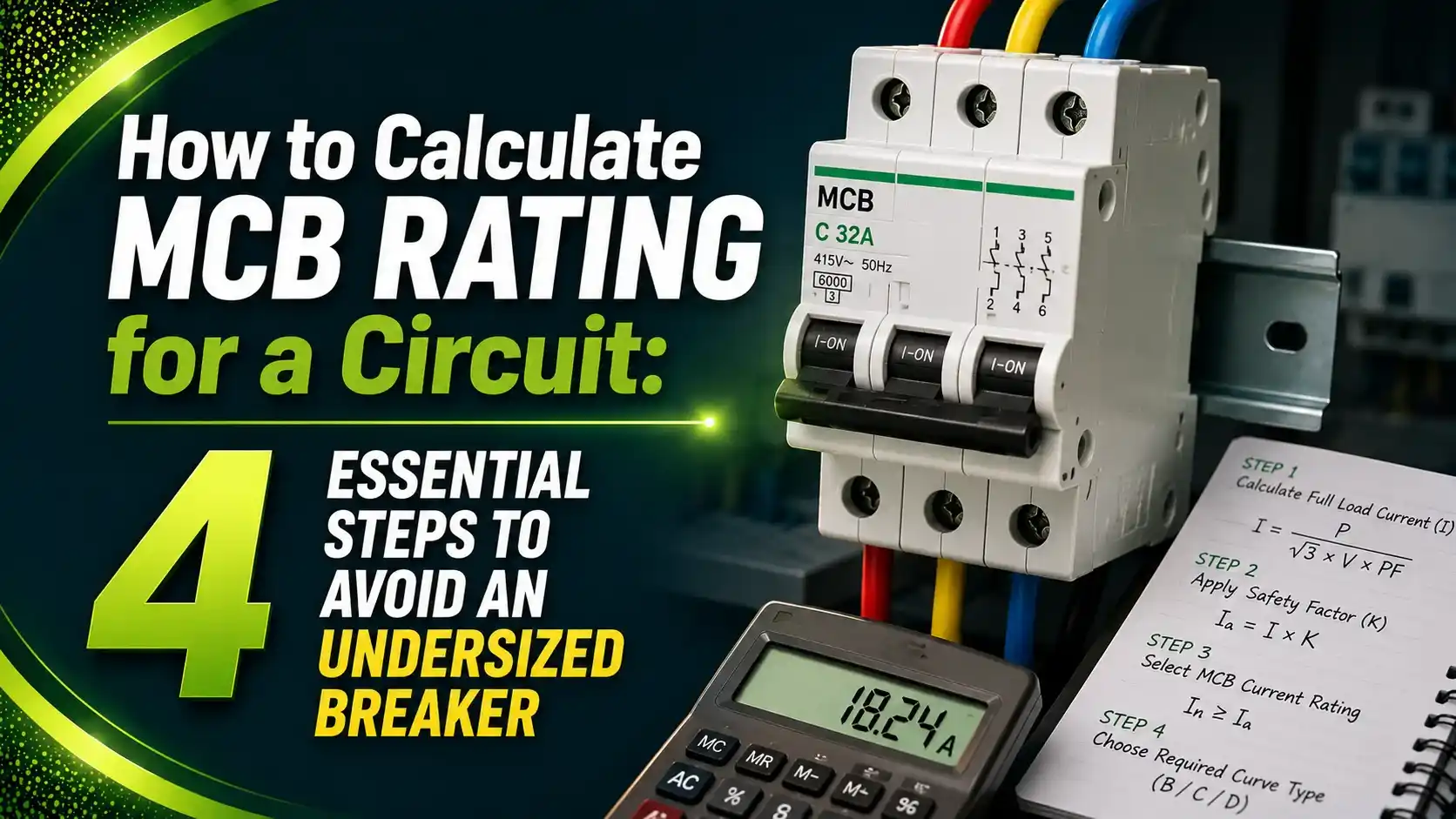
How to calculate MCB rating for a circuit means finding the design current the load actually draws, applying the correct safety margin, and choosing a standard breaker rating that stays above the load current but never exceeds what the connected cable can safely carry.
Most people size an MCB by comparing it to the load and stopping there. That's only half the calculation, and it's the easier half.
The load current tells you the minimum rating the breaker needs. It says nothing about the maximum rating the breaker is allowed to have.
That upper limit comes from the cable feeding the circuit. Every conductor has a maximum current it can carry continuously before its insulation starts to degrade from heat.
If the MCB rating sits above that cable limit, the breaker will happily let the cable run hot for years without ever tripping. Nothing about that failure mode looks wrong until it does.
According to VIOX's breaker sizing and load calculation guide, correct sizing always sits at the intersection of the load's real current draw, the cable's rated ampacity, and the breaker's own trip characteristics.
Get any one of those three wrong, and the protection scheme silently stops doing its actual job, protecting the wire, not just switching the power.
This guide walks through the exact calculation, the standard ratings available, and how to pick the right trip curve for the load actually connected.
The Fundamental Rule: Ib ≤ In ≤ Iz
Every correct MCB rating calculation ultimately answers to this one inequality, straight from cable protection theory.
An MCB that's too small nuisance trips on legitimate demand. An MCB that's too large stops protecting the cable the moment its rating crosses above Iz. Both failures come from skipping half of the same inequality.
The 4 Steps to Calculate MCB Rating
Work through these in order every time, since each step can change the final answer, a sequence HUYU Electric's sizing guide also confirms is essential to avoid dangerous overheating.
Calculate the Design Current (Ib)
Use I = P/V for single phase, or I = P/(1.732 x V x PF) for three phase, based on the connected load's real power.
Apply the Continuous Load Margin
For loads running 3 hours or more continuously, multiply Ib by 1.25 before selecting a rating.
Choose the Trip Curve Type
Match B, C, or D to the load's actual inrush behavior, not just its steady-state current.
Verify Against Cable Ampacity
Confirm the chosen In doesn't exceed Iz, the cable's safe carrying capacity after any derating.
Interactive MCB Sizing Calculator
Enter the load and voltage details to calculate design current and the minimum breaker rating with margin applied.
B, C, and D Curve Trip Characteristics (IEC 60898-1)
These real numbers, for a 16A breaker, show how dramatically the instantaneous trip band shifts between curve types.
| Curve | Instantaneous Trip Range | 16A Example | Typical Use |
|---|---|---|---|
| Type B | 3 to 5 × In | 48 to 80 A | Lighting, domestic sockets, resistive loads |
| Type C | 5 to 10 × In | 80 to 160 A | Motors, fluorescent lighting, moderate inrush |
| Type D | 10 to 20 × In | 160 to 320 A | Transformers, capacitors, high inrush loads |
All three curve types share the same thermal (overload) band per EEP's low voltage electrician reference: roughly 1.13 x In for non-tripping, and 1.45 x In for tripping within one hour.
Standard MCB Ratings and Temperature Derating
Standard IEC ratings follow a fixed series, and per Purely Energy's breaker size reference, ambient temperature above the calibration point reduces the usable rating.
| Item | Value |
|---|---|
| Standard IEC MCB ratings | 6, 10, 16, 20, 25, 32, 40, 50, 63, 80, 100, 125A |
| Typical calibration temperature | 30°C (some families 40°C) |
| Example derating at 50°C ambient | Factor of roughly 0.9 applied to nominal rating |
| MCB vs MCCB boundary | MCB typically tops out at 125A; MCCB covers higher ranges |
MCB vs MCCB
Both protect circuits from overload and short circuit, but they serve very different current ranges.
MCB (Miniature Circuit Breaker)
Fixed thermal-magnetic trip settings, ratings up to 125A, per VIOX's MCCB selection guide comparison.
MCCB (Molded Case Circuit Breaker)
Adjustable electronic trip units, ratings up to 4000A, higher breaking capacity for fault currents.
Applications Requiring Careful MCB Rating
Residential Lighting Circuits
Type B breakers matched to steady, low inrush loads.
Motor Control Circuits
Type C or D breakers to survive starting inrush current.
EV Charge Points
Continuous load margin critical for extended charging sessions.
Commercial Kitchens
Ovens and catering equipment treated as continuous loads.
Industrial Sub-Panels
Temperature derating critical inside enclosed panel spaces.
Server and Data Racks
Continuous, near-constant load demanding accurate margin.
Do's and Don'ts of MCB Rating Selection
✓ Do
- Always verify the final MCB rating against the cable's Iz, not just the load
- Apply the 125% margin for any load running continuously for 3 hours or more
- Match curve type to inrush behavior, not just steady-state current
- Recalculate derating whenever ambient temperature or grouping changes
✗ Don't
- Size an MCB to the load alone without checking the cable's rated ampacity
- Use a B-curve breaker on a circuit with genuine motor starting inrush
- Ignore continuous load duty when sizing EV chargers or ovens
- Assume MCB and MCCB are interchangeable above 125A
Breaking Capacity: The Rating Everyone Forgets
Current rating and trip curve only handle overload and moderate fault conditions. Breaking capacity covers something different entirely.
It's the maximum fault current, usually expressed in kA, the MCB can safely interrupt without its contacts welding shut or the enclosure failing.
A breaker correctly sized for load current but rated for only 6kA breaking capacity can fail catastrophically on a system with a 10kA prospective fault current. This spec must always be checked against the actual fault level at the installation point, not assumed from the amperage rating alone.
Reference Materials on MCB Rating
FAQs on MCB Rating Calculation
External References
- Circuit Breaker Size Calculator, Purely Energy
- Circuit Breaker Trip Curves (B, C, D) Guide, Breaker Hunters
- Circuit Breaker Sizing and Load Calculation Guide, VIOX
- 1C10UR MCB Datasheet, Altech
- Maximum Earth Fault Loop Impedance for Protective Devices, IET Wiring Matters
What we learn today
- How to calculate MCB rating for a circuit always follows Ib ≤ In ≤ Iz: design current, breaker rating, and cable capacity, in that order.
- Continuous loads running 3 hours or more need the design current multiplied by 1.25 before selecting a standard breaker size.
- Curve type matters as much as amperage: Type B trips at 3 to 5 x In, Type C at 5 to 10 x In, and Type D at 10 to 20 x In.
- All three curve types share the same thermal band, roughly 1.13 x In non-tripping and 1.45 x In tripping within one hour.
- An MCB rated above the cable's Iz stops protecting that cable, even though it still protects against a dead short.