
Multiply voltage by current and stop there, and a three phase calculation comes out wrong every time.
The square root of 3 isn't optional. It's the whole reason three phase power delivers what single phase never can.
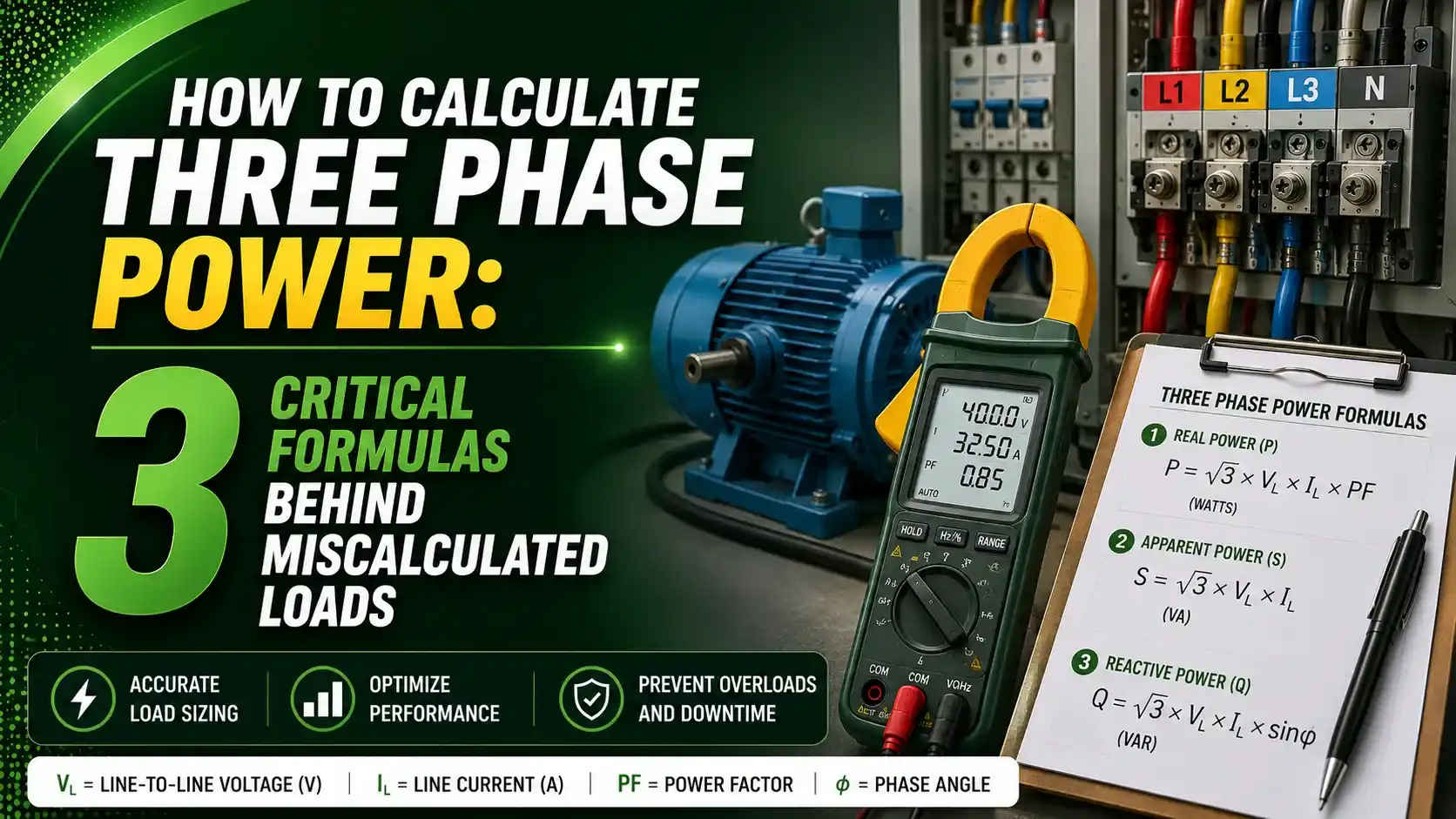
How to calculate three phase power comes down to three related quantities, real power in kW, reactive power in kVAR, and apparent power in kVA, connected through the power factor and the square root of 3.
Three separate voltage waveforms, each offset by 120 degrees, combine to deliver continuous power instead of the pulsing on-off delivery of single phase.
That continuous delivery is exactly why almost every motor above a few horsepower runs on three phase power instead of single phase.
The 3 Types of Power in a Three Phase System
These three quantities form what's known as the power triangle, and every three phase calculation ultimately touches all three.
Real Power (kW)
The power that actually does useful work, driving motors, generating heat and light. This is what a utility bills for.
Reactive Power (kVAR)
Non-working power that builds and maintains magnetic fields in motors and transformers. Necessary, but does no useful work.
Apparent Power (kVA)
The vector sum of real and reactive power, and the total current the system actually has to carry and supply.
Star (Wye) vs Delta Connection
The connection type changes the relationship between line and phase quantities, though not the total power delivered.
Star (Wye) Connection
Line voltage is 1.732 times phase voltage. Line current equals phase current. Provides a neutral point.
Delta Connection
Line voltage equals phase voltage. Line current is 1.732 times phase current. No neutral point available.
Why the Square Root of 3 Appears
The 1.732 factor isn't an arbitrary constant. It falls directly out of the geometry of three voltages spaced 120 degrees apart.
Star and delta connections of the same phase voltage, current, and angle deliver exactly the same total power, even though their line quantities look completely different on a meter.
Three Phase Power Formulas and a Worked Example
These formulas apply to balanced loads regardless of whether the connection is star or delta.
Example: 480V three-phase system, 50A line current, PF = 0.85
S = 1.732 x 480 x 50 = 41,568 VA = 41.6 kVA
P = 41.6 x 0.85 = 35.4 kW
Q = 41.6 x sin(31.8°) = 21.9 kVAR
Star vs Delta: Line and Phase Values
These relationships hold regardless of the load's power factor.
| Quantity | Star (Wye) | Delta |
|---|---|---|
| Line voltage (VL) | √3 x phase voltage | Equal to phase voltage |
| Line current (IL) | Equal to phase current | √3 x phase current |
| Neutral point | Available | Not available |
| Common use | Distribution, needs a neutral | Transmission, motor starting |
Correcting for Unbalanced Loads
The clean 1.732 formula assumes a perfectly balanced load, which real installations rarely have exactly.
For an unbalanced three phase system, apparent power should be calculated per phase and summed, rather than using a single average current in the standard formula.
NEMA MG-1 and IEEE standards generally limit current unbalance to about 10 percent for motors and 5 percent for sensitive electronic equipment, with significant derating required beyond that.
Where Three Phase Power Calculations Matter
Motor Sizing
Selecting the correct feeder, breaker, and starter for a given motor.
Transformer Loading
Verifying secondary loading stays within nameplate kVA capacity.
Industrial Distribution
Panel and switchgear sizing for mixed motor and lighting loads.
Data Centers
Power factor correction for low PF UPS and server loads.
Power Factor Correction
Sizing capacitor banks to reduce reactive power demand.
Energy Metering
Verifying utility billing meters against calculated demand.
Do's and Don'ts of Three Phase Power Calculations
✓ Do
- Always include the square root of 3 factor for line quantity calculations
- Confirm whether a nameplate voltage is line-to-line or line-to-neutral
- Calculate per-phase apparent power separately for unbalanced loads
- Distinguish clearly between kW, kVAR, and kVA in every calculation
✗ Don't
- Simply add single phase power three times without checking the connection type
- Confuse star and delta line-to-phase relationships
- Ignore power factor when converting between kVA and kW
- Assume a "balanced load" formula is accurate on a genuinely unbalanced system
Live Three Phase Power Calculator
Enter line voltage, line current, and power factor to calculate apparent, real, and reactive power.
Power Factor Correction Reduces Apparent Power
A low power factor means the same real power draws more current than it should, and that extra current still has to be paid for and delivered.
Capacitor banks correct this by supplying reactive power locally, right at the load, instead of pulling it all the way from the source.
The required capacitor size follows Qc = P x (tan(φ1) minus tan(φ2)), moving the power triangle's angle from the existing power factor to the target power factor without changing real power at all.
Reference Materials on Three Phase Power
FAQs on How to Calculate Three Phase Power
External References
- Three-Phase Y and Delta Configurations, All About Circuits
- Star and Delta Connection Explained, The Electrical Guy
- Three Phase Power Calculator and Formula Derivation, Omni Calculator
- Three-Phase Power Systems, CED Engineering
- 3-Phase Efficiency, Power Factor, and Harmonics, LaMarche Manufacturing
What we learn today
- How to calculate three phase power involves three related quantities: real power (P) in kW, reactive power (Q) in kVAR, and apparent power (S) in kVA.
- The core formula is S = 1.732 x line voltage x line current, with real power found by multiplying by the power factor.
- Star connections use VL = 1.732 x phase voltage, while delta connections use IL = 1.732 x phase current, but both deliver the same total power.
- The square root of 3 factor is why three phase power delivers roughly 73% more power than single phase for the same conductor size.
- Unbalanced loads need per-phase apparent power calculations summed together, not the standard balanced-load formula.