
A lightning strike a mile away can still send a damaging spike down a power line into a home or plant.
Most of the time, the small ceramic disc that quietly absorbs that spike is a varistor.
A varistor is a voltage-dependent resistor, most commonly a metal oxide varistor (MOV), that stays nearly invisible to a circuit at normal voltage but collapses to a low resistance the instant voltage rises past a threshold, diverting surge energy away from sensitive components.
What Is a Varistor? How it Works
Every piece of electronics connected to a power line lives with a quiet risk. Lightning, utility switching, and even a nearby motor starting can all send a brief, damaging spike down that same line.
Fuses and circuit breakers are far too slow to catch these events. A voltage spike can rise and fall in microseconds, long before any mechanical or thermal protection device has time to react.
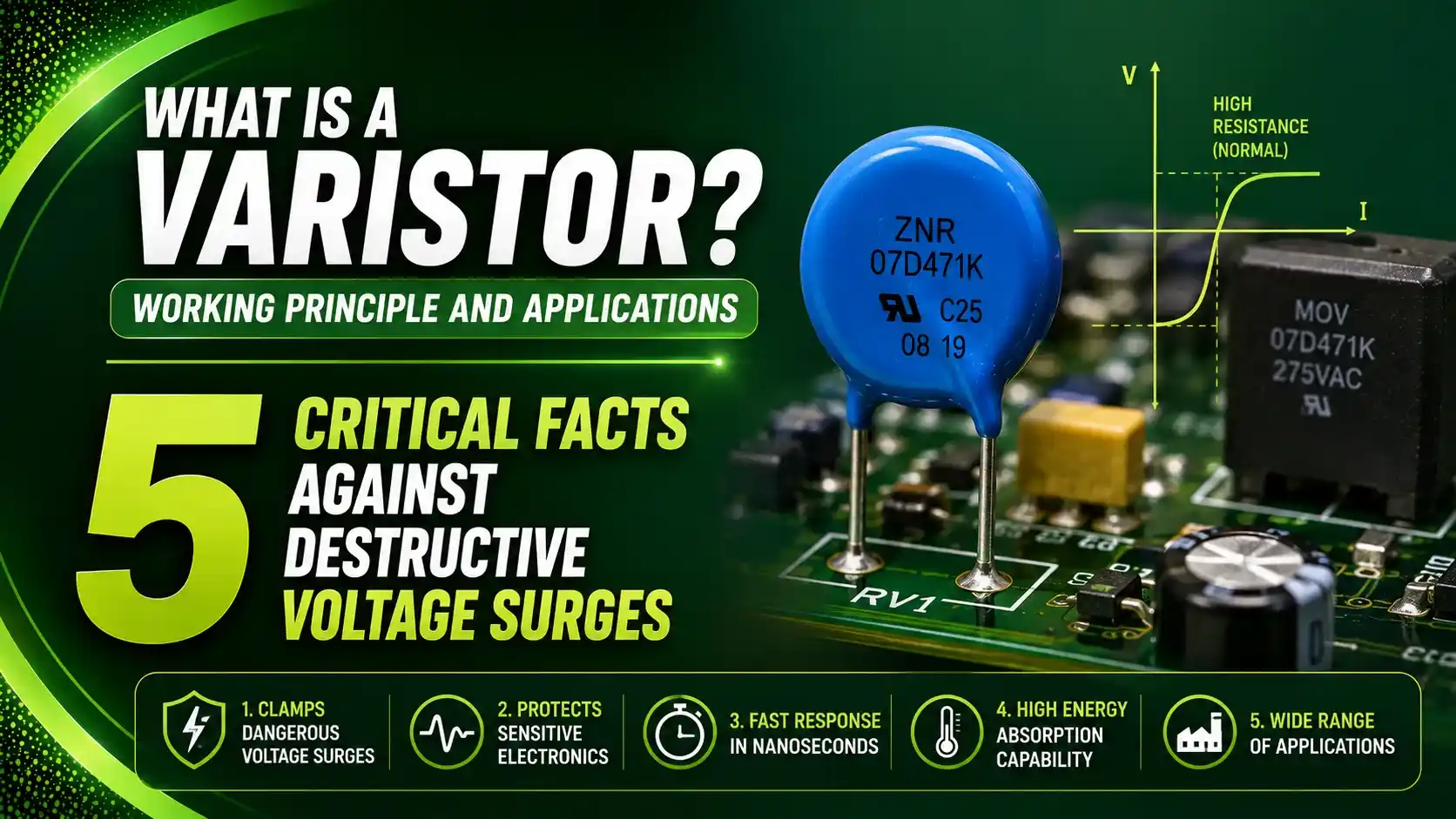
That gap is exactly where the varistor lives. It has no moving parts, no filament, and nothing that wears out from a single event the way a fuse does.
Instead, a varistor relies on a purely electrical property: its resistance depends heavily on the voltage across it, changing by orders of magnitude within nanoseconds.
Under normal conditions, that resistance sits in the megaohm range. The varistor draws almost no current and has essentially no effect on the circuit it's protecting.
The moment voltage crosses its rated threshold, that same resistance can drop to just a few ohms. Current that would have destroyed a downstream component instead flows through the varistor itself.
This entire behavior comes from the material science of the disc itself, specifically how zinc oxide grains and their boundaries are engineered during manufacturing.
Understanding that structure, along with the small handful of ratings that actually matter when selecting one, is what the rest of this guide covers.

5 Critical Facts About How a Varistor Works
These five points cover the physics, the ratings, and the real-world limits every varistor selection depends on.
Built From Zinc Oxide Grain Boundaries
Millions of ZnO grains, pressed and sintered with bismuth and other oxides, each form a microscopic diode-like junction with its neighbors.
Follows a Nonlinear Power Law
Current relates to voltage as I = kV^alpha, with alpha typically between 20 and 100, giving an extremely sharp on/off transition.
Rated by Its Clamping (Varistor) Voltage
Defined as the voltage across the device at 1 mA of current, this sets the point where meaningful conduction begins.
Has a Finite Energy Absorption Rating
Measured in joules, this caps how much surge energy the device can absorb before it's permanently damaged.
Reacts in Nanoseconds
Far faster than any mechanical protection device, making it effective against fast transients that fuses can never catch in time.
Normal Operation vs Overvoltage Condition
A varistor genuinely behaves like two different components depending on the voltage across it.
Normal Operation
Resistance sits in the megaohm range. Leakage current is microamps at most, invisible to the rest of the circuit.
Overvoltage Condition
Resistance collapses to a few ohms within nanoseconds. Amps of current divert through the varistor instead of the protected circuit.
Inside a Grain Boundary: Where the Physics Actually Happens
The magic isn't in the zinc oxide itself. It's in the countless junctions between one grain and the next.
A varistor rated for hundreds of volts isn't one big junction. It's thousands of tiny 2 to 4 volt junctions stacked end to end through the ceramic disc, all breaking down together the instant the threshold is crossed.
The Power Law and Energy Absorption Formula
Two equations describe almost everything an engineer needs to select and size a varistor.
Vc = clamping voltage, I = peak surge current, Γ = impulse duration, K = form factor
Example: Vc = 500V, I = 100A, Γ = 20 microseconds (8/20µs waveform), K ≈ 1
E = 500 x 100 x 0.00002 = 1.0 Joule (per pulse, simplified)
UL Clamping Voltage and Joule Rating Tiers
Real surge protection ratings fall into recognizable bands used across the industry.
| Rating Level | Clamping Voltage (UL 1449) | Energy Rating |
|---|---|---|
| Minimum acceptable | 500 V | 200 to 400 Joules |
| Good protection | 400 V | 400 to 600 Joules |
| Better protection | 330 V | 600+ Joules |
Where Varistors Are Used
Power Supplies
AC line input protection against surges and switching transients.
Surge Protector Strips
Consumer AC outlet strips using multiple parallel MOVs.
Whole-House Surge Arrestors
Panel-mounted high energy varistors protecting entire electrical systems.
Automotive Electronics
Protecting ECUs from load dump and ignition transients.
Telecom Equipment
Line protection on telephone and network interface circuits.
Renewable Energy Systems
Photovoltaic combiner boxes and inverter surge protection.
Do's and Don'ts of Varistor Selection
✓ Do
- Keep maximum continuous operating voltage (MCOV) safely above the supply voltage
- Choose energy rating based on the actual expected surge current, not a generic guess
- Pair varistors with fuses to fail safely after the varistor's lifetime is exhausted
- Prefer lower clamping voltage when protecting especially sensitive electronics
✗ Don't
- Assume a higher total joule rating on a power strip always means better protection
- Ignore that varistors degrade slightly with every surge event they absorb
- Select clamping voltage so low that normal supply fluctuations trigger conduction
- Use a single small varistor where a genuinely high energy event is expected
Live Varistor Energy Absorption Calculator
Enter clamping voltage, peak surge current, and impulse duration to estimate absorbed energy in joules.
Varistor vs TVS Diode: A Common Alternative
Varistors aren't the only clamping technology available. TVS (transient voltage suppression) diodes solve the same problem differently.
A TVS diode typically clamps faster and holds a tighter voltage tolerance, but its energy handling capacity is usually much lower for a given size.
Varistors remain the more common choice for absorbing large surge energy cheaply, while TVS diodes get selected when clamping precision and speed matter more than raw joules.
Reference Materials on Varistors
FAQs on Varistors
External References
- Varistor and the Metal Oxide Varistor Tutorial, Electronics Tutorials
- Varistors, An Overview, ScienceDirect Topics
- Metal Oxide Varistor (MOV): Working, Application, Design Tips and Selection Guide, Components101
- Varistor Components Product Guide, Bourns
- Overvoltage Protector Joule Ratings Application Note, Bourns
What we learn today
- A varistor is a voltage-dependent resistor, most commonly a metal oxide varistor built from zinc oxide grains, that clamps voltage transients by collapsing its resistance sharply above a threshold.
- The nonlinear behavior follows I = kV^alpha, with alpha typically between 20 and 100, giving an extremely sharp transition from insulator to conductor.
- Clamping (varistor) voltage is defined at 1 mA of reference current, and energy absorption is rated in joules using E = K x Vc x I x impulse duration.
- Real surge protector ratings fall into recognizable tiers: 500V/200-400J minimum, down to 330V/600J+ for better protection.
- Varistors respond in nanoseconds, far faster than fuses or breakers, but degrade slightly with each surge and should be paired with a fuse for safe end-of-life failure.