
A hospital ventilator, a data center rack, and a production line all share one quiet dependency, an automatic transfer switch standing by to catch a power failure before anyone notices it happened. Here is exactly what that switch does and how it earns its keep.
An automatic transfer switch is the one component in a backup power system that has to work every single time, on the one day it actually matters. It rarely gets attention until the moment the lights would otherwise go out.
An automatic transfer switch, usually shortened to ATS, automatically moves a facility's power supply from its primary source to a backup source the instant it senses a failure or outage. Once the primary source comes back and stabilizes, the same switch quietly moves the load back again.
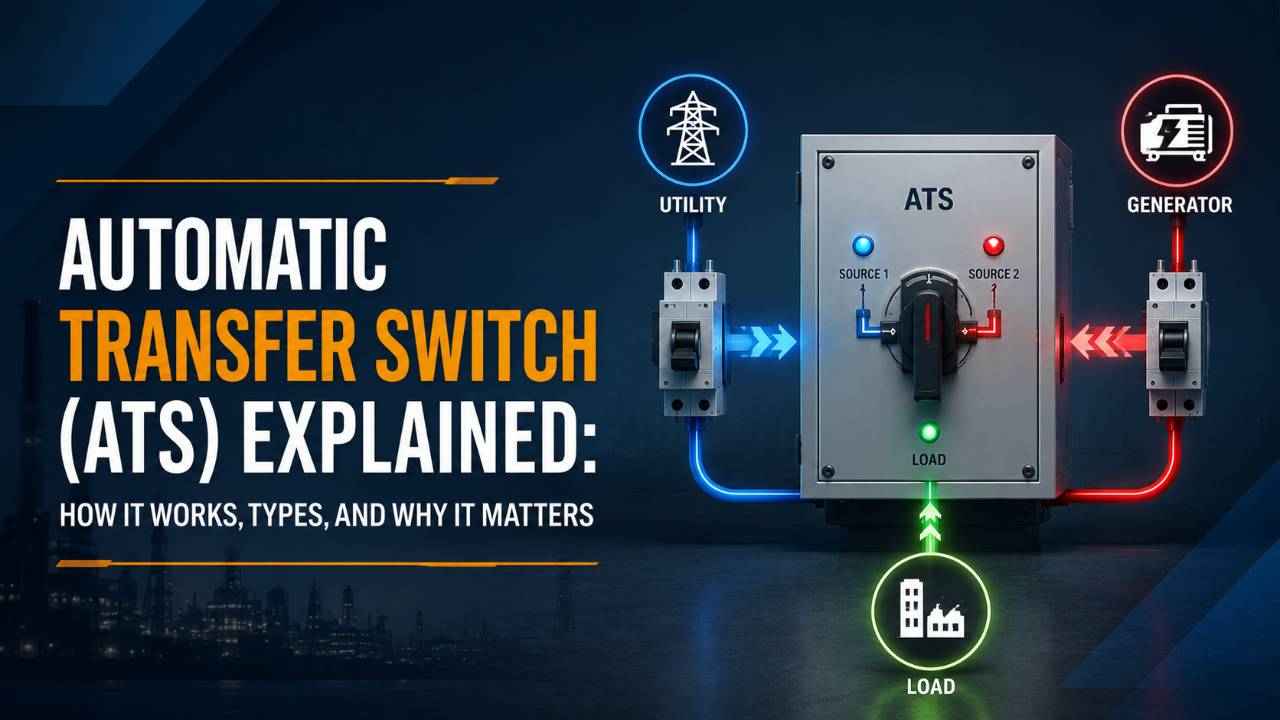
This guide covers what an ATS actually does, how it works step by step, the three ways it can transition power, the common arrangements it gets built into, and why it plays such a critical role in facilities that simply cannot afford downtime.
What Is an Automatic Transfer Switch
An automatic transfer switch is a device that automatically connects a facility's electrical equipment to backup power the moment its primary power source fails. It sits between the equipment and both power sources, acting as an intelligent electrical relay rather than a simple mechanical switch.
Hospitals, data centers, and factories are among the facilities that rely on an ATS most heavily, since even a brief power interruption in these environments can threaten safety, damage equipment, or halt production entirely.
Why an Automatic Transfer Switch Matters
Wherever downtime carries a serious cost, whether that cost is measured in lost revenue, damaged equipment, or human safety, an automatic transfer switch is doing quiet, essential work in the background. It keeps machines that require continuous or near continuous uptime running straight through a utility outage. This is exactly why an automatic transfer switch is treated as critical infrastructure rather than an optional extra.
Without an ATS, restoring power after an outage would depend on someone physically noticing the failure and manually switching over to backup power, a delay that critical loads simply cannot absorb.
The value of an automatic transfer switch is measured in the seconds it saves during the one event nobody plans for. A facility only discovers how well its ATS performs on the day the primary power actually fails.
How an Automatic Transfer Switch Works
The primary power source fails
The ATS continuously monitors the voltage and frequency of the primary source, so it recognizes a failure or an out of range reading almost immediately.
The ATS checks the secondary source
Before committing to a switch, the ATS confirms that the backup source, whether a standby power supply or a generator, is stable and within acceptable voltage and frequency tolerances.
The load switches to the secondary source
Once the backup source checks out, the ATS switches the load circuit over automatically and near instantaneously, minimizing the interruption felt downstream.
The load returns once primary power is restored
The ATS keeps watching the primary source, and once it has been stable for a set period, the switch retransfers the load back to it automatically.

Key Functions of an Automatic Transfer Switch
Failure Detection
Continuously monitors voltage and frequency on the primary source so it can react the moment either falls out of range.
Electrical Relay Function
Sits between equipment and both power sources, keeping the load connected to one of them at all times, including during short circuit or fault conditions.
Redundant Power Path
Can double as a rack mounted redundant power supply for equipment fitted with only a single power cord.
Automatic Retransfer
Senses when the primary source is restored and stable, then returns the load to it without needing a human to intervene.
Watch: How an Automatic Transfer Switch Works
This walkthrough opens the panel and shows the switching process in action, which makes the concept far easier to follow than a diagram alone.
Video: "How Automatic Transfer Switches ACTUALLY Work", via YouTube.
Three Ways an Automatic Transfer Switch Transitions Power
Depending on its design, an automatic transfer switch can hand the load between sources in one of three distinct ways.
| Transition Type | How It Works |
|---|---|
| Closed transition | Also called make before break. The ATS connects equipment to the backup source before disconnecting from the primary, so equipment never sees an interruption at all. |
| Open transition | Also called break before make. The ATS disconnects from the primary source first, then connects to the backup source, creating a brief gap in power. |
| Delayed transition | The ATS breaks the primary connection, waits briefly, then connects the backup source, giving residual voltage from inductive loads time to dissipate safely. |
Common Automatic Transfer Switch Arrangements
| Arrangement | Typical Use |
|---|---|
| Two utility sources | Provides redundancy between two independent utility feeds and allows quick restoration if one goes down. |
| Two generators | Common in remote facilities with no reliable utility connection to fall back on. |
| Utility source plus generator | The most common arrangement, switching between grid power and a standby generator. |
Some facilities go further and install a three source arrangement, adding a second generator or a second utility feed as an extra layer of backup so the site stays powered even if both the primary and first backup source fail together. Choosing the right arrangement is one of the first decisions to make when specifying an automatic transfer switch.
Internal Control Logic
An automatic transfer switch is intelligent and self acting because of the microprocessor controller built into it. That controller continuously monitors voltage and frequency on both sources, identifies a failure, switches the load automatically, and returns it to the primary source once utility power is restored.
Human operators still have a manual or nonautomatic option available, usually a handle, a rotating switch, or a button, to initiate the transfer themselves when needed.
Why an Automatic Transfer Switch Matters in Data Centers
Data centers depend on uninterrupted power more than almost any other facility type. An automatic transfer switch protects against data loss, preserves data integrity, and shields systems from the physical damage that voltage spikes, brownouts, or blackouts can cause.
Because of this, an automatic transfer switch is a standard part of business continuity and disaster recovery planning, sitting quietly at the center of a data center's emergency power strategy.
Automatic Transfer Switch Maintenance
Regular maintenance is what turns an automatic transfer switch from a theoretical safeguard into one that actually performs when called on.
✔ Do
- Inspect and clean dust from UPS and ATS intake vents on a schedule
- Test the switchover process regularly, not only during an actual outage
- Check electrical contacts for wear after any high current switching event
- Keep maintenance records for every inspection and test cycle
✘ Don't
- Assume the ATS works simply because it has never been tested
- Ignore dust buildup around cooling vents and intake points
- Skip contact inspection after a heavy fault current event
- Treat the ATS as maintenance free once it is installed
FAQs on Automatic Transfer Switches
You May Also Like
Redundant Power Supply: 4 Ultimate Rules for Zero Downtime Panels
A redundant power supply means running two SMPS units together inside a panel, one primary and one standby, so a single failure never stops the panel from running. This guide breaks down how diode based switchover works, why no controller is needed, and the wiring rules that keep it reliable.
Read Full Article →What we learn today
- An automatic transfer switch senses a primary power failure and automatically moves the load to a backup source, then retransfers it once primary power is stable again.
- Closed, open, and delayed transitions each handle the moment of switchover differently, trading off continuity against equipment protection.
- Common arrangements pair two utility feeds, two generators, or a utility source with a generator, and some facilities add a third source for extra resilience.
- A built in microprocessor controller makes the switch intelligent and self acting, while a manual override remains available for human operators.
- Regular maintenance, especially contact inspection and vent cleaning, is what keeps an ATS reliable on the one day it actually has to work.