
Every electronic component falls into one of two families, and the line between them comes down to one question: can it add net energy to a signal, or only work with what is already there? Here is exactly how active and passive components differ, with a real classification guide and a live component classifier you can try now.
What Are Active and Passive Components?
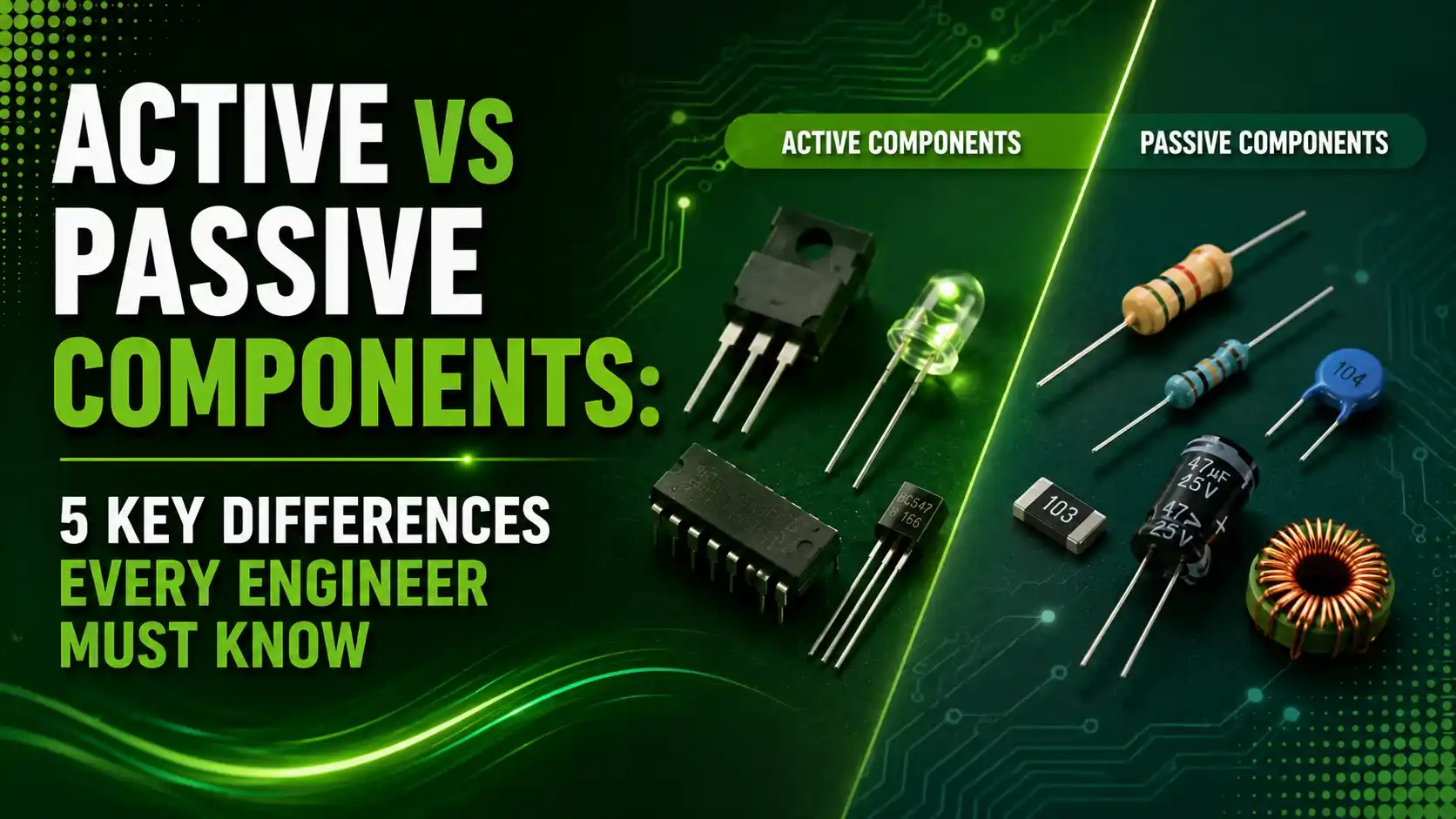
An active component can supply energy to a circuit and control the flow of current, usually by drawing on an external power source. A passive component can only receive, store, or dissipate energy, never adding net power of its own.
This one distinction shapes almost every circuit design decision, from which parts need a power rail to which ones simply respond to whatever signal reaches them. It also underlies why components like operational amplifiers and voltage regulator ICs need a supply rail, while a resistor or capacitor never does.
This guide covers the five key differences between active and passive components, from power requirements to real-world examples of each.

Active vs Passive Components: Core Definitions
Before comparing the details, it helps to see each definition side by side.
Active Components
Supply energy to a circuit and control the flow of charge, typically requiring an external power source to do so. Every functioning electronic circuit needs at least one.
Examples: transistors, integrated circuits, operational amplifiers, SCRs.
Passive Components
Receive energy and can only store, absorb, or dissipate it. They operate purely on the energy already present in the signal, with no external power needed.
Examples: resistors, capacitors, inductors, transformers.
Notice that this classification has nothing to do with size, cost, or complexity. A tiny surface-mount resistor and a large industrial transformer are both passive, while a single small transistor and a densely packed microprocessor are both active. What matters is only whether the component adds net energy and controls current flow, or simply responds to whatever energy the circuit already contains.
5 Key Differences Between Active and Passive Components
These five differences explain almost every practical question that comes up when classifying a component or designing around it.
External Power Requirement
Active components need an external power source, beyond the signal itself, to function. Passive components operate purely on the energy already present in the circuit.
Energy Behavior
Active components can add net energy to a circuit. Passive components can only receive energy, which they then dissipate as heat, store in a field, or release later, never generating power of their own.
Power Gain
Active components can deliver power gain greater than one, making genuine amplification possible. Passive components always have a gain of one or less, since they cannot output more power than they receive.
Signal Control
Active components can control the flow of current using a separate control signal, the basis of switching and amplification. Passive components simply respond according to fixed physical relationships like Ohm's law.
Real-World Examples
Transistors, integrated circuits, and operational amplifiers are classic active components. Resistors, capacitors, inductors, and transformers are classic passive components.
Power Gain Compared Across Components
The gain difference between these two families is not subtle, it spans several orders of magnitude.
This is also why cascading passive components together, no matter how cleverly arranged, can never produce amplification. A chain of resistors, capacitors, and inductors can shape, filter, or attenuate a signal in enormously useful ways, but the output power will never exceed the input power. Only introducing an active component, with its own external energy source, can break that ceiling.
Try It: Component Classifier Tool
Select a component to see whether it is active or passive, and why.
Active vs Passive Components Comparison Table
| Feature | Active Components | Passive Components |
|---|---|---|
| External Power Needed | Yes | No |
| Power Gain | Greater than 1, amplification possible | 1 or less, no amplification |
| Signal Control | Can control current using another signal | Responds to fixed physical relationships |
| Energy Behavior | Can add net energy to a circuit | Only stores, absorbs, or dissipates energy |
| Common Examples | Transistors, ICs, op-amps, SCRs | Resistors, capacitors, inductors, transformers |
Applications of Active and Passive Components
Signal Amplification
Active components like transistors and op-amps boost weak signals to usable levels.
Filtering and Timing
Passive resistors and capacitors set filter cutoffs and timing constants throughout a design.
Switching and Control
Active SCRs and transistors switch large loads on and off under small control signals.
Voltage Division
Passive resistor networks divide a supply voltage down to a desired reference level.
Power Conversion
Active voltage regulator ICs and passive transformers both shape power delivery in supplies.
Digital Logic
Active transistors form the switching elements behind every logic gate and processor.
Real circuit boards almost always mix both families in close proximity. An amplifier stage built around a single active transistor typically needs several passive resistors and capacitors just to set its bias point, shape its frequency response, and couple it to neighboring stages. Neither family does much useful work entirely on its own.
Why Circuits Need Both Component Types
What Active Components Contribute
What Passive Components Contribute
This division between active and passive components also shows up clearly on a bill of materials. Passive parts, resistors and capacitors especially, typically make up the majority of individual line items on a densely populated board, even though the handful of active components usually cost more per unit and do the heavy lifting functionally. Recognizing which category a failing component belongs to is often the first useful clue during real-world circuit troubleshooting.
Download Active and Passive Component References
These two academic references go deeper into component classification fundamentals.
Fundamentals of Electronics Engineering Lecture Notes
CVR College of Engineering notes covering active and passive component classification
Active and Passive Components Course Handout
National Tsing Hua University OpenCourseWare handout on component fundamentals
Watch: Active vs Passive Components Explained
This video walks through the classification of active and passive electronic components.
FAQs on Active vs Passive Components
External References
- CVR College of Engineering, Fundamentals of Electronics Engineering Lecture Notes
- National Tsing Hua University OpenCourseWare, Active and Passive Components Handout
- Electrical4U, Active and Passive Circuit Elements
- YouTube, Difference between Active and Passive Components Electronics
What we learn today
- Active components require external power and can control or amplify a signal, while passive components operate purely on existing signal energy.
- Only active components can provide power gain greater than one, enabling real amplification.
- Passive components can only store, absorb, or dissipate energy, never generating net power of their own.
- Transistors, ICs, and op-amps are classic active components, while resistors, capacitors, inductors, and transformers are classic passive components.
- Every functioning circuit needs at least one active component, since passive components alone cannot amplify or generate a signal.