
Single Phase vs Three Phase Power Explained: Differences and Applications
Single-phase power hands you one wave of energy that dips to zero twice every cycle. Three-phase power staggers three of those waves so perfectly that the combined power delivered never actually drops at all.
Single-phase and three-phase power differ in how many AC waveforms they use to deliver energy, and that difference drives everything from motor starting behavior to conductor size. This guide explains both systems, the power formula, and a live calculator for three-phase power.
What is the Difference Between Single Phase and Three Phase?
Single-phase power delivers electricity using a single alternating current waveform, typically via one live (hot) wire and one neutral wire. Because a sine wave crosses zero twice per cycle, single-phase power actually momentarily drops to zero volts 100 or 120 times per second (depending on grid frequency), even though this happens too fast to notice in lighting or small appliances.
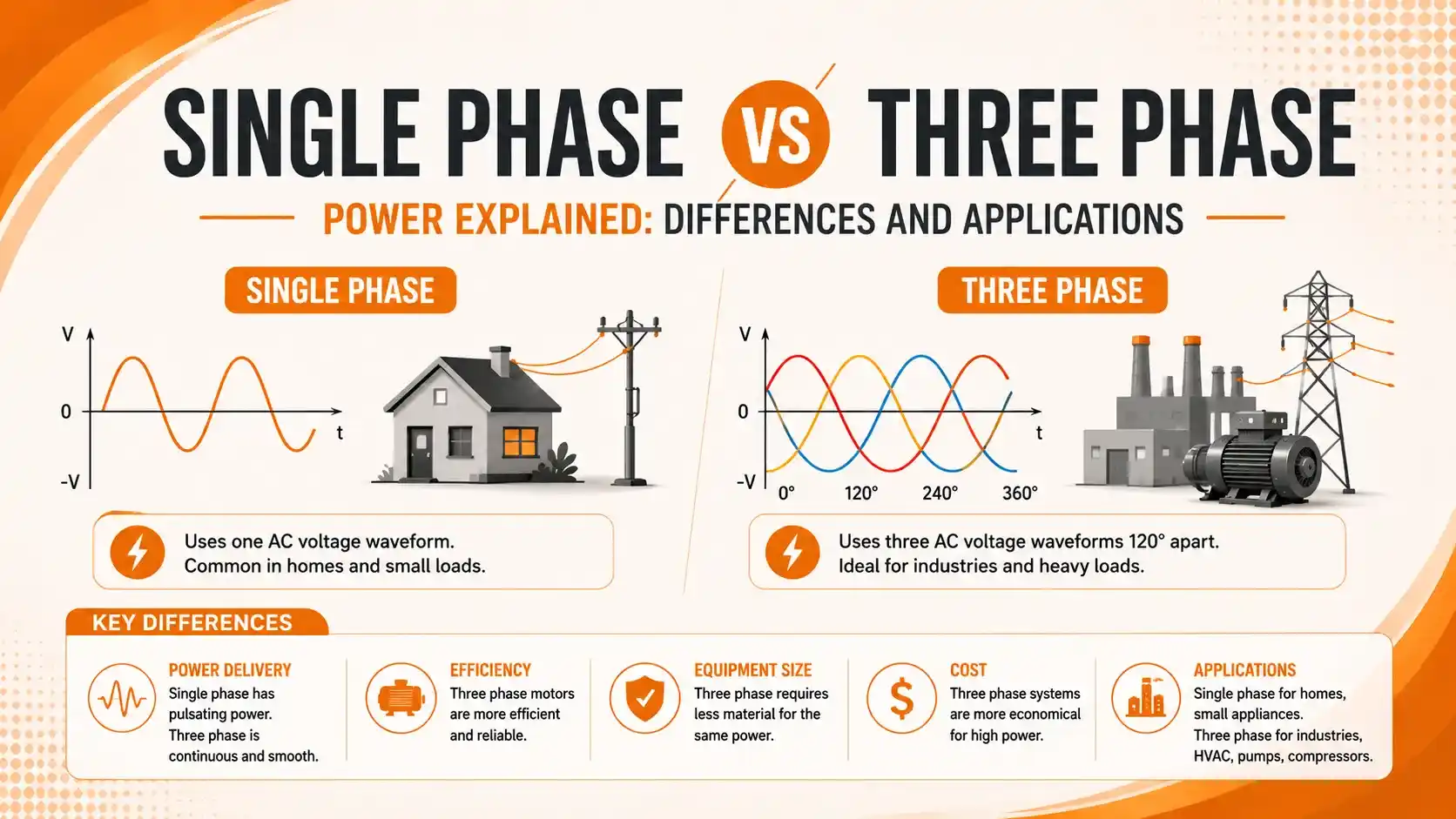
Three-phase power delivers electricity using three separate AC waveforms, each offset by exactly 120 electrical degrees from the others. Because the three waves are staggered, at any given instant at least one phase is delivering substantial power, so the combined power output stays nearly constant rather than pulsing. This is the fundamental reason large motors, industrial equipment, and three-phase systems in general run more smoothly and efficiently than their single-phase equivalents.
Real Life Example
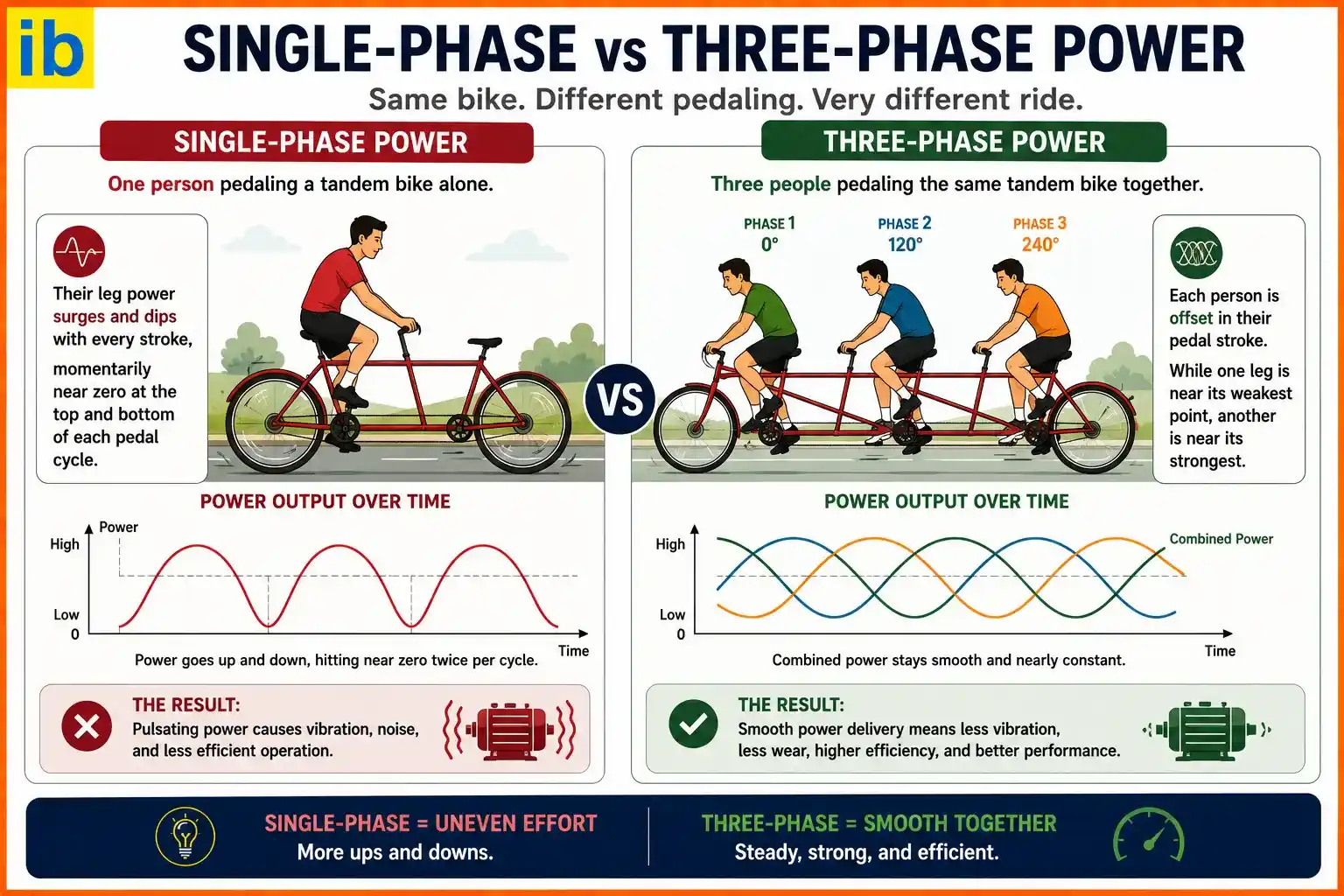
Think of single-phase power like one person pedaling a tandem bike alone: their leg power surges and dips with every stroke, momentarily near zero at the top and bottom of each pedal cycle. Three-phase power is like three people pedaling that same bike together, each offset in their pedal stroke so that while one leg is near its weakest point, another is near its strongest. The combined pedaling power stays smooth and nearly constant, exactly why three-phase motors run with far less vibration and pulsation than single-phase equivalents.
Single Phase vs Three Phase
🔌 Single-Phase Power
⚡ Three-Phase Power
Three-Phase Power Formula
Three-Phase Power Calculator
Three-Phase Power Calculator
Based on P = √3 × VL × I × PFComparison Table
| Feature | Single-Phase | Three-Phase |
|---|---|---|
| Number of Waveforms | 1 | 3, offset 120° |
| Power Delivery | Pulsing, drops to zero twice per cycle | Nearly constant, never drops to zero |
| Conductor Current (equal power) | Higher | ~57.7% of single-phase |
| Motor Starting | Needs capacitor or auxiliary winding | Self-starting, rotating field |
| Typical Voltage | 230V or 120V | 400V or 208/480V line-to-line |
| Installation Cost | Lower | Higher, more wiring and equipment |
| Typical Use | Residential, small commercial | Industrial, large commercial, data centers |
Applications
Residential Homes
Single-phase power supplies lighting, small appliances, and typical household loads.
Industrial Motors
Three-phase power drives motors, pumps, and compressors above roughly 2.2 kW.
Data Centers
Three-phase power delivers dense, efficient, stable power to high-density server rooms.
Commercial Buildings
Three-phase feeds HVAC, elevators, and large equipment while single-phase serves outlets.
Small Workshops
Single-phase power suits light equipment where three-phase service isn't available or justified.
VFD-Driven Equipment
Three-phase is standard for VFD applications due to compatibility and smoother motor control.
Single Phase vs Three Phase Power: Video Walkthrough
Frequently Asked Questions
- Fluke, Single-Phase vs Three-Phase Power Explanation
- Enerdynamics, Understanding Single-Phase and Three-Phase Electrical Service Configurations
- Vertiv, Single Phase vs Three Phase Power, Explained and Compared
What We Learn Today
- Single-phase power uses one AC waveform that pulses to zero twice per cycle; three-phase staggers three waveforms for near-constant delivery
- Three-phase draws roughly 57.7% of the current single-phase would need for the same delivered power
- Single-phase motors need a starting capacitor; three-phase motors self-start via a naturally rotating magnetic field
- Single-phase suits residential and light commercial use; three-phase is standard above roughly 2.2 kW and for VFD applications
- Real three-phase power follows P = √3 × VL × I × PF