
OPC UA Explained: Information Model, Client-Server, and Pub-Sub
Most protocols hand you a number and let you guess what it means. OPC UA hands you the number along with its own explanation of what it is, where it came from, and how it relates to everything else in the system.
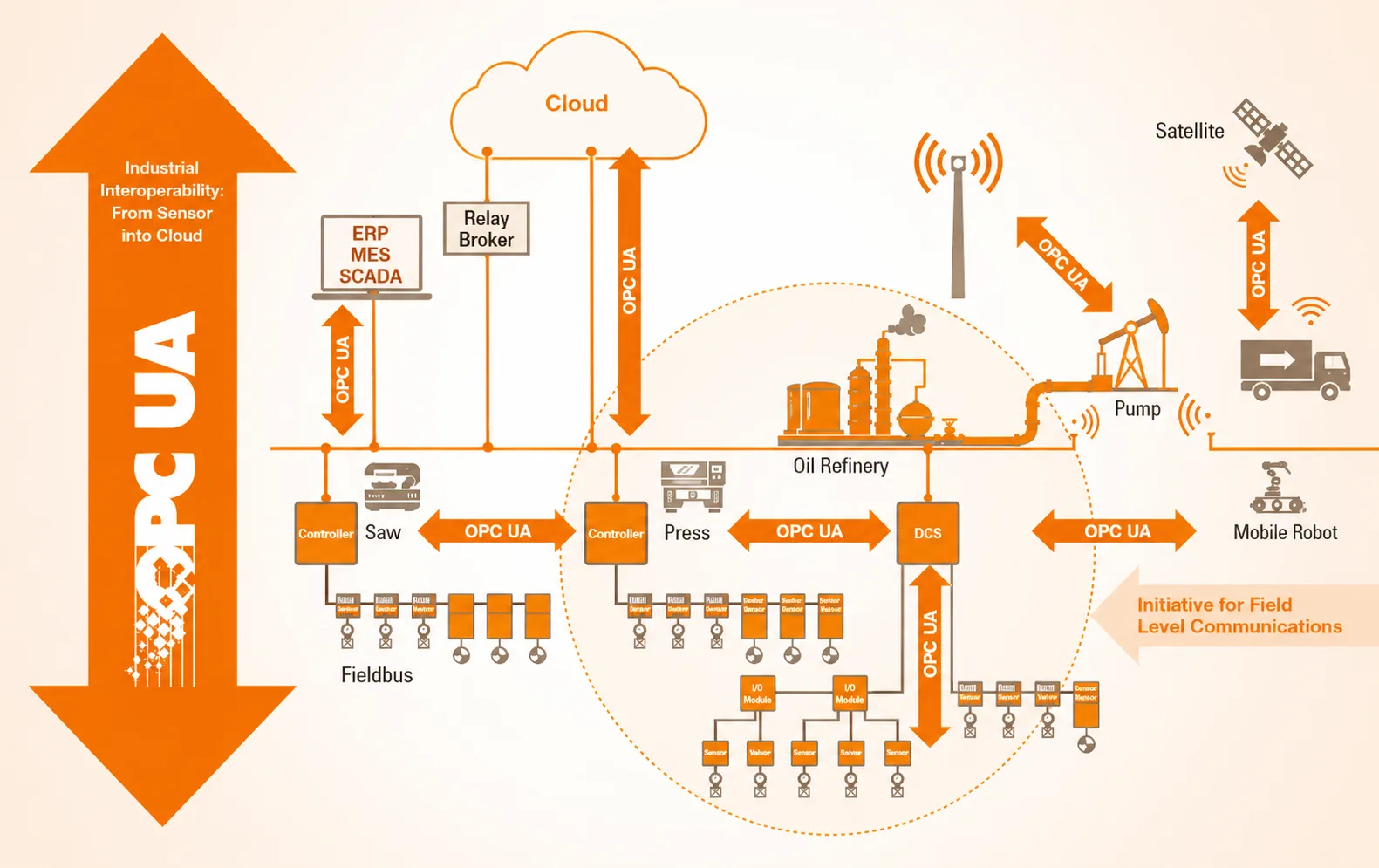
OPC UA is the communication standard that underpins most modern Industry 4.0 and IIoT architectures, letting devices from different manufacturers exchange not just raw values but the meaning behind them. This guide explains the OPC UA information model, its client-server and pub-sub communication modes, and its built-in security.
What is OPC UA?
OPC-UA (OPC Unified Architecture) is an open, platform-independent communication standard, defined by IEC 62541, that lets industrial devices and software applications exchange data reliably regardless of the operating system or vendor involved. It evolved from the earlier OPC (OLE for Process Control) standard, which was tied to Microsoft's Windows-specific COM/DCOM technology. OPC UA broke that dependency, becoming truly platform-independent, and redefined its own name as Open Platform Communications.
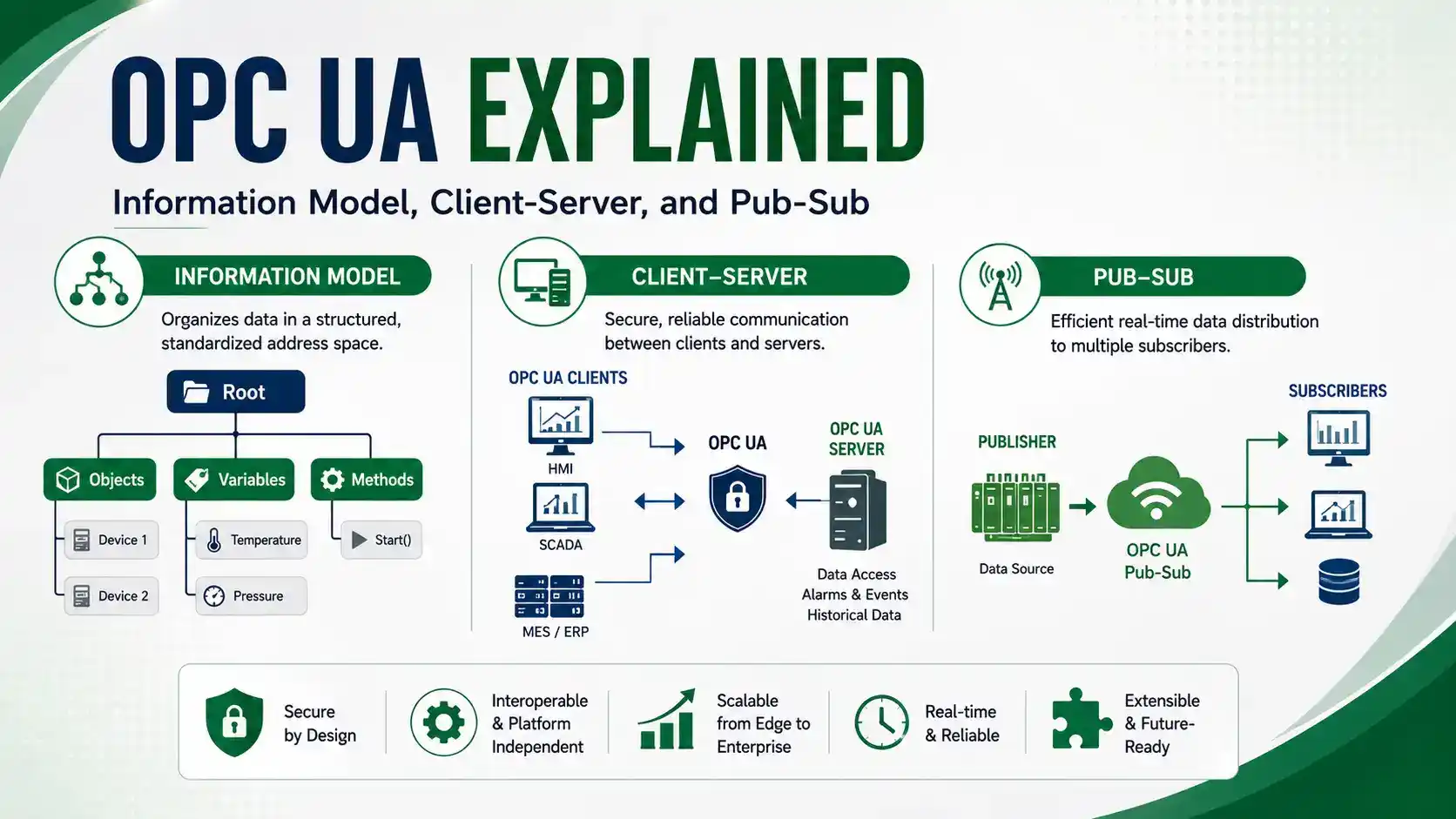
What genuinely sets OPC-UA apart from protocols like Modbus is its information model. OPC-UA doesn't just transmit a raw value, it describes what that value means, its data type, its relationships to other data, and even available methods that can be called on it, all within a structured, object-oriented address space rather than a flat list of registers.
Real Life Example
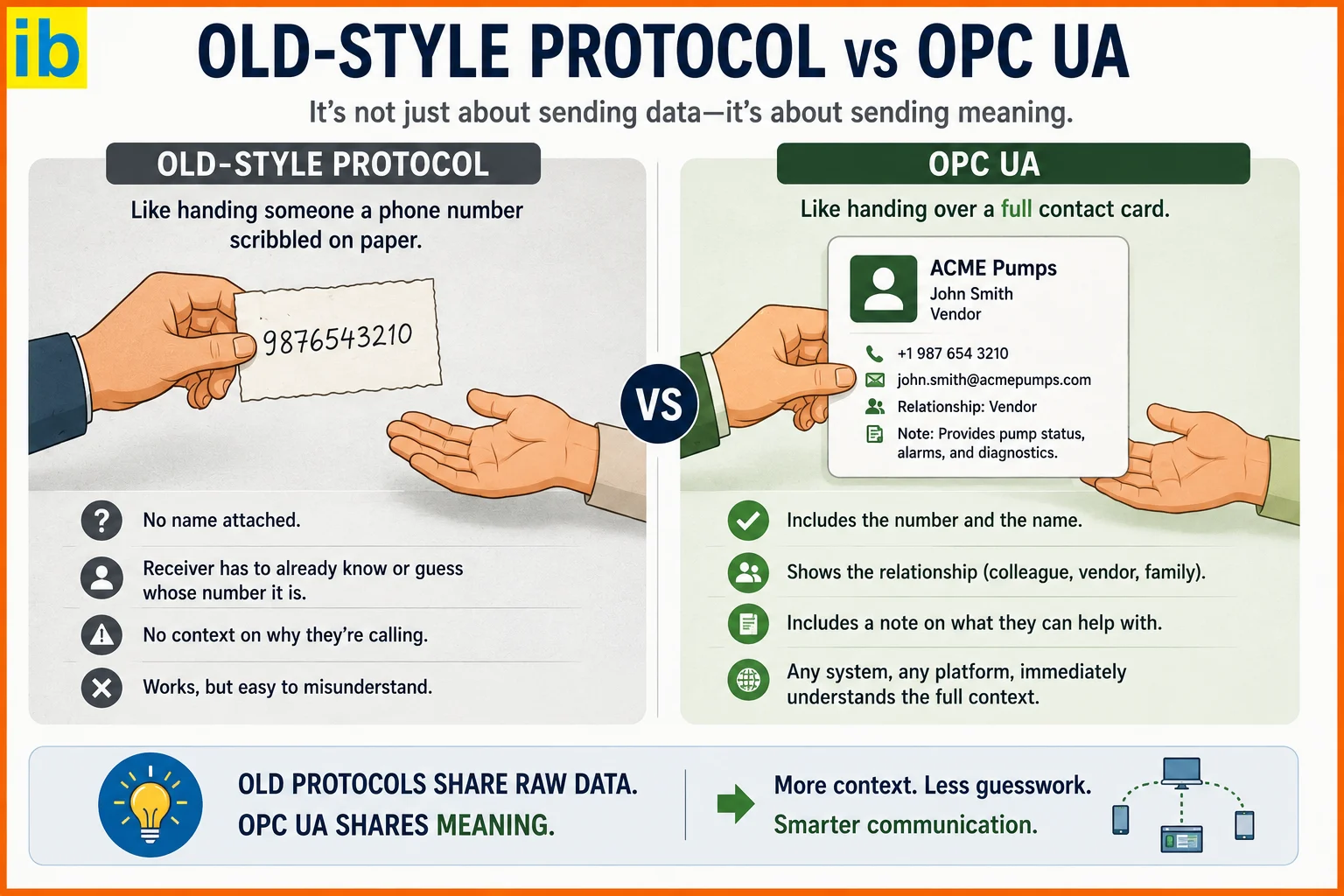
Think of an old-style protocol like handing someone a phone number scribbled on paper, with no name attached. It works, but the receiver has to already know or guess whose number it is and why they're calling.
OPC-UA is more like handing over a full contact card: the number, the name, the relationship (colleague, vendor, family), and even a note on what they can help with. Any system receiving that contact card, regardless of what phone or software it uses, immediately understands the full context, not just the raw digits.
Client-Server vs Pub-Sub
🔗 Client-Server
A Client queries data directly from a Server, or subscribes to be notified when specific values change. Ideal for typical HMI, SCADA, and MES connections where one application needs a direct, request-response relationship with a device.
📡 Pub-Sub
A Publisher sends data to a network or message broker without knowing who, if anyone, is listening. Any number of Subscribers can receive the same data independently. Ideal for distributing one data source to many consumers, like SCADA, historians, and cloud services simultaneously.
OPC-UA vs Modbus vs Foundation Fieldbus
| Feature | OPC UA | Modbus | Foundation Fieldbus |
|---|---|---|---|
| Information Model | Rich, self-describing, object-oriented | None, raw register values only | Function blocks, moderate context |
| Built-In Security | Certificates, encryption, signing | None natively | Limited |
| Communication Style | Client-Server and Pub-Sub | Master-Slave, request-response | Cyclic, scheduled by LAS |
| Typical Layer | Controller to MES/ERP/cloud level | Field device level | Field device level |
| Platform Dependency | None, fully cross-platform | None | None |
Applications of OPC UA
SCADA and MES Integration
OPC UA lets SCADA and MES systems query structured, self-describing data from PLCs.
Edge-to-Cloud Connectivity
Pub-Sub architectures publish plant floor data to cloud analytics platforms at scale.
Pharmaceutical Manufacturing
High-frequency, secure data logging supports regulatory traceability requirements.
Automotive Manufacturing
Multi-vendor PLC and robot integration benefits from OPC UA's platform independence.
Multi-Vendor Interoperability
OPC UA lets equipment from different manufacturers share data using one common standard.
Historian and Analytics Integration
Rich context in the information model simplifies downstream data analysis and reporting.
OPC UA: Video Walkthrough
Frequently Asked Questions About OPC-UA
- Sync Motion, What Is OPC UA? OPC UA Explained
- Prosys OPC, OPC UA PubSub Explained
- RealPars, OPC-UA Application, Pharmaceutical Industry
What We Learn Today
- OPC UA is a platform-independent standard that transmits both data and its meaning, via a structured information model
- Client-Server suits direct, one-to-one connections; Pub-Sub suits distributing data to many receivers at once
- Security, via certificates and encryption, is built into OPC UA as a core part of the standard, not an add-on
- OPC UA and MQTT solve different problems and are often combined in modern IIoT architectures
- Major PLC manufacturers increasingly support OPC UA natively, making it a common choice for Industry 4.0 integration