Motor Starting Methods Compared: DOL, Star-Delta, Soft Starter, and VFD

Share:
Electrical Machines

Motor Starting Methods Compared: DOL, Star-Delta, Soft Starter, and VFD

A motor at standstill looks like a dead short to the supply. Every one of these four methods exists to solve that same violent inrush moment, just at very different price points.

Electrical Machines Motor Starters Inrush Current 9 Min Read

A three-phase induction motor draws several times its rated current the instant it starts. This guide compares the four common ways to control that inrush, Direct-On-Line, Star-Delta, Soft Starter, and VFD, with a starting current calculator and a clear selection guide.

Why Motor Starting Current is a Problem

At the moment power is applied, an induction motor's rotor is stationary and generates no back-EMF to oppose the incoming current. The motor briefly behaves like a short-circuited transformer, drawing anywhere from 6 to 10 times its full load current until it accelerates and back-EMF builds up. For a small motor, this brief surge is harmless. For a large motor, it can sag supply voltage across the whole plant, trip protection devices, and mechanically shock couplings, belts, and gearboxes.

Four starting methods exist specifically to manage this problem, each trading cost and complexity against how much that inrush current gets reduced. Direct-On-Line (DOL), Star-Delta, Soft Starter, and Variable Frequency Drive (VFD) starting methods span the full range from simplest to most sophisticated.

💡 Quick Summary: DOL starting connects the motor directly to full voltage, drawing 6 to 8 times full load current. Star-Delta cuts that to roughly a third by starting in a reduced-voltage winding configuration. A Soft Starter ramps voltage gradually using thyristors. A VFD controls both voltage and frequency, delivering the lowest inrush current along with full speed control afterward.
Advertisement
Advertisement

Real Life Example

Think of pushing a stalled car. Shoving it as hard as you can from a dead stop takes an enormous initial burst of effort, exactly like DOL starting. Getting a few friends to push together but starting gently and building up speed gradually uses far less peak effort from any one person, more like a soft starter's gradual ramp. A tow truck with a winch that reels the car up to speed under full, continuous control resembles what a VFD does, managing the whole process smoothly from zero to full speed.
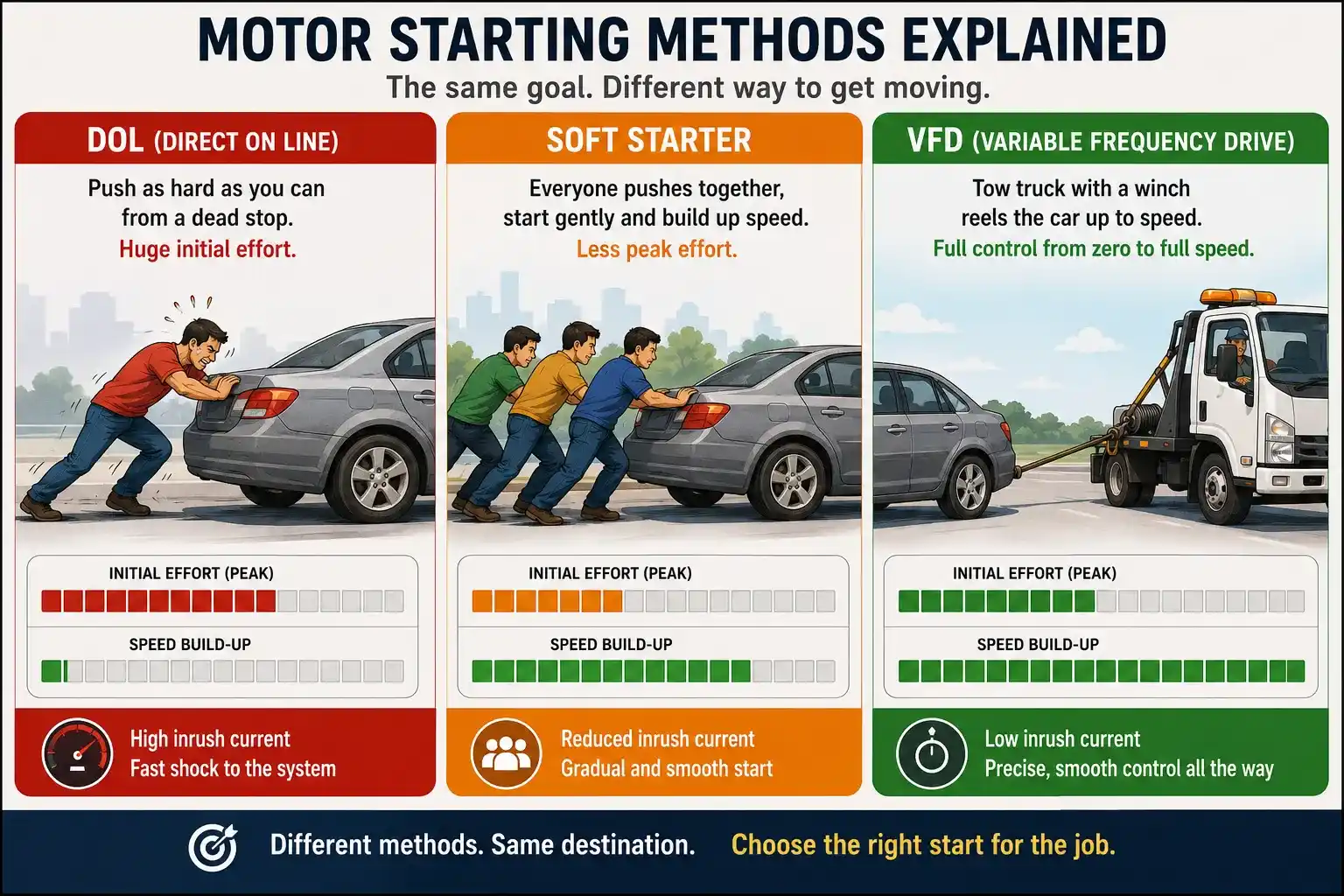
DOL-Star-Delta-Soft-Starter-and-VFD
📖 Did You Know? Star-Delta starting is only suitable for motors that can start without a load attached, since a heavily loaded motor may not reach enough speed in the star configuration before the transition to delta, sometimes causing a current spike as large as, or larger than, a DOL start.

The Four Motor Starting Methods

⚡ Direct-On-Line (DOL)

Connects the motor directly to full line voltage in one step using a contactor, overload relay, and breaker.
Starting Current: 6 to 8 times FLA
Best For: Small motors, typically up to 5 HP

🔺 Star-Delta

Starts the motor with windings in star configuration, then switches to delta once up to speed.
Starting Current: Roughly 2 times FLA, about one-third of DOL
Best For: Medium motors, light or no-load starting, 5-100 HP

📈 Soft Starter

Uses thyristors (SCRs) to gradually ramp supply voltage up over a programmable time.
Starting Current: Roughly 2 to 4 times FLA, adjustable
Best For: High inertia loads needing smooth, controlled acceleration

🎛️ VFD

Controls both frequency and voltage, starting at low frequency with proportionally low voltage.
Starting Current: Roughly 1 to 1.5 times FLA, the lowest of all methods
Best For: Applications also needing continuous speed control after starting
Advertisement
Advertisement

Motor Starting Current Calculator

🧮

Motor Starting Current Estimator

Based on typical industry inrush multipliers
-
Estimated Starting Current (A)

Comparison Table

Method
Starting Current
Relative Cost
Speed Control
DOL
6-8x FLA
Lowest
None
Star-Delta
~2x FLA
Low
None
Soft Starter
2-4x FLA
Moderate
Starting/stopping only
VFD
1-1.5x FLA
Highest
Full continuous control
💡 Engineering Tip: A soft starter only controls voltage during starting and stopping, while a VFD controls both voltage and frequency continuously. If an application needs variable running speed, not just a gentler start, a VFD is the only one of these four methods that actually delivers it.

Applications

🔧

Small Pumps and Fans

DOL starters handle small, low-inertia loads where starting current is not a concern.

🏭

Medium Industrial Motors

Star-Delta starters serve mid-size motors starting without significant load.

🌀

High Inertia Loads

Soft starters smooth acceleration for large fans, conveyors, and crushers.

💧

Variable Flow Pumping

VFDs both start gently and continuously match pump speed to actual demand.

🌬️

HVAC Fan Systems

VFDs cut energy use dramatically versus damper throttling on variable torque loads.

⚙️

Compressors

Soft starters and VFDs both reduce mechanical shock on belt and gearbox driven compressors.

Motor Starting Methods: Video Walkthrough

Advertisement
Advertisement

Frequently Asked Questions

Why does a motor draw so much current when starting?
At standstill, the motor's rotor generates no back-EMF to oppose the supply current, so the motor briefly behaves like a short-circuited transformer, drawing 6 to 10 times its rated running current until it accelerates.
When is Star-Delta starting not suitable?
Star-Delta starting is only suitable for motors starting without a significant load. A heavily loaded motor may not reach sufficient speed in star configuration before switching to delta, causing a current spike that can rival a DOL start.
What is the difference between a soft starter and a VFD?
A soft starter controls only voltage, and only during starting and stopping. A VFD controls both voltage and frequency continuously, providing full speed control throughout operation, not just at start-up.
Which starting method is cheapest?
Direct-On-Line (DOL) is the cheapest and simplest method, but it produces the highest inrush current, limiting its practical use to small motors where the current spike does not strain the supply.
Do all motors need reduced-voltage starting?
No. Small motors, typically up to around 5 HP, are commonly started DOL without issue. Reduced-voltage or reduced-current methods become important as motor size grows and the starting current would otherwise strain the electrical supply or shock the mechanical load.
External References
Advertisement
Advertisement

What We Learn Today

  • An induction motor at standstill draws 6 to 10 times its rated current until back-EMF builds up during acceleration
  • DOL starting is simplest but produces the highest inrush, suitable only for small motors
  • Star-Delta cuts starting current to roughly a third of DOL, but only works for lightly loaded starts
  • Soft starters ramp voltage smoothly, ideal for high inertia loads needing gentle acceleration
  • VFDs deliver the lowest starting current and are the only method offering continuous speed control afterward
"I hope you like above blog. There is no cost associated in sharing the article in your social media. Thanks for Reading !! Happy Learning"

Leave a Reply

Your email address will not be published. Required fields are marked *