
Alarm Management and Rationalization: ISA-18.2 Explained
An alarm system that shouts constantly protects nobody. Here is the standard that turns thousands of nuisance alerts into the handful an operator can actually act on.
Alarm management is the engineering discipline that keeps an operator's alarm system useful instead of overwhelming. This guide explains the ISA-18.2 alarm lifecycle, rationalization, priority schemes, and the benchmarks that separate a healthy alarm system from one heading toward an alarm flood.
What is Alarm Management?
Alarm management is the systematic process of designing, configuring, monitoring, and continuously improving the alarm system in a process plant so that every alarm presented to an operator is genuinely useful, timely, and actionable. The goal is not to alert an operator to every deviation a sensor can detect. It is to help that operator catch a real abnormal condition before it escalates into a safety incident, an environmental release, or a production loss.
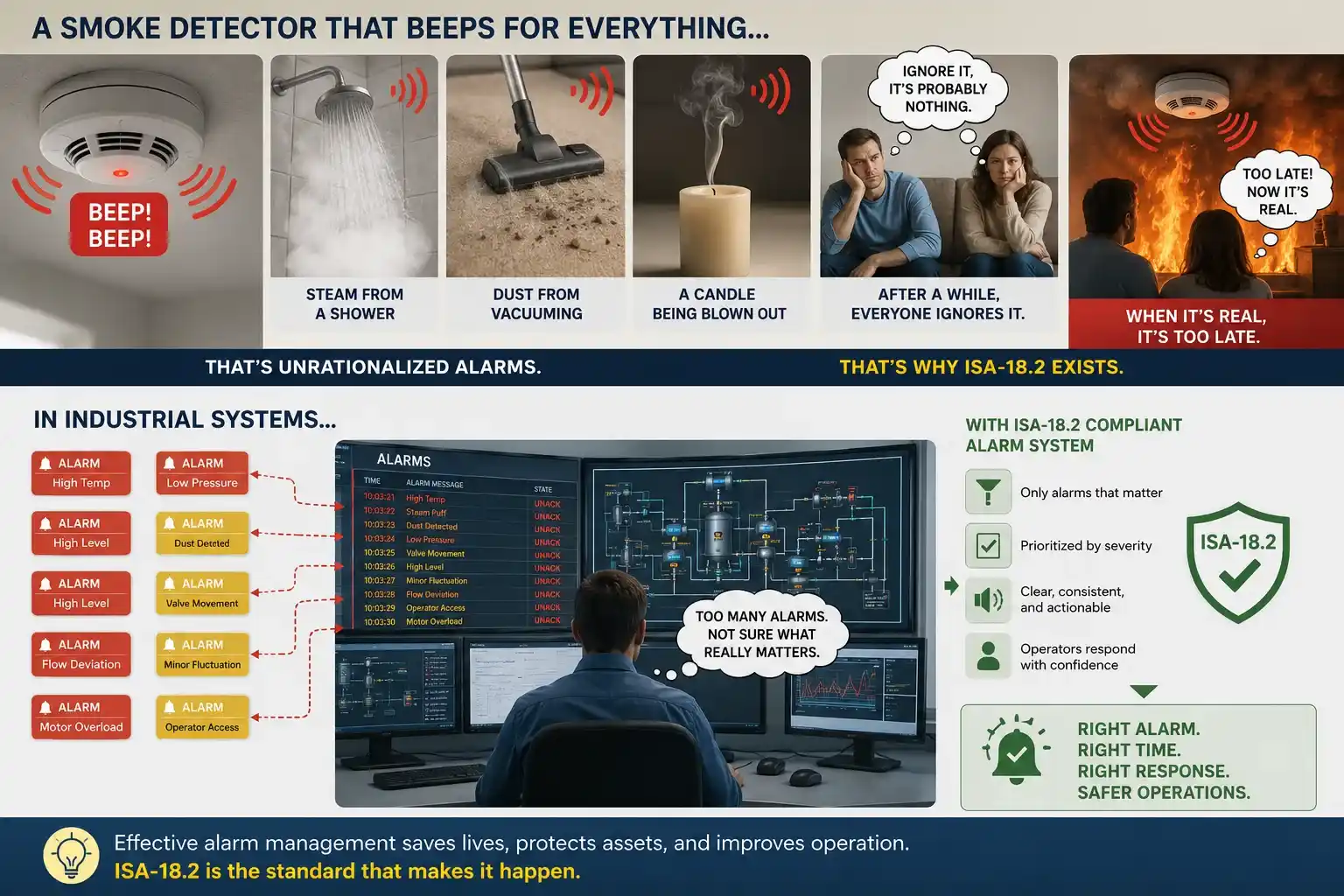
Done badly, an alarm system can generate hundreds of alerts an hour, far more than any operator can absorb. Done well, following ISA-18.2 and the closely related IEC 62682 and EEMUA 191 guidance, a compliant system averages fewer than 6 alarms per operator per hour and presents an alarm only when a genuine response is actually required. The difference between those two outcomes is almost always the presence, or absence, of a disciplined alarm management lifecycle.
Real Life Example
Imagine a smoke detector that beeps not just for smoke, but for steam from a shower, dust from vacuuming, and a candle being blown out. Within a week, everyone in the house learns to ignore it, and the one time there is a genuine fire, nobody reacts fast enough. That is exactly what an unrationalized industrial alarm system feels like to a control room operator, and exactly why ISA-18.2 exists.
The ISA-18.2 Alarm Management Lifecycle
ISA-18.2 treats alarm management as a continuous, closed-loop lifecycle rather than a single project. The lifecycle has ten connected stages, and results from later stages regularly feed back to improve earlier ones.
Philosophy
Identification
Rationalization
Detailed Design
Implementation
Operation
Maintenance
Monitoring & Assessment
Management of Change
Audit
The Philosophy document is the foundation everything else references. It defines what actually qualifies as an alarm, establishes the priority scheme, sets performance targets, and documents the approval process for adding new alarms. A notification that requires no operator response is not an alarm under ISA-18.2, no matter how it is displayed on the HMI.
What is Alarm Rationalization?
Rationalization is the stage where every candidate alarm is judged, one by one, against the criteria set out in the alarm philosophy document. A cross-functional team, typically a process engineer, a control systems engineer, and an experienced operator, works through the alarm database asking one central question for each alarm: if this alarm activates and the operator takes no action, what is the consequence, and how quickly does it become irreversible?
The output of rationalization is a Master Alarm Database (MADB) documenting each alarm's setpoint, cause, consequence, priority, classification, and the specific operator action expected. Because most existing alarm systems were never rationalized in the first place, this single stage typically eliminates 30 to 60 percent of the alarms an unmanaged system had been configured to generate.
Acceptable Alarm Rate Benchmarks
Alarm Rate Assessment Calculator
Alarm Rate Assessment Calculator
Compare your alarm rate against ISA-18.2 benchmarksApplications of Alarm Management
Chemical and Refining
Rationalized alarms reduce operator overload during process upsets on continuous units.
Power Generation
Alarm philosophy keeps boiler and turbine alarms actionable during load changes.
Water and Wastewater
SCADA-based alarm management prevents nuisance alerts across widely distributed sites.
Oil and Gas Pipelines
API RP 1167, aligned with ISA-18.2, governs pipeline SCADA alarm management specifically.
Batch and Pharma
ISA-18.2 technical reports address alarm strategy differences for batch and discrete processes.
Packaged Equipment
Compressor and heat trace skids get their alarms aligned with the plant-wide philosophy.
Common Alarm Management Mistakes
✅ Do This
- Write and maintain a documented alarm philosophy before configuring alarms
- Rationalize every alarm against a consequence-based decision matrix
- Use deadbands and time delays to prevent chattering near setpoints
- Monitor alarm rate and priority distribution on an ongoing basis
❌ Avoid This
- Configuring alarms for every deviation instead of only actionable conditions
- Assigning Priority 1 without documenting a genuine consequence
- Skipping rationalization and living with an unmanaged legacy alarm database
- Treating alarm management as a one-time project instead of a lifecycle
Alarm Management: Video Walkthrough
Frequently Asked Questions About Alarm Management
- ISA, ISA-18 Series of Standards
- Emerson, Alarm Rationalization White Paper
- Yokogawa, Implementing Alarm Management per the ANSI/ISA-18.2 Standard
What We Learn Today
- Alarm management is a continuous ten-stage lifecycle under ISA-18.2, not a one-time project
- Rationalization judges every alarm against a documented philosophy, typically removing 30 to 60 percent of configured alarms
- An alarm flood is defined as more than 10 alarms in any 10-minute period
- Fewer than 5 percent of all alarms should carry Priority 1 under a properly rationalized system
- A well-managed system averages under 6 alarms per operator per hour, keeping every alarm genuinely actionable