
Incremental vs Absolute Encoders: Key Differences and Applications
Cut power to a machine and one encoder wakes up already knowing exactly where it is. The other has to go find out all over again. Here is why that single difference decides which one belongs in your design.
Incremental and absolute encoders both convert shaft rotation into an electrical signal, but they answer completely different questions. Learn how each one works, the resolution formula behind them, and which one your motion control application actually needs.
What is an Encoder?
An encoder is an electromechanical device that converts the rotational or linear motion of a shaft into an electrical signal that a control system can interpret. Encoders provide the position, speed, and direction feedback that motors, robotics, and PLC-driven automation systems rely on to know exactly what is happening on the mechanical side of the process. Almost every servo motor, CNC axis, and robotic arm has an encoder feeding position data back to its controller.
Encoders fall into two broad categories based on how they report that position: incremental and absolute. Both typically use a rotating disk, either optical or magnetic, paired with a fixed sensor, but the pattern on that disk and what it can tell the system apart is where the two technologies diverge completely.
How an Incremental Encoder Works
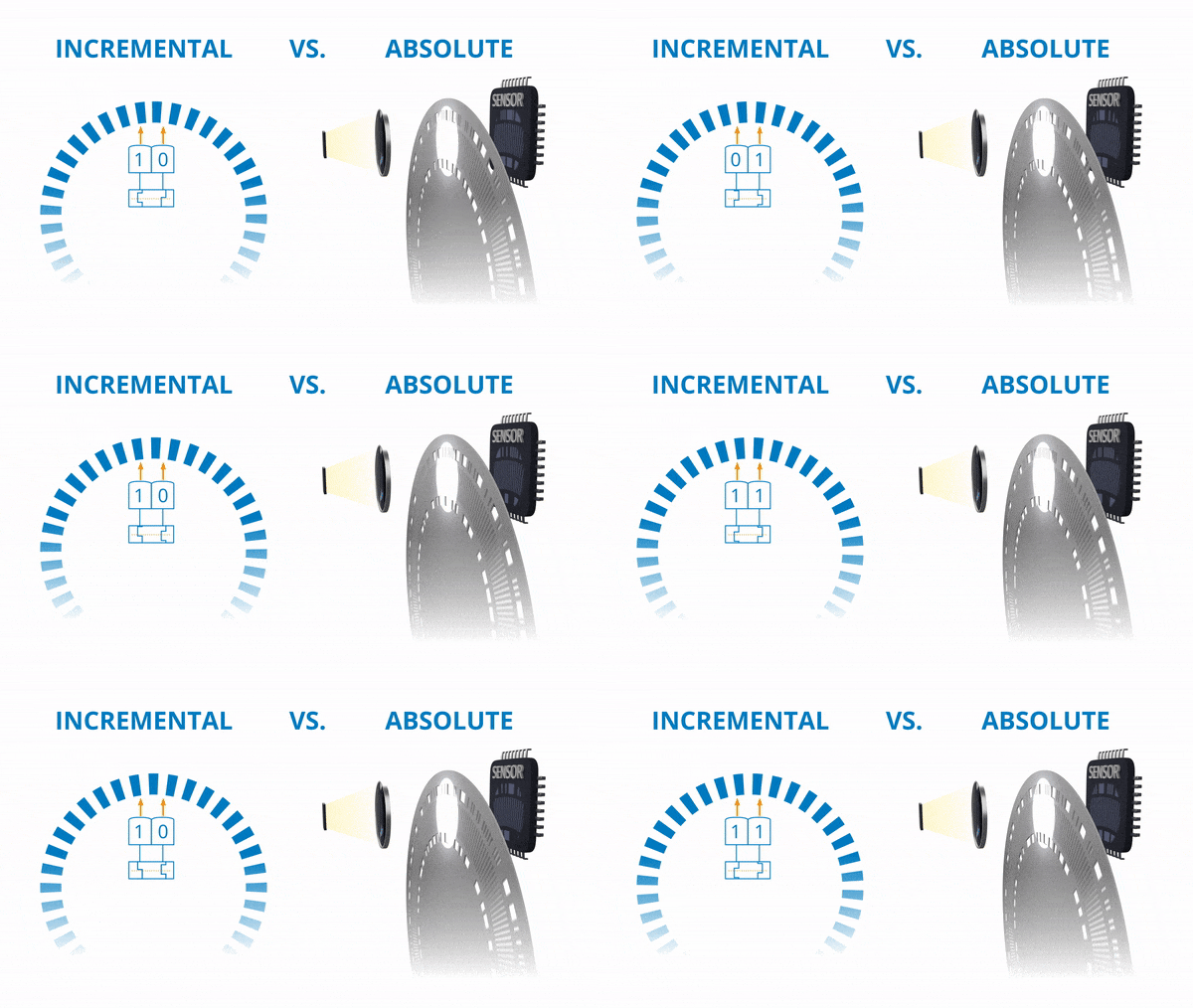
An incremental encoder uses a disk marked with a uniform series of equally spaced lines or windows. An LED shines through the disk toward a photo detector on the opposite side, and as the shaft rotates, the alternating windows and lines chop the light beam into pulses. Every pulse represents the same fixed increment of rotation, and counting those pulses over time tells the system how far the shaft has moved.
Most industrial incremental encoders output two channels, called A and B, offset by 90 degrees in phase. This quadrature arrangement lets the controller determine direction, not just movement, by checking which channel leads the other. Many designs add a third channel, called the index or Z pulse, which fires once per revolution and gives the system a repeatable reference point. Without power, or before that index pulse is found again, an incremental encoder has no way to state its absolute position.
How an Absolute Encoder Works
An absolute encoder uses a disk with multiple concentric tracks instead of one uniform ring of slots. Each track has its own light source and detector, and together the tracks form a unique binary or Gray code pattern for every single position around the disk. Because every angle corresponds to one specific code, the encoder can report exact shaft position the instant it is powered on, with no rotation or homing required.
The number of tracks determines the encoder's resolution. An 8-bit absolute encoder, for example, has 8 tracks and can distinguish 2⁸ = 256 unique positions in a single rotation. Multi-turn absolute encoders add extra internal counting stages, often a small gear train or battery-backed counter, so they can also track how many full rotations have occurred, not just the angle within one turn.
🔄 Incremental Encoder Disk
- Uniform, evenly spaced slots produce identical pulses everywhere on the disk
🎯 Absolute Encoder Disk
- Multiple tracks combine into a unique code for every position
- No two positions on the disk share the same combined pattern
Incremental vs Absolute Encoders: Key Differences
- 1. Position ReportingIncremental: Reports change in position via pulsesAbsolute: Reports exact position via a unique code
- 2. Power Loss BehaviorIncremental: Loses position, needs to re-homeAbsolute: Retains position, no re-homing needed
- 3. Disk PatternIncremental: Single ring of uniform slotsAbsolute: Multiple tracks forming a unique code
- 4. Output SignalIncremental: Quadrature pulses (A, B, and optional Z index)Absolute: Digital word (binary or Gray code)
- 5. Direction DetectionIncremental: Only with two-channel quadrature outputAbsolute: Inherent in the position code itself
- 6. External Counter NeededIncremental: Yes, to track cumulative positionAbsolute: No, position is read directly
- 7. Mechanical ComplexityIncremental: Simpler, fewer tracksAbsolute: More complex, multiple tracks or multi-turn stages
- 8. Typical CostIncremental: Lower upfront costAbsolute: Higher upfront cost
- 9. Best Suited ForIncremental: Speed, direction, simple position trackingAbsolute: Safety-critical or power-cycle-sensitive positioning
Encoder Resolution Formula
Encoder Resolution Calculator
Encoder Resolution Calculator
Pick the encoder type you are sizingComparison Table
Which Encoder Should You Choose?
| Application Requirement | Recommended Encoder |
|---|---|
| Conveyor speed and direction monitoring | Incremental |
| Simple motor speed feedback | Incremental |
| Robotic arm joint position | Absolute |
| CNC machine axis positioning | Absolute |
| Palletizer gripper X-Y positioning | Absolute |
| Basic tachometer or pulse counting | Incremental |
| Applications where re-homing after power loss is unsafe | Absolute |
| Cost-sensitive, non-critical position tracking | Incremental |
Applications of Encoders
Robotics
Absolute encoders track joint position reliably, even after unexpected power cycles.
Conveyor Systems
Incremental encoders provide speed and direction feedback for line synchronization.
CNC Machining
Absolute encoders give exact axis position without a homing cycle at startup.
Printing and Packaging
Incremental encoders synchronize web speed and registration on high speed lines.
Servo Motor Feedback
Both encoder types feed position and speed data back to servo drive controllers.
Palletizing Systems
Absolute encoders position grippers precisely across repeated pick and place cycles.
Common Selection Mistakes
✅ Do This
- Choose absolute encoders wherever a power cycle must not lose position data
- Use incremental encoders for simple speed and direction feedback to save cost
- Check quadrature output requirements before selecting an incremental encoder
- Confirm resolution in bits or PPR actually meets your positioning accuracy needs
❌ Avoid This
- Using an incremental encoder where a lost home position creates a safety hazard
- Overspending on an absolute encoder for a simple speed monitoring task
- Ignoring the need for a homing routine in incremental encoder based systems
- Confusing single-turn absolute resolution with multi-turn tracking capability
Incremental vs Absolute Encoders: Video Walkthrough
Video credit: RealPars, "What is the Difference between Absolute and Incremental Encoders?"
Frequently Asked Questions
- RealPars, Absolute vs Incremental Encoders: Key Differences Explained
- Encoder Products Company, Absolute Encoders vs Incremental Encoders
- US Digital, Incremental or Absolute Encoder? Find Out Fast
What We Learn Today
- Incremental encoders report a change in position through pulses and lose that data on power loss
- Absolute encoders assign a unique code to every position, retaining exact position through a power cycle
- Quadrature A/B outputs give incremental encoders direction sensing, index pulses give them a reference point
- Resolution is expressed as PPR for incremental encoders and as bits, giving 2^bits positions, for absolute encoders
- Choosing between them comes down to whether losing position on power loss is acceptable for the application