
Vortex Flow Meter Working Principle: Strouhal Number, Formula, and Calculator
Drop a bridge pier into a river and watch eddies peel off downstream. Put a bluff body in a pipe and the same physics gives you a flow meter with no moving parts at all.
A vortex flow meter measures flow by counting the vortices shed behind a bluff body placed in the pipe. Learn the working principle, the Strouhal number formula, a worked example, and where this no-moving-parts meter earns its place over DP and Coriolis alternatives.
What is a Vortex Flow Meter?
A vortex flow meter measures the volumetric flow of liquid, gas, or steam by detecting the frequency of vortices shed behind an obstruction placed in the flow path. Unlike a differential pressure meter that relies on a pressure drop, or a Coriolis meter that relies on a vibrating tube, a vortex meter has no moving parts and produces a frequency signal that is inherently linear with flow velocity.
The physical basis of this behavior is called vortex shedding, first described mathematically by physicist Theodore von Kármán in 1912. When a fluid flows past a non-streamlined object, called a bluff body, it cannot follow the object's surface smoothly on the downstream side. Instead, the flow separates and rolls up into alternating swirls on each side, a pattern known as a Kármán vortex street. The rate at which these vortices form, called the shedding frequency, is directly proportional to how fast the fluid is moving.
Real Life Example
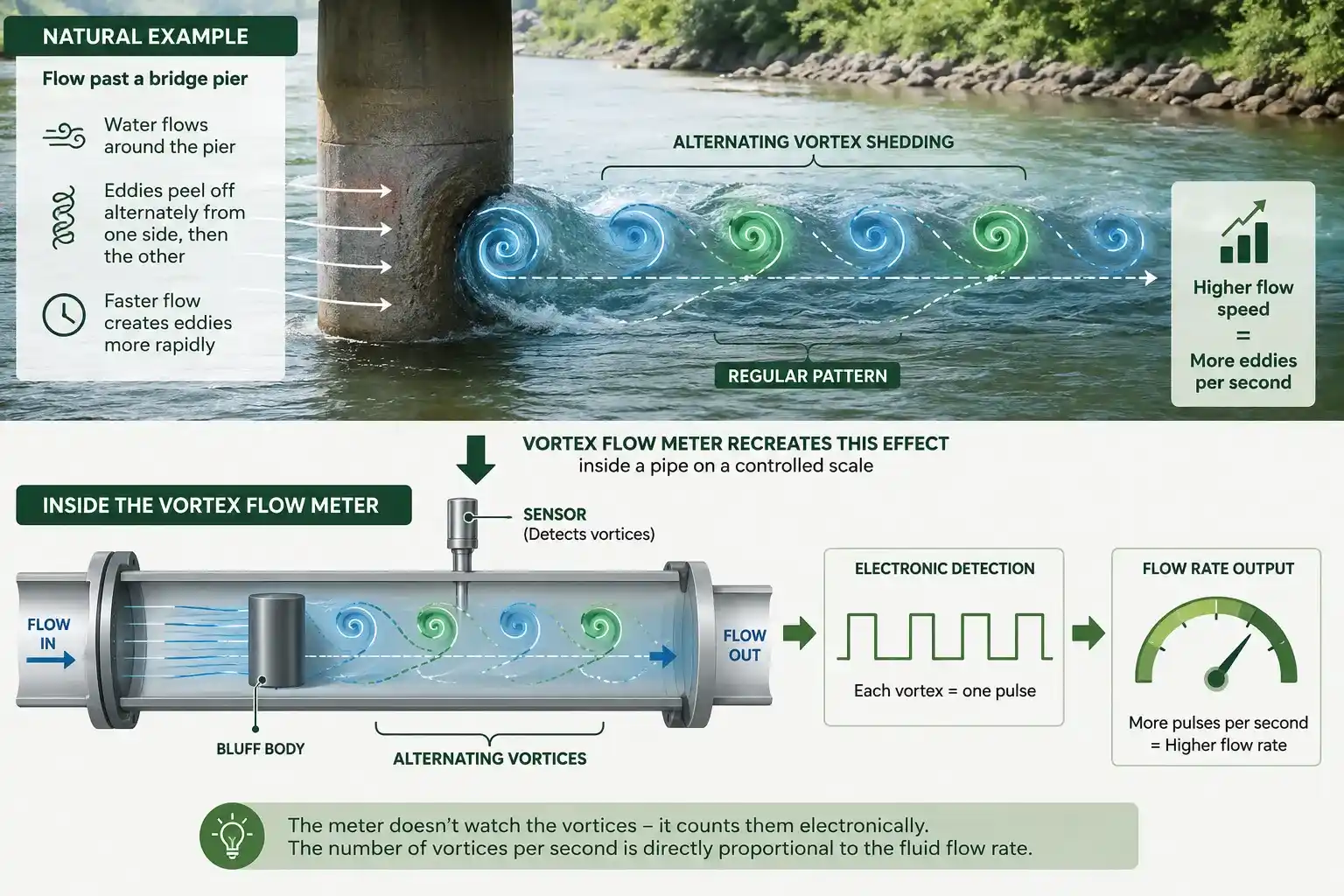
Watch water flow past a bridge pier or a rock in a stream. Just downstream, you will see swirling eddies peeling off first from one side, then the other, in a regular alternating pattern. The faster the water moves, the more rapidly those eddies form. A vortex flow meter recreates this exact effect inside a pipe on a much smaller and more controlled scale, then counts the eddies electronically instead of watching them by eye.
How Does a Vortex Flow Meter Work?
Understanding how a vortex flow meter works starts with the sensor placement right behind the bluff body.
- The bluff body sits across the pipe, forcing the flow to separate on both sides
- Vortices shed alternately from the top edge of the bluff body
- Vortices shed alternately from the bottom edge, forming the Kármán vortex street downstream
A sensor mounted just downstream of the bluff body detects the pressure or velocity oscillation created as each vortex passes, typically using a piezoelectric, capacitive, or ultrasonic sensing element. Each detected vortex produces one pulse, and the transmitter counts these pulses per second to determine the shedding frequency. Since that frequency scales directly with flow velocity, the electronics convert it into a flow rate using the pipe's known cross sectional area.
4-Step Working Principle of a Vortex Flow Meter
Fluid Approaches
Fluid flows toward the bluff body positioned across the center of the pipe.
Vortices Shed
Flow separates around the bluff body, shedding alternating vortices on each side.
Sensor Detects Pulses
A sensor downstream detects each vortex as a pressure or velocity pulse.
Frequency Becomes Flow
The transmitter converts pulse frequency into volumetric flow rate using the Strouhal relationship.
Vortex Flow Meter Formula: The Strouhal Number
The Strouhal number stays essentially constant over a wide range of Reynolds numbers, typically from about 10,000 to several million, which is exactly why a vortex meter can hold a single linear calibration factor across most of its operating range. Below the minimum Reynolds number threshold, the Strouhal relationship becomes unstable, which is why every vortex meter datasheet specifies a minimum flow velocity for reliable measurement.
Vortex Flow Meter Calculator
Vortex Shedding Flow Calculator
Based on the Strouhal number relationshipVortex Flow Meter vs Other Flow Measurement Technologies
Choosing between a vortex flow meter, a DP meter, and a Coriolis meter comes down to turndown ratio, pressure loss, and the fluid you are measuring.
| Feature | Vortex Meter | DP (Orifice) Meter | Coriolis Meter |
|---|---|---|---|
| Moving Parts | None | None | None (vibrating tube) |
| Measures | Volumetric flow | Volumetric flow (derived) | Mass flow directly |
| Turndown Ratio | 10:1 to 15:1 | 4:1 to 5:1 | 20:1 to 100:1 |
| Permanent Pressure Loss | Low to moderate | High | Moderate |
| Fluid Types | Liquid, gas, steam | Liquid, gas, steam | Liquid, gas |
| Typical Accuracy | ±0.75% to ±1.5% | ±1% to ±2% | ±0.1% to ±0.5% |
| Best For | Steam and gas with variable conditions | General purpose, low cost | Custody transfer, high accuracy |
Applications of Vortex Flow Meters
A vortex flow meter fits especially well anywhere fluid conditions vary but a wide, reliable turndown ratio still matters.
Steam Distribution
Saturated and superheated steam flow measurement in boilers and process heating systems.
Compressed Air and Gas
Utility gas metering and compressed air monitoring across industrial plants.
Chemical Processing
Non-conductive liquids where an electromagnetic meter cannot be used.
Power Generation
Feedwater and steam flow monitoring for turbine protection and efficiency tracking.
Oil and Gas
Natural gas and hydrocarbon vapor flow measurement in variable pressure conditions.
Pharmaceutical and Food
Clean-in-place compatible designs for hygienic process flow monitoring.
Vortex Flow Meter Advantages and Limitations
✅ Advantages
- No moving parts, meaning low maintenance and long service life
- Wide turndown ratio compared to differential pressure meters
- Works across liquids, gases, and steam with the same basic design
- Largely unaffected by density, pressure, and viscosity changes within its range
❌ Limitations
- Requires a minimum flow velocity to generate a stable, measurable vortex
- Needs adequate straight pipe runs upstream and downstream for accuracy
- Performance can suffer in low Reynolds number, low velocity conditions
- Two-phase flow and heavy pipe vibration can distort the sensor signal
Vortex Flow Meter: Video Walkthrough
Video credit: Endress+Hauser, "The Vortex Flow Measuring Principle"
Frequently Asked Questions About Vortex Flow Meters
- Endress+Hauser, Vortex Flow Measuring Principle
- ifm, Vortex Flow Meter Calculation: Formulas and Equations
- EPCLand, What is a Vortex Flow Meter and How Does It Work
What We Learn Today
- A vortex flow meter measures flow by counting vortices shed behind a bluff body, with no moving parts
- The Strouhal number ties shedding frequency directly to flow velocity across a wide, stable range of Reynolds numbers
- Vortex meters offer a much wider turndown ratio than DP meters, with lower permanent pressure loss
- Minimum flow velocity and straight pipe run requirements matter as much as the sizing calculation itself
- Steam, gas, and non-conductive liquid applications are where vortex meters most often win over the alternatives