
Flow Measurement · Positive Displacement · Custody Transfer · Viscous Fluids
Positive Displacement Flow Meter Working Principle: 5 Proven Advantages for Custody Transfer Accuracy
A positive displacement flow meter measures flow by physically trapping and counting fixed-volume packets of fluid as they pass through, making it the most direct and arguably the most trustworthy volumetric flow measurement technology in existence. This guide covers the complete working principle, the main PD meter types, the K-factor calibration formula, and a live flow calculator.
What Is a Positive Displacement Flow Meter and How Does It Work?
A positive displacement (PD) flow meter measures flow by mechanically isolating a fixed, precisely known volume of fluid in a chamber, then counting how many times that chamber fills and empties as fluid passes through. Unlike inferential meters such as orifice plates or vortex meters, which calculate flow from a secondary effect (pressure drop, vortex shedding frequency), a PD meter measures volume directly. Every rotation of the internal mechanism represents an exact, known volume of fluid that has physically passed through the meter.
This direct measurement principle is what makes PD meters one of the most accurate volumetric technologies available, and the historical standard for custody transfer applications before Coriolis meters became widespread. PD meters remain the preferred choice for viscous fluids such as fuel oil, lubricants and chemicals where other flow technologies struggle.
Positive Displacement Flow Meter Working Principle: 4 Steps
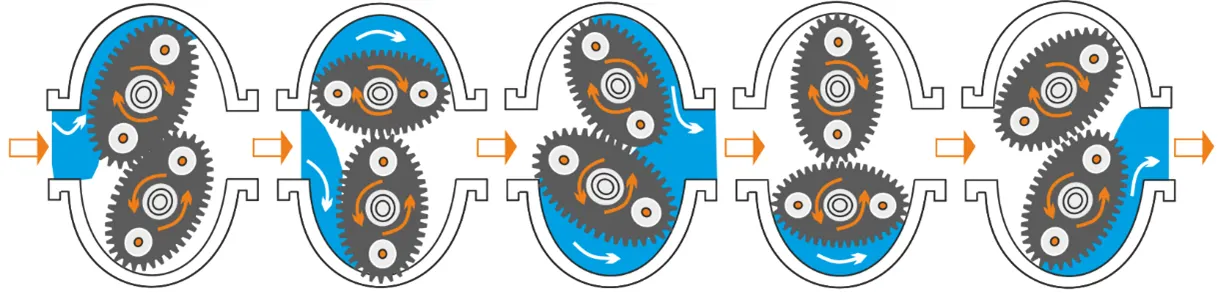
Fluid enters the measuring chamber and pushes against the rotating or oscillating measuring element (gears, disc, or piston).
→A precisely known, fixed volume of fluid is mechanically trapped between the measuring element and the chamber wall.
→Continued fluid pressure rotates the element, releasing the trapped volume to the outlet and trapping the next volume simultaneously.
→A sensor counts each rotation. Total volume = rotation count × chamber volume per rotation, output via pulse or 4-20 mA.
Positive Displacement Flow Meter Types: Oval Gear, Nutating Disc and Piston
Two oval-shaped gears mesh together and rotate in opposite directions, each trapping a fixed crescent-shaped volume of fluid between gear and chamber wall on every rotation.
Best for: Viscous fluids, fuel oils, lubricants, chemical metering.
A disc wobbles (nutates) inside a spherical chamber, tracing a fixed path that displaces a known volume of fluid per cycle. Common in residential and commercial water meters.
Best for: Clean water service, residential/commercial billing meters.
A piston oscillates within a cylinder, displacing fixed volumes with each stroke. Rotary piston designs are common in viscous and high-precision applications.
Best for: High-viscosity fluids, aviation fuel, precision batching.
Helical or lobed rotors mesh and rotate, each cycle displacing a fixed volume, with smooth continuous flow ideal for very large pipe sizes.
Best for: Large-bore crude oil and refined product pipelines.
Oval Gear Positive Displacement Flow Meter: How Trapped Volume Works
Positive Displacement Flow Meter K-Factor and Calibration Formula
Flow rate Q = f / K
Where:
f = pulse frequency from rotation sensor (Hz)
K = K-factor from factory calibration (pulses per unit volume)
Total volume V = total pulse count / K
Example: K-Factor = 200 pulses/litre, measured frequency = 40 Hz Q = 40 / 200 = 0.2 L/s = 12 L/min = 720 L/h Unlike inferential meters, the PD meter K-factor is extremely stable because it is purely a mechanical/geometric property of the chamber volume, not dependent on the flow profile or Reynolds number. This is why PD meters achieve some of the tightest accuracy specifications in flow measurement, typically ±0.1% to ±0.5% of reading.
Positive Displacement vs Turbine vs Coriolis Flow Meter
Industrial Applications of Positive Displacement Flow Meters
Petrol station pumps, aviation fuel metering, diesel dispensing where precise volume billing is essential.
Crude oil, refined products, lubricants where fiscal-grade accuracy and legal traceability are mandatory.
Residential and commercial water meters using nutating disc design for decades of proven reliability.
Precise batching of viscous chemicals, resins and additives where accuracy at low flow matters most.
Honey, syrup, edible oil and other viscous food products where hygienic PD designs ensure accurate filling.
Piston-type PD meters provide the high-precision standard required for aircraft refuelling operations.
5 Proven Advantages of Positive Displacement Flow Meters vs Key Limitations
- Direct volume measurement: No inference from velocity profile, pressure drop or vortex shedding : the most fundamentally direct volumetric technology.
- Works at any Reynolds number: Equally accurate in laminar or turbulent flow, ideal for viscous fluids where other meters fail.
- No straight-pipe run required: Mechanical trapping is unaffected by upstream flow disturbance, unlike turbine or orifice meters.
- Excellent low-flow accuracy: Maintains specification accuracy down to very low flow rates, unlike most inferential meters.
- Stable K-factor over time: A purely geometric calibration constant that does not drift with flow profile changes.
- Moving parts wear over time: Gears, discs or pistons require periodic maintenance and eventual replacement.
- Not suitable for dirty fluids: Particles or debris can jam the close-tolerance moving mechanism.
- Higher pressure drop: Mechanical resistance of the measuring element causes more pressure loss than non-intrusive meters.
- Size and cost at large bore: Becomes expensive and heavy above DN150-200 compared to electronic alternatives.
- Limited turndown vs Coriolis: Typically 10:1 to 30:1, narrower than the 100:1+ achievable with Coriolis meters.
Positive Displacement Flow Meter K-Factor Calculator
Enter the K-factor from your meter nameplate and measured pulse frequency to calculate flow rate, or use known flow rate to find expected frequency for loop verification.
Quick FAQs: Positive Displacement Flow Meter
- Coriolis Flow Meter: Mass Flow Alternative to Positive Displacement
- Turbine Flow Meter: K-Factor Calibration Compared to PD Meters
- Magnetic Flow Meter Sizing: Electronic Alternative for Conductive Liquids
- Reynolds Number: Why PD Meters Work at Any Flow Regime
- Laminar and Turbulent Flow: Instrument Selection Matrix
External References
- Flow Control Network: Positive Displacement Flow Meter Technology
- API MPMS Chapter 5: Metering, Positive Displacement Meters
- ISO 9951: Measurement of Gas Flow in Closed Conduits
What we learn today
- A positive displacement flow meter traps a fixed, known volume of fluid in a chamber using gears, a disc or a piston, then counts rotations to calculate total volume directly. Flow rate Q = f/K, where f is pulse frequency and K is the K-factor (pulses per unit volume) from factory calibration.
- Four main types: oval gear (most common, viscous fluids), nutating disc (water utility billing), piston (highest accuracy, aviation fuel), and helical/lobe (large-bore custody transfer). All work reliably at any Reynolds number, including fully laminar flow, because they measure volume mechanically.
- PD meters achieve ±0.1-0.5% accuracy with a stable K-factor that does not drift with flow profile, making them ideal for custody transfer and viscous fluid metering. The trade-off is moving parts that wear over time and unsuitability for dirty or particle-laden fluids.