
Table of Contents
ToggleWhat is Complementary Split Range Control (CSRC)?
In industrial process control, maintaining a process variable such as temperature, pressure, flow, or level within a desired range is one of the most important tasks. In many applications, a single control valve is enough to regulate the process. However, there are situations where a single valve cannot provide the required accuracy, resolution, or flexibility.
For example, consider a tank where both hot and cold water are used to maintain a precise temperature. If only one valve is used, achieving accurate temperature control can become difficult and slow.
To overcome such challenges, engineers use a technique known as Complementary Split Range Control (CSRC).
Complementary Split Range Control allows multiple control elements to work together in a coordinated manner to regulate a single process variable. By operating in opposite directions, these control elements provide smoother control, better accuracy, and improved process stability.
In this article, we will understand the concept of CSRC, how it works, its advantages, applications, and practical examples.
Understanding Complementary Split Range Control
Complementary Split Range Control (CSRC) is a control strategy in which two or more control elements operate inversely to each other while controlling a single process variable.
The word “complementary” means that when one control element increases its output, the other decreases by a corresponding amount.
In simple terms:
If Valve A opens more, Valve B closes proportionally.
If Valve A closes, Valve B opens.
Both valves are controlled by a single PID controller output and work together to maintain the desired process condition.
The purpose of this arrangement is to ensure that the process receives the exact combination of media required to achieve the desired result.
How Does Complementary Split Range Control Work?
Let us consider a simple example involving two control valves.
Suppose a process requires mixing two fluids:
- Hot water
- Cold water
The objective is to maintain a specific temperature inside a tank.
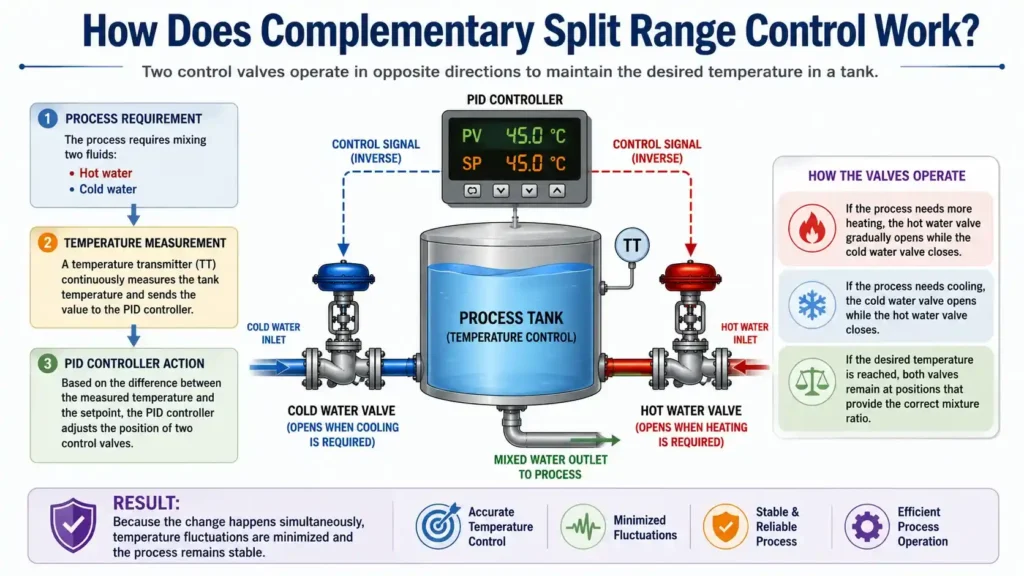
A temperature transmitter continuously measures the tank temperature and sends the value to a PID controller.
Based on the difference between the measured temperature and the setpoint, the controller adjusts the position of two control valves:
- A hot water valve
- A cold water valve
Both valves operate in opposite directions.
For example:
- If the process needs more heating, the hot water valve gradually opens while the cold water valve closes.
- If the process needs cooling, the cold water valve opens while the hot water valve closes.
- If the desired temperature is reached, both valves remain at positions that provide the correct mixture ratio.
Because the change happens simultaneously, temperature fluctuations are minimized and the process remains stable.
Control Signal Distribution in CSRC
The controller output is usually divided between the two valves.
A typical arrangement may look like this:
Controller Output = 0%
Cold Valve = 100% Open
Hot Valve = 0% Open
Controller Output = 50%
Cold Valve = 50% Open
Hot Valve = 50% Open
Controller Output = 100%
Cold Valve = 0% Open
Hot Valve = 100% Open
As the controller output changes, the valve positions adjust proportionally and inversely.
This creates a smooth transition between operating conditions without sudden process disturbances.
Practical Example of CSRC
Imagine a food processing plant where milk must be maintained at a specific temperature before packaging.
If the milk becomes too cold, product quality may be affected.
If it becomes too hot, nutrients may be damaged.
To maintain an exact temperature:
- A hot water control valve supplies heated water.
- A chilled water control valve supplies cooling water.
- A temperature controller continuously monitors the process.
- Both valves move inversely to maintain the desired temperature.
This arrangement provides highly accurate temperature control and ensures consistent product quality.
Difference Between Normal Split Range Control and Complementary Split Range Control
Although both methods involve multiple control valves, their operation differs.
In traditional split range control, one valve operates over one portion of the controller output while another valve operates over a different portion.
For example:
- Valve A may operate from 0% to 50% controller output.
- Valve B may operate from 50% to 100% controller output.
Only one valve may be active at a time.
In Complementary Split Range Control:
- Both valves operate simultaneously.
- One valve opens while the other closes.
- The combined effect controls the process continuously.
This provides smoother and more precise control.

Advantages of Complementary Split Range Control
1. Improved Process Accuracy
Because two control elements work together, the process variable can be maintained much closer to the desired setpoint.
This results in better product quality and process consistency.
2. Smooth Process Operation
Since one valve gradually compensates for the movement of the other, sudden changes in process conditions are minimized.
This reduces oscillations and process instability.
3. Better Mixing Control
CSRC is ideal for applications involving the mixing of two different media.
The ratio of both media can be adjusted continuously and accurately.
4. Reduced Mechanical Stress
Gradual valve movements reduce mechanical shock, vibration, and wear.
This increases equipment life and reduces maintenance costs.
5. Increased Process Safety
Extreme valve positions are often avoided because both valves share the control responsibility.
This helps maintain safer operating conditions.
6. Enhanced Product Flexibility
Manufacturers can produce different product grades or variations by simply adjusting the mixing ratio controlled through CSRC.
7. Redundancy Possibilities
In some applications, complementary arrangements can be configured to provide backup operation if one control element becomes unavailable.
Applications of Complementary Split Range Control
CSRC is commonly used in many industries where accurate control of mixing, heating, cooling, or blending is required.
Some common applications include:
1. Temperature Control Systems
Mixing hot and cold water to achieve a desired temperature.
2. HVAC Systems
Controlling heating and cooling coils simultaneously for precise environmental control.
3. Chemical Processing
Blending multiple chemicals in accurate proportions.
4. Food and Beverage Industry
Maintaining product temperatures during processing and packaging.
5. Pharmaceutical Manufacturing
Controlling process conditions where product quality depends on precise temperature regulation.
6. Water Treatment Plants
Mixing treated and untreated streams to achieve desired process conditions.
Challenges of CSRC
Although CSRC offers many benefits, proper system design is essential.
Some challenges include:
1. Accurate valve sizing is required.
2. PID tuning becomes more critical.
3. Valve response characteristics should be matched.
4. Instrument calibration must be maintained.
5. Improper configuration can cause process instability.
Therefore, engineers must carefully design and test the control strategy before implementation.
Frequently Asked Questions (FAQs)
1. What is Complementary Split Range Control?
Complementary Split Range Control (CSRC) is a control strategy where two or more control elements operate inversely to each other to regulate a single process variable.
2. Why is CSRC used?
CSRC is used when a single control valve cannot provide the required accuracy, resolution, or flexibility needed for process control.
3. What is the main principle behind CSRC?
The main principle is that when one control element opens, the other closes proportionally, ensuring smooth and accurate process control.
4. What are common applications of CSRC?
Common applications include temperature control, HVAC systems, chemical blending, food processing, pharmaceutical manufacturing, and water treatment.
5. What is the difference between split range control and complementary split range control?
In traditional split range control, valves operate in separate output ranges. In CSRC, valves operate simultaneously and inversely throughout the control range.
6. Can CSRC improve process safety?
Yes. By preventing sudden process changes and maintaining balanced operation, CSRC can improve process stability and safety.
7. Is a PID controller required for CSRC?
In most industrial applications, a PID controller is used to coordinate the operation of the complementary control elements and maintain the desired setpoint.
What we learn today?
Complementary Split Range Control (CSRC) is a control strategy used when a single control element cannot provide the required level of process accuracy and flexibility.
In this method, multiple control elements operate inversely to each other to regulate a single process variable.
By continuously balancing the flow of different media, CSRC provides smoother control, improved stability, higher accuracy, and better product quality.
Whether it is mixing hot and cold water, controlling HVAC systems, or regulating chemical processes, CSRC plays an important role in modern industrial automation.
Understanding this concept helps instrumentation engineers design more efficient and reliable control systems capable of meeting demanding process requirements.


I hope you like above blog. There is no cost associated in sharing the article in your social media. Thanks for Reading !! Happy Learning